

252
23 A Particle Solution—The Inertia of Energy
P
=
P − v E/c
2
o
1 − v 2 /c 2
o
,
E
=
E − v P
1 − v 2 /c 2
o
,
←→
P =
P
− v E
/c
2
o
1 − v 2 /c 2
o
,
E =
E
− v P
1 − v 2 /c 2
o
.
⎫
⎪ ⎪ ⎪ ⎪ ⎬
⎪ ⎪ ⎪ ⎪ ⎭
(298)
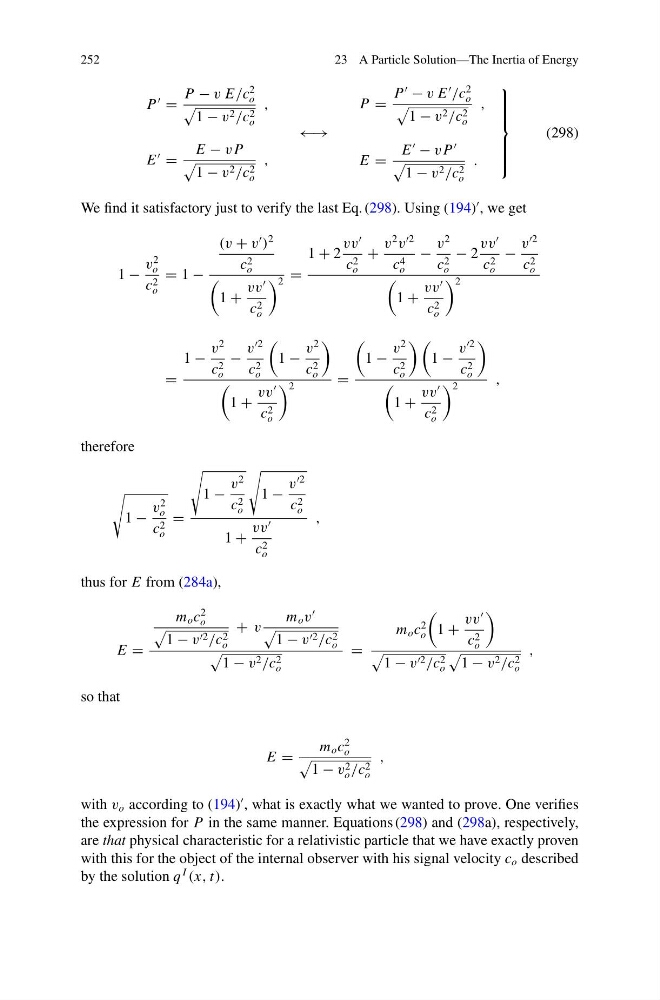
We find it satisfactory just to verify the last Eq. (298). Using (194)
, we get
1 −
v
2
o
c 2
o
= 1 −
(v + v
)
2
c 2
o
1 +
vv
c 2
o
2 =
1 + 2
vv
c 2
o
+
v
2
v
2
c 4
o
−
v
2
c 2
o
− 2
vv
c 2
o
−
v
2
c 2
o
1 +
vv
c 2
o
2
=
1 −
v
2
c 2
o
−
v
2
c 2
o
1 −
v
2
c 2
o
1 +
vv
c 2
o
2
=
1 −
v
2
c 2
o
1 −
v
2
c 2
o
1 +
vv
c 2
o
2
,
therefore
1 −
v
2
o
c 2
o
=
1 −
v
2
c 2
o
1 −
v
2
c 2
o
1 +
vv
c 2
o
,
thus for E from (284a),
E =
m o c
2
o
1 − v 2 /c 2
o
+ v
m o v
1 − v 2 /c 2
o
1 − v 2 /c 2
o
=
m o c
2
o
1 +
vv
c 2
o
1 − v 2 /c 2
o
1 − v 2 /c 2
o
,
so that
E =
m o c
2
o
1 − v 2
o /c 2
o
,
with v o according to (194)
, what is exactly what we wanted to prove. One verifies
the expression for P in the same manner. Equations (298) and (298a), respectively,
are that physical characteristic for a relativistic particle that we have exactly proven
with this for the object of the internal observer with his signal velocity c o described
by the solution q
I
(x, t).
23 A Particle Solution—The Inertia of Energy
P
=
P − v E/c
2
o
1 − v 2 /c 2
o
,
E
=
E − v P
1 − v 2 /c 2
o
,
←→
P =
P
− v E
/c
2
o
1 − v 2 /c 2
o
,
E =
E
− v P
1 − v 2 /c 2
o
.
⎫
⎪ ⎪ ⎪ ⎪ ⎬
⎪ ⎪ ⎪ ⎪ ⎭
(298)
We find it satisfactory just to verify the last Eq. (298). Using (194)
, we get
1 −
v
2
o
c 2
o
= 1 −
(v + v
)
2
c 2
o
1 +
vv
c 2
o
2 =
1 + 2
vv
c 2
o
+
v
2
v
2
c 4
o
−
v
2
c 2
o
− 2
vv
c 2
o
−
v
2
c 2
o
1 +
vv
c 2
o
2
=
1 −
v
2
c 2
o
−
v
2
c 2
o
1 −
v
2
c 2
o
1 +
vv
c 2
o
2
=
1 −
v
2
c 2
o
1 −
v
2
c 2
o
1 +
vv
c 2
o
2
,
therefore
1 −
v
2
o
c 2
o
=
1 −
v
2
c 2
o
1 −
v
2
c 2
o
1 +
vv
c 2
o
,
thus for E from (284a),
E =
m o c
2
o
1 − v 2 /c 2
o
+ v
m o v
1 − v 2 /c 2
o
1 − v 2 /c 2
o
=
m o c
2
o
1 +
vv
c 2
o
1 − v 2 /c 2
o
1 − v 2 /c 2
o
,
so that
E =
m o c
2
o
1 − v 2
o /c 2
o
,
with v o according to (194)
, what is exactly what we wanted to prove. One verifies
the expression for P in the same manner. Equations (298) and (298a), respectively,
are that physical characteristic for a relativistic particle that we have exactly proven
with this for the object of the internal observer with his signal velocity c o described
by the solution q
I
(x, t).