

22 Particles and Fields
241
in other words Eq. (277) is valid.
The mass m of this particle is distributed with a density ρ in the same fashion,
m =
+∞
−∞
ρ dx and flows with the same velocity v through space. Once again, ρ =
ρ(x, t) = ρ(x − v t) is valid. This mass density is attributed to a momentum density
p according to p = p(x, t) = ρ(x − v t) v. Once again, this momentum density p
flows with the velocity v through space and generates a field momentum flux density
v p = v v ρ(x − v t), which is identical to the negative stress t, thus t = −v v ρ(x −
v t) so that
∂t
∂x
= −
∂
∂x
v
2
ρ(x − v t)
= −v v
∂ρ(x − v t)
∂x
= v
∂ρ(x − v t)
∂t
=
∂ p
∂t
,
in other words, Eq. (277a) is valid.
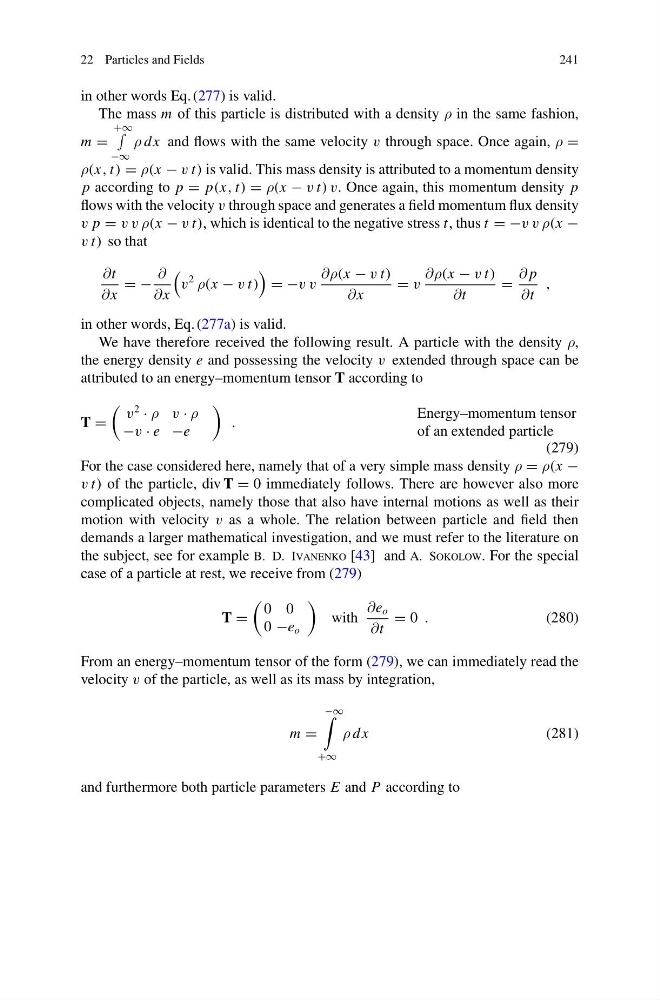
We have therefore received the following result. A particle with the density ρ,
the energy density e and possessing the velocity v extended through space can be
attributed to an energy–momentum tensor T according to
T =
v
2
· ρ v · ρ
−v · e −e
.
Energy–momentum tensor
of an extended particle
(279)
For the case considered here, namely that of a very simple mass density ρ = ρ(x −
v t) of the particle, div T = 0 immediately follows. There are however also more
complicated objects, namely those that also have internal motions as well as their
motion with velocity v as a whole. The relation between particle and field then
demands a larger mathematical investigation, and we must refer to the literature on
the subject, see for example B. D. Ivanenko [43] and A. Sokolow. For the special
case of a particle at rest, we receive from (279)
T =
0 0
0 −e o
with
∂e o
∂t
= 0 .
(280)
From an energy–momentum tensor of the form (279), we can immediately read the
velocity v of the particle, as well as its mass by integration,
m =
−∞
+∞
ρ dx
(281)
and furthermore both particle parameters E and P according to
241
in other words Eq. (277) is valid.
The mass m of this particle is distributed with a density ρ in the same fashion,
m =
+∞
−∞
ρ dx and flows with the same velocity v through space. Once again, ρ =
ρ(x, t) = ρ(x − v t) is valid. This mass density is attributed to a momentum density
p according to p = p(x, t) = ρ(x − v t) v. Once again, this momentum density p
flows with the velocity v through space and generates a field momentum flux density
v p = v v ρ(x − v t), which is identical to the negative stress t, thus t = −v v ρ(x −
v t) so that
∂t
∂x
= −
∂
∂x
v
2
ρ(x − v t)
= −v v
∂ρ(x − v t)
∂x
= v
∂ρ(x − v t)
∂t
=
∂ p
∂t
,
in other words, Eq. (277a) is valid.
We have therefore received the following result. A particle with the density ρ,
the energy density e and possessing the velocity v extended through space can be
attributed to an energy–momentum tensor T according to
T =
v
2
· ρ v · ρ
−v · e −e
.
Energy–momentum tensor
of an extended particle
(279)
For the case considered here, namely that of a very simple mass density ρ = ρ(x −
v t) of the particle, div T = 0 immediately follows. There are however also more
complicated objects, namely those that also have internal motions as well as their
motion with velocity v as a whole. The relation between particle and field then
demands a larger mathematical investigation, and we must refer to the literature on
the subject, see for example B. D. Ivanenko [43] and A. Sokolow. For the special
case of a particle at rest, we receive from (279)
T =
0 0
0 −e o
with
∂e o
∂t
= 0 .
(280)
From an energy–momentum tensor of the form (279), we can immediately read the
velocity v of the particle, as well as its mass by integration,
m =
−∞
+∞
ρ dx
(281)
and furthermore both particle parameters E and P according to