

240
22 Particles and Fields
and thus
∂e
∂t
= −
∂s
∂x
.
(277)
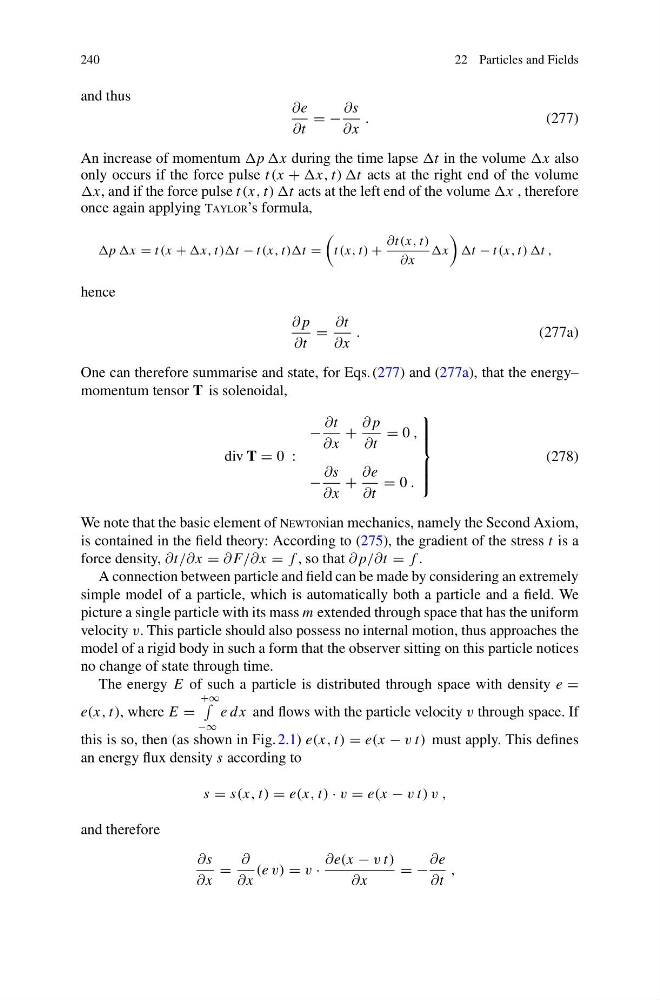
An increase of momentum p x during the time lapse t in the volume x also
only occurs if the force pulse t (x + x, t) )t acts at the right end of the volume
x, and if the force pulse t (x, t) )t acts at the left end of the volume x , therefore
once again applying Taylor’s formula,
p x = t (x + x, t))t − t (x, t))t =
t (x, t) +
∂t (x, t)
∂x
x
t − t (x, t) )t ,
hence
∂ p
∂t
=
∂t
∂x
.
(277a)
One can therefore summarise and state, for Eqs. (277) and (277a), that the energy–
momentum tensor T is solenoidal,
−
∂t
∂x
+
∂ p
∂t
= 0 ,
div T = 0 :
−
∂s
∂x
+
∂e
∂t
= 0 .
⎫
⎪ ⎪ ⎪ ⎬
⎪ ⎪ ⎪ ⎭
(278)
We note that the basic element of Newtonian mechanics, namely the Second Axiom,
is contained in the field theory: According to (275), the gradient of the stress t is a
force density, ∂t/∂x = ∂ F/∂x = f , so that ∂ p/∂t = f .
A connection between particle and field can be made by considering an extremely
simple model of a particle, which is automatically both a particle and a field. We
picture a single particle with its mass m extended through space that has the uniform
velocity v. This particle should also possess no internal motion, thus approaches the
model of a rigid body in such a form that the observer sitting on this particle notices
no change of state through time.
The energy E of such a particle is distributed through space with density e =
e(x, t), where E =
+∞
−∞
e dx and flows with the particle velocity v through space. If
this is so, then (as shown in Fig. 2.1) e(x, t) = e(x − v t) must apply. This defines
an energy flux density s according to
s = s(x, t) = e(x, t) · v = e(x − v t) v ,
and therefore
∂s
∂x
=
∂
∂x
(e v) = v ·
∂e(x − v t)
∂x
= −
∂e
∂t
,
22 Particles and Fields
and thus
∂e
∂t
= −
∂s
∂x
.
(277)
An increase of momentum p x during the time lapse t in the volume x also
only occurs if the force pulse t (x + x, t) )t acts at the right end of the volume
x, and if the force pulse t (x, t) )t acts at the left end of the volume x , therefore
once again applying Taylor’s formula,
p x = t (x + x, t))t − t (x, t))t =
t (x, t) +
∂t (x, t)
∂x
x
t − t (x, t) )t ,
hence
∂ p
∂t
=
∂t
∂x
.
(277a)
One can therefore summarise and state, for Eqs. (277) and (277a), that the energy–
momentum tensor T is solenoidal,
−
∂t
∂x
+
∂ p
∂t
= 0 ,
div T = 0 :
−
∂s
∂x
+
∂e
∂t
= 0 .
⎫
⎪ ⎪ ⎪ ⎬
⎪ ⎪ ⎪ ⎭
(278)
We note that the basic element of Newtonian mechanics, namely the Second Axiom,
is contained in the field theory: According to (275), the gradient of the stress t is a
force density, ∂t/∂x = ∂ F/∂x = f , so that ∂ p/∂t = f .
A connection between particle and field can be made by considering an extremely
simple model of a particle, which is automatically both a particle and a field. We
picture a single particle with its mass m extended through space that has the uniform
velocity v. This particle should also possess no internal motion, thus approaches the
model of a rigid body in such a form that the observer sitting on this particle notices
no change of state through time.
The energy E of such a particle is distributed through space with density e =
e(x, t), where E =
+∞
−∞
e dx and flows with the particle velocity v through space. If
this is so, then (as shown in Fig. 2.1) e(x, t) = e(x − v t) must apply. This defines
an energy flux density s according to
s = s(x, t) = e(x, t) · v = e(x − v t) v ,
and therefore
∂s
∂x
=
∂
∂x
(e v) = v ·
∂e(x − v t)
∂x
= −
∂e
∂t
,