

22 Particles and Fields
239
interval t with a positive mathematical sign if s flows in the direction of increasing
x-values,
s = s(x, t) =
E
t
.
Energy flux density
of the field q(x, t)
(273)
3. Our field now produces a momentum density p. This is the momentum P of the
field contained in the volume x divided by x, thus
p = p(x, t) =
P
x
.
Momentum density
of the field q(x, t)
(274)
Here one has to take note that P is only the momentum of our q-field on the length
x and not the momentum of the dislocation masses m α according to Eq. (79) in
Chap. 8. P only incorporates the increase of the momentum based on the q-field.
4. This momentum density generally changes because of a stress t in the field. The
stress t can also be physically understood as the negative field momentum flux density.
In our one-dimensional case, this stress is simply reduced to a force F that acts from
the particular neighbouring ‘volume element’ x on the particular end point of the
‘volume element’ x. Here, traditionally the stress is calculated as positive if the
force at the right-hand side of x points in a positive direction,
t = t (x, t) = F .
Stress
of the field q(x, t)
(275)
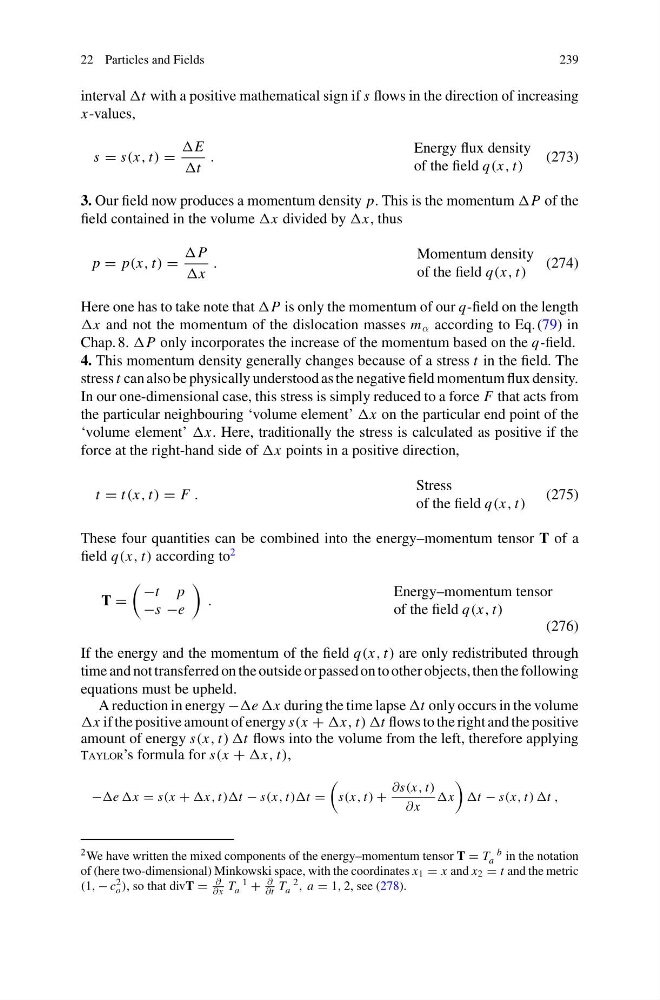
These four quantities can be combined into the energy–momentum tensor T of a
field q(x, t) according to
2
T =
−t p
−s −e
.
Energy–momentum tensor
of the field q(x, t)
(276)
If the energy and the momentum of the field q(x, t) are only redistributed through
time and not transferred on the outside or passed on to other objects, then the following
equations must be upheld.
A reduction in energy −e x during the time lapse t only occurs in the volume
x if the positive amount of energy s(x + x, t) )t flows to the right and the positive
amount of energy s(x, t) )t flows into the volume from the left, therefore applying
Taylor’s formula for s(x + x, t),
−e x = s(x + x, t))t − s(x, t))t =
s(x, t) +
∂s(x, t)
∂x
x
t − s(x, t) )t ,
2 We have written the mixed components of the energy–momentum tensor T = T b
a in the notation
of (here two-dimensional) Minkowski space, with the coordinates x 1 = x and x 2 = t and the metric
(1, − c 2
o ), so that divT =
∂
∂x T 1
a +
∂
∂t T 2
a , a = 1, 2, see (278).
239
interval t with a positive mathematical sign if s flows in the direction of increasing
x-values,
s = s(x, t) =
E
t
.
Energy flux density
of the field q(x, t)
(273)
3. Our field now produces a momentum density p. This is the momentum P of the
field contained in the volume x divided by x, thus
p = p(x, t) =
P
x
.
Momentum density
of the field q(x, t)
(274)
Here one has to take note that P is only the momentum of our q-field on the length
x and not the momentum of the dislocation masses m α according to Eq. (79) in
Chap. 8. P only incorporates the increase of the momentum based on the q-field.
4. This momentum density generally changes because of a stress t in the field. The
stress t can also be physically understood as the negative field momentum flux density.
In our one-dimensional case, this stress is simply reduced to a force F that acts from
the particular neighbouring ‘volume element’ x on the particular end point of the
‘volume element’ x. Here, traditionally the stress is calculated as positive if the
force at the right-hand side of x points in a positive direction,
t = t (x, t) = F .
Stress
of the field q(x, t)
(275)
These four quantities can be combined into the energy–momentum tensor T of a
field q(x, t) according to
2
T =
−t p
−s −e
.
Energy–momentum tensor
of the field q(x, t)
(276)
If the energy and the momentum of the field q(x, t) are only redistributed through
time and not transferred on the outside or passed on to other objects, then the following
equations must be upheld.
A reduction in energy −e x during the time lapse t only occurs in the volume
x if the positive amount of energy s(x + x, t) )t flows to the right and the positive
amount of energy s(x, t) )t flows into the volume from the left, therefore applying
Taylor’s formula for s(x + x, t),
−e x = s(x + x, t))t − s(x, t))t =
s(x, t) +
∂s(x, t)
∂x
x
t − s(x, t) )t ,
2 We have written the mixed components of the energy–momentum tensor T = T b
a in the notation
of (here two-dimensional) Minkowski space, with the coordinates x 1 = x and x 2 = t and the metric
(1, − c 2
o ), so that divT =
∂
∂x T 1
a +
∂
∂t T 2
a , a = 1, 2, see (278).