

238
22 Particles and Fields
particle—or using the expression of mechanics, as a ‘solid’—with one mass and one
single velocity, or maybe as several such particles or solids?
The function q = q(x, t) is a field that has the value q for every x and every t—just
as the solutions of Maxwell’s equations for electric and magnetic field strengths are
attributed to specific values in space at every point of time. Physical fields are different
with respect to pure mathematical functions in that they are carriers of energy and
momentum, which are distributed in a certain density throughout space. Exchange
processes involving energy and momentum occur throughout space when two fields
interact. Only under certain conditions, describing the interactions between fields,
the net result of energy and momentum can be represented as if it were a collision
between particles. As is well known, the energy and momentum distribution of an
electromagnetic field according to Maxwell’s theory only can be described using
a system of particles if the space actually contains no charge carriers. In this way,
Einstein was able to introduce his photons, the ‘light particles’ for the electromagnetic
field in vacuum. We will now examine the connection between particles and fields for
the sine-Gordon equation. We will first of all agree upon a simplification of notation.
Mathematical quantities, whose properties do not just serve to attribute a number,
for example vectors and tensors, have been distinguished using bold characters; we
therefore write F for a force vector in comparison with the length L of a rod, or
the temperature T . The boldface type also has the role of generally informing the
reader that the corresponding quantity has to be described using more than one
numerical date, for example using the components F x and F y of a force vector
F = (F x , F y ) on the x-y-plane. However, we only have to deal with one spatial
dimension when discussing the sine-Gordon equation. In this case, spatial vectors
and tensors are always described using only one number, F = (F x ). Even a onedimensional vector cannot be completely described using only one numerical date.
If the direction of the axis is reversed, then the vector component F x changes its
mathematical sign, and the length L or the temperature T stays unchanged. The
one-dimensional force vector also has a direction, whereas temperature does not.
This special vector property will only play one important role later on in Chap. 29
during our discussion about the tachyon momentum and the velocity of tachyons. We
will therefore not to use boldface type for vectors or tensors composed of only one
component, so that (F x ) = F. We will use boldface type only for quantities made
up of two or more components; see for example (276).
A field always creates four quantities that are defined in space:
1. The energy density e describes the energy E present in a (sufficiently small)
volume V . In our one-dimensional case of the sine-Gordon equation, V = x
and thus
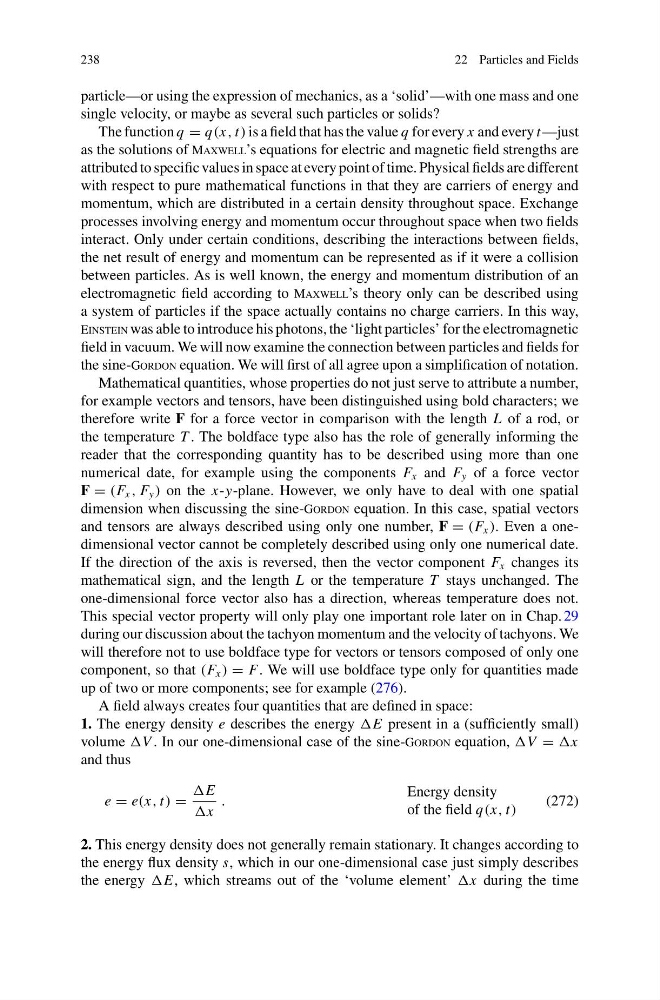
e = e(x, t) =
E
x
.
Energy density
of the field q(x, t)
(272)
2. This energy density does not generally remain stationary. It changes according to
the energy flux density s, which in our one-dimensional case just simply describes
the energy E, which streams out of the ‘volume element’ x during the time
22 Particles and Fields
particle—or using the expression of mechanics, as a ‘solid’—with one mass and one
single velocity, or maybe as several such particles or solids?
The function q = q(x, t) is a field that has the value q for every x and every t—just
as the solutions of Maxwell’s equations for electric and magnetic field strengths are
attributed to specific values in space at every point of time. Physical fields are different
with respect to pure mathematical functions in that they are carriers of energy and
momentum, which are distributed in a certain density throughout space. Exchange
processes involving energy and momentum occur throughout space when two fields
interact. Only under certain conditions, describing the interactions between fields,
the net result of energy and momentum can be represented as if it were a collision
between particles. As is well known, the energy and momentum distribution of an
electromagnetic field according to Maxwell’s theory only can be described using
a system of particles if the space actually contains no charge carriers. In this way,
Einstein was able to introduce his photons, the ‘light particles’ for the electromagnetic
field in vacuum. We will now examine the connection between particles and fields for
the sine-Gordon equation. We will first of all agree upon a simplification of notation.
Mathematical quantities, whose properties do not just serve to attribute a number,
for example vectors and tensors, have been distinguished using bold characters; we
therefore write F for a force vector in comparison with the length L of a rod, or
the temperature T . The boldface type also has the role of generally informing the
reader that the corresponding quantity has to be described using more than one
numerical date, for example using the components F x and F y of a force vector
F = (F x , F y ) on the x-y-plane. However, we only have to deal with one spatial
dimension when discussing the sine-Gordon equation. In this case, spatial vectors
and tensors are always described using only one number, F = (F x ). Even a onedimensional vector cannot be completely described using only one numerical date.
If the direction of the axis is reversed, then the vector component F x changes its
mathematical sign, and the length L or the temperature T stays unchanged. The
one-dimensional force vector also has a direction, whereas temperature does not.
This special vector property will only play one important role later on in Chap. 29
during our discussion about the tachyon momentum and the velocity of tachyons. We
will therefore not to use boldface type for vectors or tensors composed of only one
component, so that (F x ) = F. We will use boldface type only for quantities made
up of two or more components; see for example (276).
A field always creates four quantities that are defined in space:
1. The energy density e describes the energy E present in a (sufficiently small)
volume V . In our one-dimensional case of the sine-Gordon equation, V = x
and thus
e = e(x, t) =
E
x
.
Energy density
of the field q(x, t)
(272)
2. This energy density does not generally remain stationary. It changes according to
the energy flux density s, which in our one-dimensional case just simply describes
the energy E, which streams out of the ‘volume element’ x during the time