

242
22 Particles and Fields
P =
+∞
−∞
p dx = v m ,
E =
+∞
−∞
e dx .
⎫
⎪ ⎪ ⎪ ⎪ ⎪ ⎪ ⎪ ⎬
⎪ ⎪ ⎪ ⎪ ⎪ ⎪ ⎪ ⎭
(282)
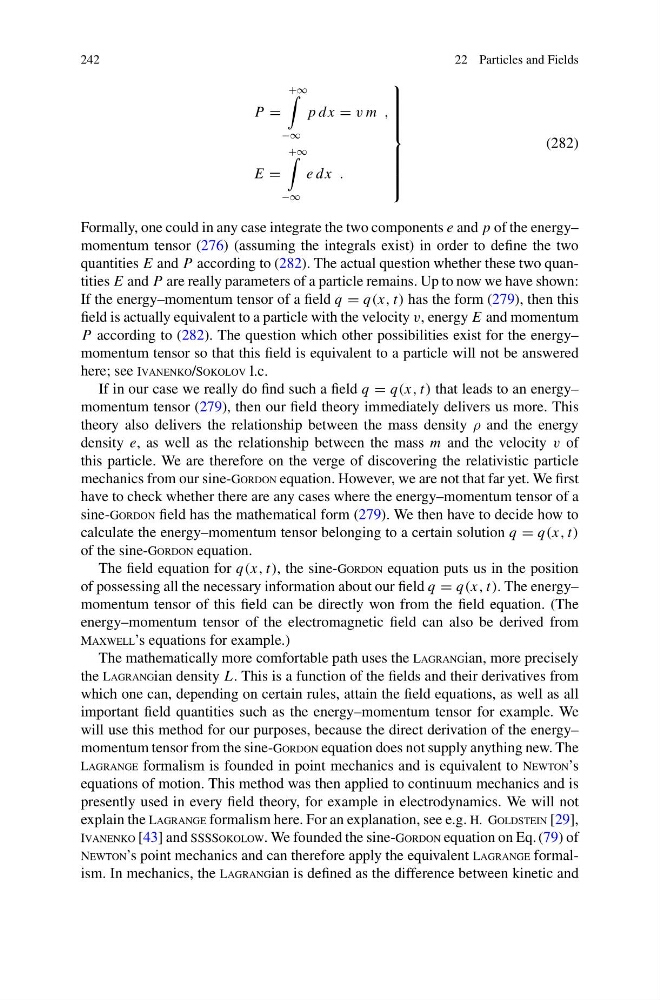
Formally, one could in any case integrate the two components e and p of the energy–
momentum tensor (276) (assuming the integrals exist) in order to define the two
quantities E and P according to (282). The actual question whether these two quantities E and P are really parameters of a particle remains. Up to now we have shown:
If the energy–momentum tensor of a field q = q(x, t) has the form (279), then this
field is actually equivalent to a particle with the velocity v, energy E and momentum
P according to (282). The question which other possibilities exist for the energy–
momentum tensor so that this field is equivalent to a particle will not be answered
here; see Ivanenko/Sokolov l.c.
If in our case we really do find such a field q = q(x, t) that leads to an energy–
momentum tensor (279), then our field theory immediately delivers us more. This
theory also delivers the relationship between the mass density ρ and the energy
density e, as well as the relationship between the mass m and the velocity v of
this particle. We are therefore on the verge of discovering the relativistic particle
mechanics from our sine-Gordon equation. However, we are not that far yet. We first
have to check whether there are any cases where the energy–momentum tensor of a
sine-Gordon field has the mathematical form (279). We then have to decide how to
calculate the energy–momentum tensor belonging to a certain solution q = q(x, t)
of the sine-Gordon equation.
The field equation for q(x, t), the sine-Gordon equation puts us in the position
of possessing all the necessary information about our field q = q(x, t). The energy–
momentum tensor of this field can be directly won from the field equation. (The
energy–momentum tensor of the electromagnetic field can also be derived from
Maxwell’s equations for example.)
The mathematically more comfortable path uses the Lagrangian, more precisely
the Lagrangian density L. This is a function of the fields and their derivatives from
which one can, depending on certain rules, attain the field equations, as well as all
important field quantities such as the energy–momentum tensor for example. We
will use this method for our purposes, because the direct derivation of the energy–
momentum tensor from the sine-Gordon equation does not supply anything new. The
Lagrange formalism is founded in point mechanics and is equivalent to Newton’s
equations of motion. This method was then applied to continuum mechanics and is
presently used in every field theory, for example in electrodynamics. We will not
explain the Lagrange formalism here. For an explanation, see e.g. H. Goldstein [29],
Ivanenko [43] and SSSSokolow. We founded the sine-Gordon equation on Eq. (79) of
Newton’s point mechanics and can therefore apply the equivalent Lagrange formalism. In mechanics, the Lagrangian is defined as the difference between kinetic and
22 Particles and Fields
P =
+∞
−∞
p dx = v m ,
E =
+∞
−∞
e dx .
⎫
⎪ ⎪ ⎪ ⎪ ⎪ ⎪ ⎪ ⎬
⎪ ⎪ ⎪ ⎪ ⎪ ⎪ ⎪ ⎭
(282)
Formally, one could in any case integrate the two components e and p of the energy–
momentum tensor (276) (assuming the integrals exist) in order to define the two
quantities E and P according to (282). The actual question whether these two quantities E and P are really parameters of a particle remains. Up to now we have shown:
If the energy–momentum tensor of a field q = q(x, t) has the form (279), then this
field is actually equivalent to a particle with the velocity v, energy E and momentum
P according to (282). The question which other possibilities exist for the energy–
momentum tensor so that this field is equivalent to a particle will not be answered
here; see Ivanenko/Sokolov l.c.
If in our case we really do find such a field q = q(x, t) that leads to an energy–
momentum tensor (279), then our field theory immediately delivers us more. This
theory also delivers the relationship between the mass density ρ and the energy
density e, as well as the relationship between the mass m and the velocity v of
this particle. We are therefore on the verge of discovering the relativistic particle
mechanics from our sine-Gordon equation. However, we are not that far yet. We first
have to check whether there are any cases where the energy–momentum tensor of a
sine-Gordon field has the mathematical form (279). We then have to decide how to
calculate the energy–momentum tensor belonging to a certain solution q = q(x, t)
of the sine-Gordon equation.
The field equation for q(x, t), the sine-Gordon equation puts us in the position
of possessing all the necessary information about our field q = q(x, t). The energy–
momentum tensor of this field can be directly won from the field equation. (The
energy–momentum tensor of the electromagnetic field can also be derived from
Maxwell’s equations for example.)
The mathematically more comfortable path uses the Lagrangian, more precisely
the Lagrangian density L. This is a function of the fields and their derivatives from
which one can, depending on certain rules, attain the field equations, as well as all
important field quantities such as the energy–momentum tensor for example. We
will use this method for our purposes, because the direct derivation of the energy–
momentum tensor from the sine-Gordon equation does not supply anything new. The
Lagrange formalism is founded in point mechanics and is equivalent to Newton’s
equations of motion. This method was then applied to continuum mechanics and is
presently used in every field theory, for example in electrodynamics. We will not
explain the Lagrange formalism here. For an explanation, see e.g. H. Goldstein [29],
Ivanenko [43] and SSSSokolow. We founded the sine-Gordon equation on Eq. (79) of
Newton’s point mechanics and can therefore apply the equivalent Lagrange formalism. In mechanics, the Lagrangian is defined as the difference between kinetic and