

222
20 Tachyons and Causality
q
T
(x, t) =
2a
π
arctan exp
⎡
⎢
⎣
c o
λ o
t −
v x
c 2
o
1 − v 2 /c 2
o
⎤
⎥
⎦ +
a
2
,
(256)
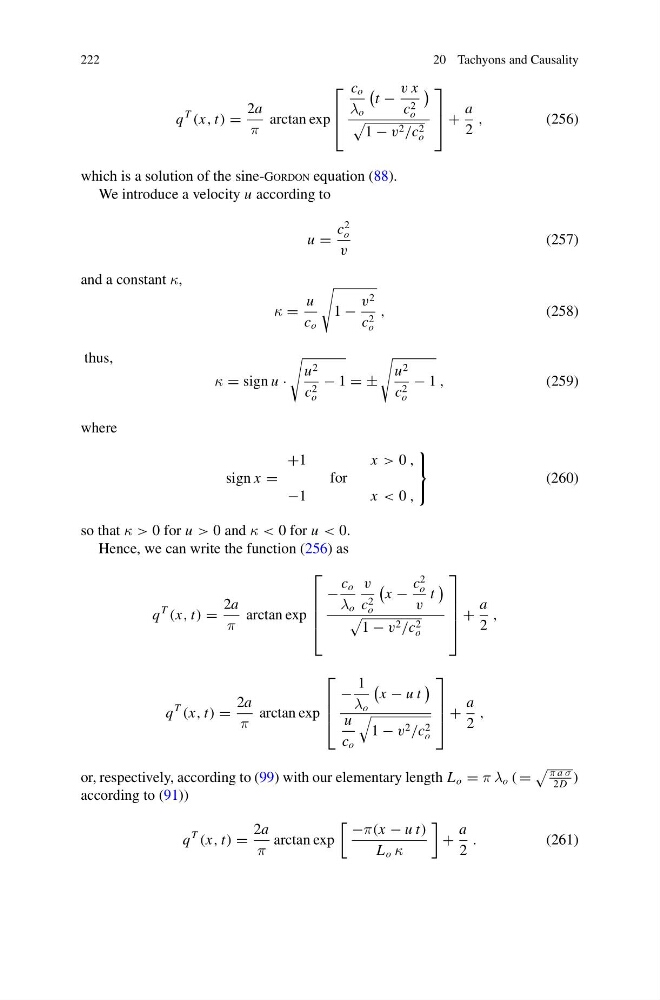
which is a solution of the sine-Gordon equation (88).
We introduce a velocity u according to
u =
c
2
o
v
(257)
and a constant κ,
κ =
u
c o
1 −
v 2
c 2
o
,
(258)
thus,
κ = sign u ·
u 2
c 2
o
− 1 = ±
u 2
c 2
o
− 1 ,
(259)
where
sign x =
+1
x > 0 ,
for
−1
x < 0 ,
⎫
⎬
⎭
(260)
so that κ > 0 for u > 0 and κ < 0 for u < 0.
Hence, we can write the function (256) as
q
T
(x, t) =
2a
π
arctan exp
⎡
⎢
⎢
⎢
⎣
−
c o
λ o
v
c 2
o
x −
c
2
o
v
t
1 − v 2 /c 2
o
⎤
⎥
⎥
⎥
⎦
+
a
2
,
q
T
(x, t) =
2a
π
arctan exp
⎡
⎢
⎢
⎣
−
1
λ o
x − u t
u
c o
1 − v 2 /c 2
o
⎤
⎥
⎥
⎦ +
a
2
,
or, respectively, according to (99) with our elementary length L o = π λ o ( =
π a σ
2D
)
according to (91))
q
T
(x, t) =
2a
π
arctan exp
−π(x − u t)
L o κ
+
a
2
.
(261)
20 Tachyons and Causality
q
T
(x, t) =
2a
π
arctan exp
⎡
⎢
⎣
c o
λ o
t −
v x
c 2
o
1 − v 2 /c 2
o
⎤
⎥
⎦ +
a
2
,
(256)
which is a solution of the sine-Gordon equation (88).
We introduce a velocity u according to
u =
c
2
o
v
(257)
and a constant κ,
κ =
u
c o
1 −
v 2
c 2
o
,
(258)
thus,
κ = sign u ·
u 2
c 2
o
− 1 = ±
u 2
c 2
o
− 1 ,
(259)
where
sign x =
+1
x > 0 ,
for
−1
x < 0 ,
⎫
⎬
⎭
(260)
so that κ > 0 for u > 0 and κ < 0 for u < 0.
Hence, we can write the function (256) as
q
T
(x, t) =
2a
π
arctan exp
⎡
⎢
⎢
⎢
⎣
−
c o
λ o
v
c 2
o
x −
c
2
o
v
t
1 − v 2 /c 2
o
⎤
⎥
⎥
⎥
⎦
+
a
2
,
q
T
(x, t) =
2a
π
arctan exp
⎡
⎢
⎢
⎣
−
1
λ o
x − u t
u
c o
1 − v 2 /c 2
o
⎤
⎥
⎥
⎦ +
a
2
,
or, respectively, according to (99) with our elementary length L o = π λ o ( =
π a σ
2D
)
according to (91))
q
T
(x, t) =
2a
π
arctan exp
−π(x − u t)
L o κ
+
a
2
.
(261)