

20 Tachyons and Causality
221
(The identity of the primed and unprimed space coordinates is purely coincidental
and is just a result of the chosen numerical example).
According to Holmes’ observations, Dr Fast was still in prison at event E 1 , because
of t
1 < 0, and was not in possession of his tachyon machine. Dr Fast was released at
t
o = 0. Holmes had thus proven that Mr Stus was already dead before Dr Fast was
released from prison! A tachyon produced by Dr Fast at the moment he was released
from prison could therefore not be the cause of Mr Stus’ death. If this were so, then
the observations made by Holmes in the reference system
, cause and result,
would be completely reversed. This would be in contradiction to our experiences
made using our causal constructed world. Do tachyons teach us something else? Do
we have to reconsider our proven definitions of causality if we accept the existence of
tachyons? Somehow tachyons do not fit into our conceptions. They seem to belong
more to the world of metaphysics and are surrounded with a touch of mysticism. We
will continue our detective story in Chap. 30.
We now return to the world of our crystal and investigate the question of tachyons
from the empirical viewpoint of our internal observer in our infinite crystal, for
which a Special Theory of Relativity exists, however with the sine-Gordon equation’s
critical velocity c o as the limiting velocity.
Let us remind ourselves of a fact. For internal observers, the solutions of the
sine-Gordon equation are objects of experience.
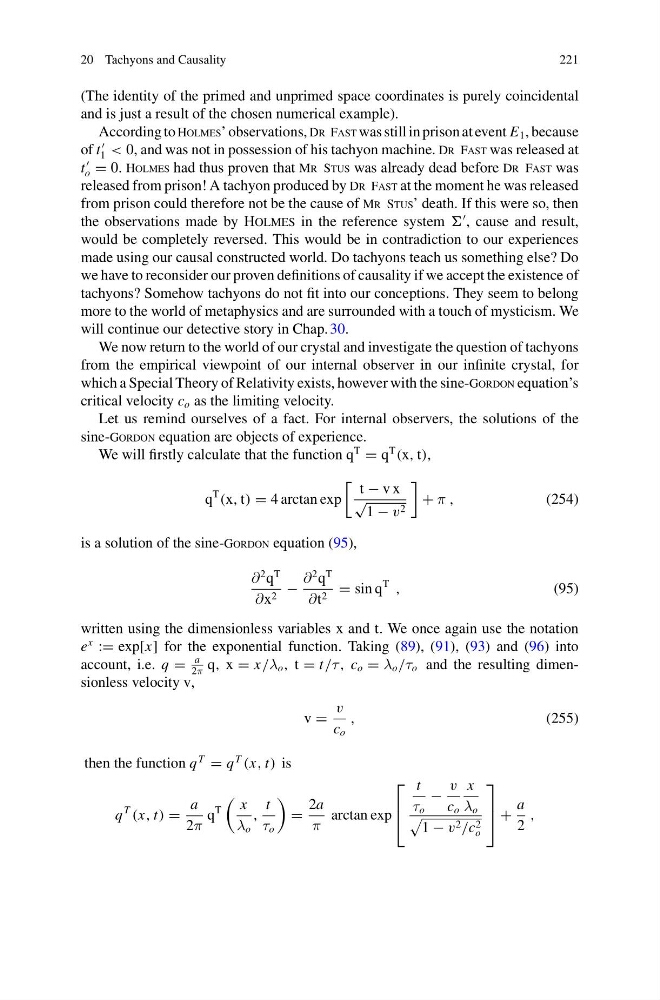
We will firstly calculate that the function q
T
= q
T
(x, t),
q
T
(x, t) = 4 arctan exp
t − v x
√
1 − v 2
+ π ,
(254)
is a solution of the sine-Gordon equation (95),
∂
2 q
T
∂x 2 −
∂
2 q
T
∂t 2 = sin q
T
,
(95)
written using the dimensionless variables x and t. We once again use the notation
e
x
:= exp[x] for the exponential function. Taking (89), (91), (93) and (96) into
account, i.e. q =
a
2π
q, x = x/λ o , t = t/τ , c o = λ o /τ o and the resulting dimensionless velocity v,
v =
v
c o
,
(255)
then the function q
T
= q
T
(x, t) is
q
T
(x, t) =
a
2π
q
T
x
λ o
,
t
τ o
=
2a
π
arctan exp
⎡
⎢
⎣
t
τ o
−
v
c o
x
λ o
1 − v 2 /c 2
o
⎤
⎥
⎦ +
a
2
,
221
(The identity of the primed and unprimed space coordinates is purely coincidental
and is just a result of the chosen numerical example).
According to Holmes’ observations, Dr Fast was still in prison at event E 1 , because
of t
1 < 0, and was not in possession of his tachyon machine. Dr Fast was released at
t
o = 0. Holmes had thus proven that Mr Stus was already dead before Dr Fast was
released from prison! A tachyon produced by Dr Fast at the moment he was released
from prison could therefore not be the cause of Mr Stus’ death. If this were so, then
the observations made by Holmes in the reference system
, cause and result,
would be completely reversed. This would be in contradiction to our experiences
made using our causal constructed world. Do tachyons teach us something else? Do
we have to reconsider our proven definitions of causality if we accept the existence of
tachyons? Somehow tachyons do not fit into our conceptions. They seem to belong
more to the world of metaphysics and are surrounded with a touch of mysticism. We
will continue our detective story in Chap. 30.
We now return to the world of our crystal and investigate the question of tachyons
from the empirical viewpoint of our internal observer in our infinite crystal, for
which a Special Theory of Relativity exists, however with the sine-Gordon equation’s
critical velocity c o as the limiting velocity.
Let us remind ourselves of a fact. For internal observers, the solutions of the
sine-Gordon equation are objects of experience.
We will firstly calculate that the function q
T
= q
T
(x, t),
q
T
(x, t) = 4 arctan exp
t − v x
√
1 − v 2
+ π ,
(254)
is a solution of the sine-Gordon equation (95),
∂
2 q
T
∂x 2 −
∂
2 q
T
∂t 2 = sin q
T
,
(95)
written using the dimensionless variables x and t. We once again use the notation
e
x
:= exp[x] for the exponential function. Taking (89), (91), (93) and (96) into
account, i.e. q =
a
2π
q, x = x/λ o , t = t/τ , c o = λ o /τ o and the resulting dimensionless velocity v,
v =
v
c o
,
(255)
then the function q
T
= q
T
(x, t) is
q
T
(x, t) =
a
2π
q
T
x
λ o
,
t
τ o
=
2a
π
arctan exp
⎡
⎢
⎣
t
τ o
−
v
c o
x
λ o
1 − v 2 /c 2
o
⎤
⎥
⎦ +
a
2
,