

220
20 Tachyons and Causality
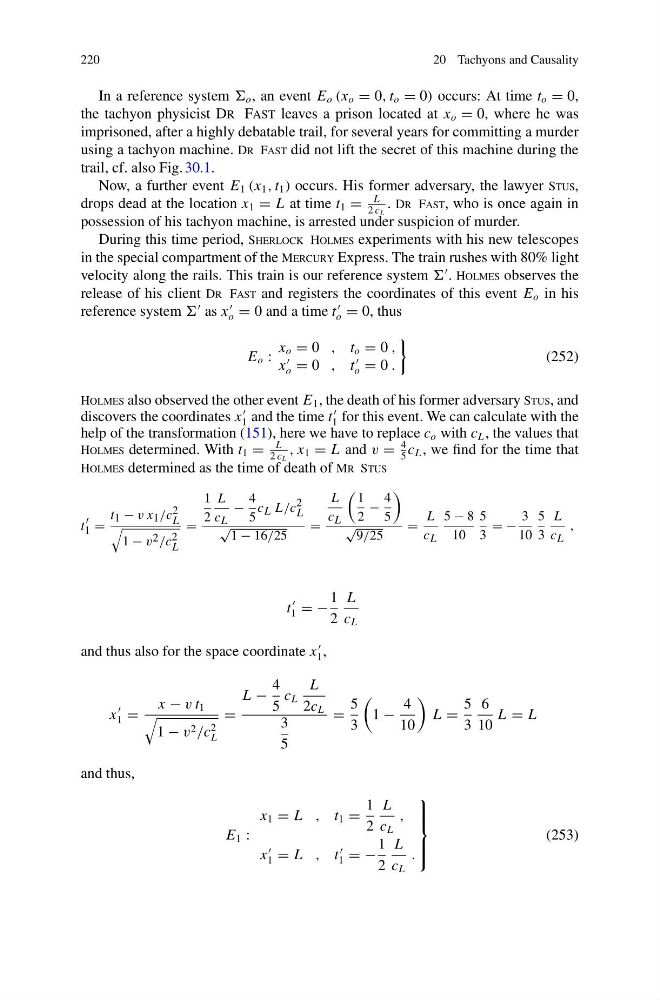
In a reference system o , an event E o (x o = 0, t o = 0) occurs: At time t o = 0,
the tachyon physicist Dr Fast leaves a prison located at x o = 0, where he was
imprisoned, after a highly debatable trail, for several years for committing a murder
using a tachyon machine. Dr Fast did not lift the secret of this machine during the
trail, cf. also Fig. 30.1.
Now, a further event E 1 (x 1 , t 1 ) occurs. His former adversary, the lawyer Stus,
drops dead at the location x 1 = L at time t 1 =
L
2 c L
. Dr Fast, who is once again in
possession of his tachyon machine, is arrested under suspicion of murder.
During this time period, Sherlock Holmes experiments with his new telescopes
in the special compartment of the Mercury Express. The train rushes with 80% light
velocity along the rails. This train is our reference system
. Holmes observes the
release of his client Dr Fast and registers the coordinates of this event E o in his
reference system
as x
o = 0 and a time t
o = 0, thus
E o :
x o = 0 , t o = 0 ,
x
o = 0 , t
o = 0 .
(252)
Holmes also observed the other event E 1 , the death of his former adversary Stus, and
discovers the coordinates x
1 and the time t
1 for this event. We can calculate with the
help of the transformation (151), here we have to replace c o with c L , the values that
Holmes determined. With t 1 =
L
2 c L
, x 1 = L and v =
4
5
c L , we find for the time that
Holmes determined as the time of death of Mr Stus
t
1 =
t 1 − v x 1 /c 2
L
1 − v 2 /c 2
L
=
1
2
L
c L
−
4
5
c L L/c 2
L
√
1 − 16/25
=
L
c L
1
2
−
4
5
√
9/25
=
L
c L
5 − 8
10
5
3
= −
3
10
5
3
L
c L
,
t
1 = −
1
2
L
c L
and thus also for the space coordinate x
1 ,
x
1 =
x − v t 1
1 − v 2 /c
2
L
=
L −
4
5
c L
L
2c L
3
5
=
5
3
1 −
4
10
L =
5
3
6
10
L = L
and thus,
E 1 :
x 1 = L , t 1 =
1
2
L
c L
,
x
1 = L , t
1 = −
1
2
L
c L
.
⎫
⎪ ⎪ ⎬
⎪ ⎪ ⎭
(253)
20 Tachyons and Causality
In a reference system o , an event E o (x o = 0, t o = 0) occurs: At time t o = 0,
the tachyon physicist Dr Fast leaves a prison located at x o = 0, where he was
imprisoned, after a highly debatable trail, for several years for committing a murder
using a tachyon machine. Dr Fast did not lift the secret of this machine during the
trail, cf. also Fig. 30.1.
Now, a further event E 1 (x 1 , t 1 ) occurs. His former adversary, the lawyer Stus,
drops dead at the location x 1 = L at time t 1 =
L
2 c L
. Dr Fast, who is once again in
possession of his tachyon machine, is arrested under suspicion of murder.
During this time period, Sherlock Holmes experiments with his new telescopes
in the special compartment of the Mercury Express. The train rushes with 80% light
velocity along the rails. This train is our reference system
. Holmes observes the
release of his client Dr Fast and registers the coordinates of this event E o in his
reference system
as x
o = 0 and a time t
o = 0, thus
E o :
x o = 0 , t o = 0 ,
x
o = 0 , t
o = 0 .
(252)
Holmes also observed the other event E 1 , the death of his former adversary Stus, and
discovers the coordinates x
1 and the time t
1 for this event. We can calculate with the
help of the transformation (151), here we have to replace c o with c L , the values that
Holmes determined. With t 1 =
L
2 c L
, x 1 = L and v =
4
5
c L , we find for the time that
Holmes determined as the time of death of Mr Stus
t
1 =
t 1 − v x 1 /c 2
L
1 − v 2 /c 2
L
=
1
2
L
c L
−
4
5
c L L/c 2
L
√
1 − 16/25
=
L
c L
1
2
−
4
5
√
9/25
=
L
c L
5 − 8
10
5
3
= −
3
10
5
3
L
c L
,
t
1 = −
1
2
L
c L
and thus also for the space coordinate x
1 ,
x
1 =
x − v t 1
1 − v 2 /c
2
L
=
L −
4
5
c L
L
2c L
3
5
=
5
3
1 −
4
10
L =
5
3
6
10
L = L
and thus,
E 1 :
x 1 = L , t 1 =
1
2
L
c L
,
x
1 = L , t
1 = −
1
2
L
c L
.
⎫
⎪ ⎪ ⎬
⎪ ⎪ ⎭
(253)