

20 Tachyons and Causality
223
The function q
T
(x, t) is thus a solution of the sine-Gordon equation (88) if the
function q
T
(x, t) is a solution of the sine-Gordon equation (95). We know that the
function
q
I
(x, t) = 4 arctan exp
x − v t
√
1 − v 2
(262)
fulfils Eq. (95), because (262) is nothing other than the Eq. (111) transcribed to the
dimensionless variables q, x, v and t. Using (254), it is
q
T
(x, t) = q
I
(t, x) + π
(263)
and thus
∂
2 q
T
(x, t)
∂x 2
−
∂
2 q
T
(x, t)
∂t 2
=
∂
2 q
I
(t, x)
∂x 2
−
∂
2 q
I
(t, x)
∂t 2
= −
∂
2 q
I
(t, x)
∂t 2
−
∂
2 q
I
(t, x)
∂x 2
= − sin q
I
(t, x)
= sin
q
I
(t, x) + π
= sin q
T
(x, t) ,
which is exactly what we wanted to show.
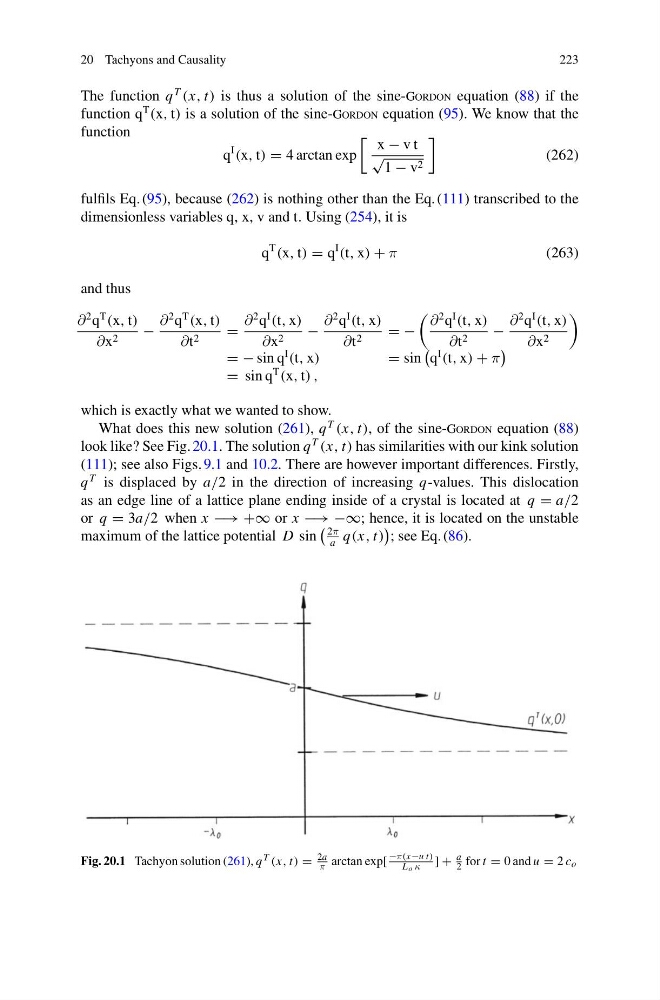
What does this new solution (261), q
T
(x, t), of the sine-Gordon equation (88)
look like? See Fig. 20.1. The solution q
T
(x, t) has similarities with our kink solution
(111); see also Figs. 9.1 and 10.2. There are however important differences. Firstly,
q
T is displaced by a/2 in the direction of increasing q-values. This dislocation
as an edge line of a lattice plane ending inside of a crystal is located at q = a/2
or q = 3a/2 when x −→ +∞ or x −→ −∞; hence, it is located on the unstable
maximum of the lattice potential D sin
2π
a
q(x, t)
; see Eq. (86).
Fig. 20.1 Tachyon solution (261), q T (x, t) =
2a
π arctan exp[
−π(x−u t)
Lo κ
] +
a
2 for t = 0 and u = 2 c o
223
The function q
T
(x, t) is thus a solution of the sine-Gordon equation (88) if the
function q
T
(x, t) is a solution of the sine-Gordon equation (95). We know that the
function
q
I
(x, t) = 4 arctan exp
x − v t
√
1 − v 2
(262)
fulfils Eq. (95), because (262) is nothing other than the Eq. (111) transcribed to the
dimensionless variables q, x, v and t. Using (254), it is
q
T
(x, t) = q
I
(t, x) + π
(263)
and thus
∂
2 q
T
(x, t)
∂x 2
−
∂
2 q
T
(x, t)
∂t 2
=
∂
2 q
I
(t, x)
∂x 2
−
∂
2 q
I
(t, x)
∂t 2
= −
∂
2 q
I
(t, x)
∂t 2
−
∂
2 q
I
(t, x)
∂x 2
= − sin q
I
(t, x)
= sin
q
I
(t, x) + π
= sin q
T
(x, t) ,
which is exactly what we wanted to show.
What does this new solution (261), q
T
(x, t), of the sine-Gordon equation (88)
look like? See Fig. 20.1. The solution q
T
(x, t) has similarities with our kink solution
(111); see also Figs. 9.1 and 10.2. There are however important differences. Firstly,
q
T is displaced by a/2 in the direction of increasing q-values. This dislocation
as an edge line of a lattice plane ending inside of a crystal is located at q = a/2
or q = 3a/2 when x −→ +∞ or x −→ −∞; hence, it is located on the unstable
maximum of the lattice potential D sin
2π
a
q(x, t)
; see Eq. (86).
Fig. 20.1 Tachyon solution (261), q T (x, t) =
2a
π arctan exp[
−π(x−u t)
Lo κ
] +
a
2 for t = 0 and u = 2 c o