

18 The Doppler Effect
209
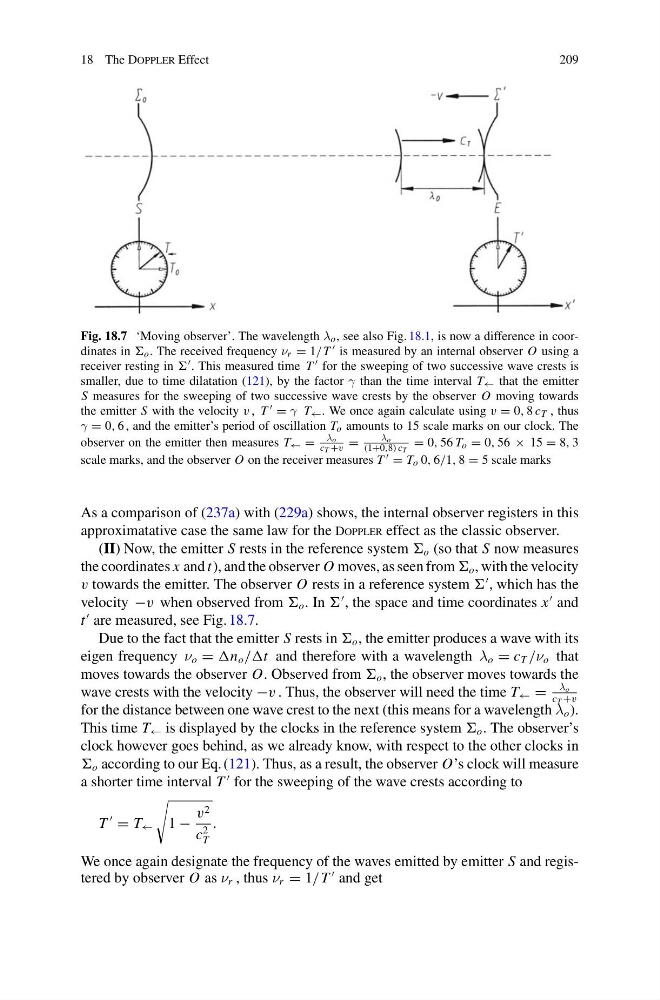
Fig. 18.7 ‘Moving observer’. The wavelength λ o , see also Fig. 18.1, is now a difference in coordinates in o . The received frequency ν r = 1/T is measured by an internal observer O using a
receiver resting in . This measured time T for the sweeping of two successive wave crests is
smaller, due to time dilatation (121), by the factor γ than the time interval T ← that the emitter
S measures for the sweeping of two successive wave crests by the observer O moving towards
the emitter S with the velocity v , T = γ T ← . We once again calculate using v = 0, 8 c T , thus
γ = 0, 6 , and the emitter’s period of oscillation T o amounts to 15 scale marks on our clock. The
observer on the emitter then measures T ← =
λo
c T +v =
λo
(1+0,8) c T
= 0, 56 T o = 0, 56 × 15 = 8, 3
scale marks, and the observer O on the receiver measures T = T o 0, 6/1, 8 = 5 scale marks
As a comparison of (237a) with (229a) shows, the internal observer registers in this
approximatative case the same law for the Doppler effect as the classic observer.
(II) Now, the emitter S rests in the reference system o (so that S now measures
the coordinates x and t), and the observer O moves, as seen from o , with the velocity
v towards the emitter. The observer O rests in a reference system
, which has the
velocity −v when observed from o . In
, the space and time coordinates x
and
t
are measured, see Fig. 18.7.
Due to the fact that the emitter S rests in o , the emitter produces a wave with its
eigen frequency ν o = n o //t and therefore with a wavelength λ o = c T /ν o that
moves towards the observer O. Observed from o , the observer moves towards the
wave crests with the velocity −v . Thus, the observer will need the time T ← =
λ o
c T +v
for the distance between one wave crest to the next (this means for a wavelength λ o ).
This time T ← is displayed by the clocks in the reference system o . The observer’s
clock however goes behind, as we already know, with respect to the other clocks in
o according to our Eq. (121). Thus, as a result, the observer O’s clock will measure
a shorter time interval T
for the sweeping of the wave crests according to
T
= T ←
1 −
v 2
c
2
T
.
We once again designate the frequency of the waves emitted by emitter S and registered by observer O as ν r , thus ν r = 1/T
and get
209
Fig. 18.7 ‘Moving observer’. The wavelength λ o , see also Fig. 18.1, is now a difference in coordinates in o . The received frequency ν r = 1/T is measured by an internal observer O using a
receiver resting in . This measured time T for the sweeping of two successive wave crests is
smaller, due to time dilatation (121), by the factor γ than the time interval T ← that the emitter
S measures for the sweeping of two successive wave crests by the observer O moving towards
the emitter S with the velocity v , T = γ T ← . We once again calculate using v = 0, 8 c T , thus
γ = 0, 6 , and the emitter’s period of oscillation T o amounts to 15 scale marks on our clock. The
observer on the emitter then measures T ← =
λo
c T +v =
λo
(1+0,8) c T
= 0, 56 T o = 0, 56 × 15 = 8, 3
scale marks, and the observer O on the receiver measures T = T o 0, 6/1, 8 = 5 scale marks
As a comparison of (237a) with (229a) shows, the internal observer registers in this
approximatative case the same law for the Doppler effect as the classic observer.
(II) Now, the emitter S rests in the reference system o (so that S now measures
the coordinates x and t), and the observer O moves, as seen from o , with the velocity
v towards the emitter. The observer O rests in a reference system
, which has the
velocity −v when observed from o . In
, the space and time coordinates x
and
t
are measured, see Fig. 18.7.
Due to the fact that the emitter S rests in o , the emitter produces a wave with its
eigen frequency ν o = n o //t and therefore with a wavelength λ o = c T /ν o that
moves towards the observer O. Observed from o , the observer moves towards the
wave crests with the velocity −v . Thus, the observer will need the time T ← =
λ o
c T +v
for the distance between one wave crest to the next (this means for a wavelength λ o ).
This time T ← is displayed by the clocks in the reference system o . The observer’s
clock however goes behind, as we already know, with respect to the other clocks in
o according to our Eq. (121). Thus, as a result, the observer O’s clock will measure
a shorter time interval T
for the sweeping of the wave crests according to
T
= T ←
1 −
v 2
c
2
T
.
We once again designate the frequency of the waves emitted by emitter S and registered by observer O as ν r , thus ν r = 1/T
and get