

210
18 The Doppler Effect
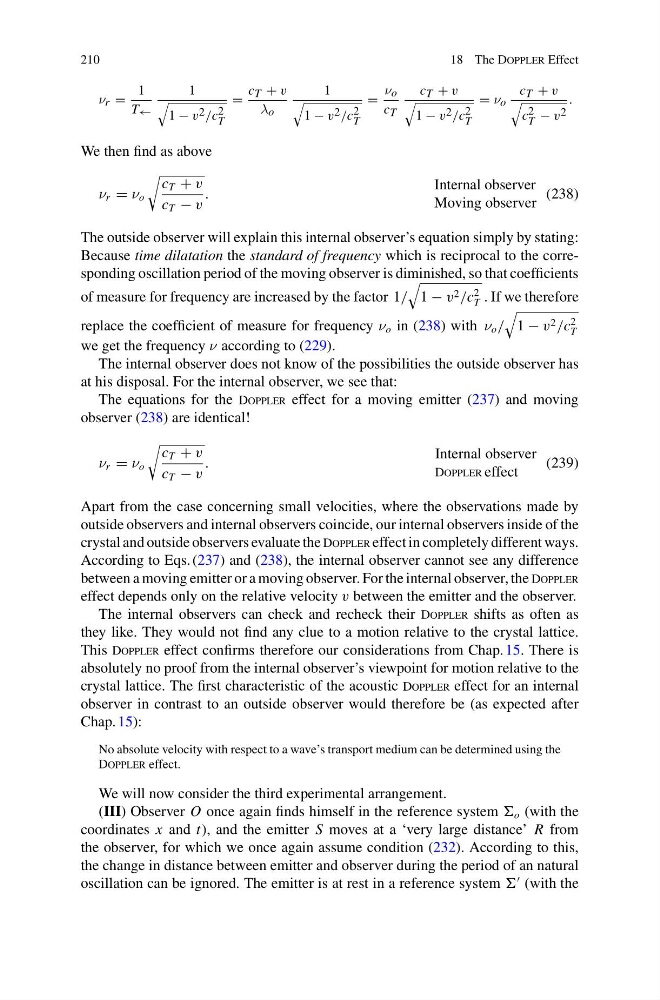
ν r =
1
T ←
1
1 − v 2 /c 2
T
=
c T + v
λ o
1
1 − v 2 /c 2
T
=
ν o
c T
c T + v
1 − v 2 /c 2
T
= ν o
c T + v
c 2
T − v 2
.
We then find as above
ν r = ν o
c T + v
c T − v
.
Internal observer
Moving observer
(238)
The outside observer will explain this internal observer’s equation simply by stating:
Because time dilatation the standard of frequency which is reciprocal to the corresponding oscillation period of the moving observer is diminished, so that coefficients
of measure for frequency are increased by the factor 1/
1 − v 2 /c
2
T . If we therefore
replace the coefficient of measure for frequency ν o in (238) with ν o /
1 − v 2 /c
2
T
we get the frequency ν according to (229).
The internal observer does not know of the possibilities the outside observer has
at his disposal. For the internal observer, we see that:
The equations for the Doppler effect for a moving emitter (237) and moving
observer (238) are identical!
ν r = ν o
c T + v
c T − v
.
Internal observer
Doppler effect
(239)
Apart from the case concerning small velocities, where the observations made by
outside observers and internal observers coincide, our internal observers inside of the
crystal and outside observers evaluate the Doppler effect in completely different ways.
According to Eqs. (237) and (238), the internal observer cannot see any difference
between a moving emitter or a moving observer. For the internal observer, the Doppler
effect depends only on the relative velocity v between the emitter and the observer.
The internal observers can check and recheck their Doppler shifts as often as
they like. They would not find any clue to a motion relative to the crystal lattice.
This Doppler effect confirms therefore our considerations from Chap. 15. There is
absolutely no proof from the internal observer’s viewpoint for motion relative to the
crystal lattice. The first characteristic of the acoustic Doppler effect for an internal
observer in contrast to an outside observer would therefore be (as expected after
Chap. 15):
No absolute velocity with respect to a wave’s transport medium can be determined using the
Doppler effect.
We will now consider the third experimental arrangement.
(III) Observer O once again finds himself in the reference system o (with the
coordinates x and t), and the emitter S moves at a ‘very large distance’ R from
the observer, for which we once again assume condition (232). According to this,
the change in distance between emitter and observer during the period of an natural
oscillation can be ignored. The emitter is at rest in a reference system
(with the
18 The Doppler Effect
ν r =
1
T ←
1
1 − v 2 /c 2
T
=
c T + v
λ o
1
1 − v 2 /c 2
T
=
ν o
c T
c T + v
1 − v 2 /c 2
T
= ν o
c T + v
c 2
T − v 2
.
We then find as above
ν r = ν o
c T + v
c T − v
.
Internal observer
Moving observer
(238)
The outside observer will explain this internal observer’s equation simply by stating:
Because time dilatation the standard of frequency which is reciprocal to the corresponding oscillation period of the moving observer is diminished, so that coefficients
of measure for frequency are increased by the factor 1/
1 − v 2 /c
2
T . If we therefore
replace the coefficient of measure for frequency ν o in (238) with ν o /
1 − v 2 /c
2
T
we get the frequency ν according to (229).
The internal observer does not know of the possibilities the outside observer has
at his disposal. For the internal observer, we see that:
The equations for the Doppler effect for a moving emitter (237) and moving
observer (238) are identical!
ν r = ν o
c T + v
c T − v
.
Internal observer
Doppler effect
(239)
Apart from the case concerning small velocities, where the observations made by
outside observers and internal observers coincide, our internal observers inside of the
crystal and outside observers evaluate the Doppler effect in completely different ways.
According to Eqs. (237) and (238), the internal observer cannot see any difference
between a moving emitter or a moving observer. For the internal observer, the Doppler
effect depends only on the relative velocity v between the emitter and the observer.
The internal observers can check and recheck their Doppler shifts as often as
they like. They would not find any clue to a motion relative to the crystal lattice.
This Doppler effect confirms therefore our considerations from Chap. 15. There is
absolutely no proof from the internal observer’s viewpoint for motion relative to the
crystal lattice. The first characteristic of the acoustic Doppler effect for an internal
observer in contrast to an outside observer would therefore be (as expected after
Chap. 15):
No absolute velocity with respect to a wave’s transport medium can be determined using the
Doppler effect.
We will now consider the third experimental arrangement.
(III) Observer O once again finds himself in the reference system o (with the
coordinates x and t), and the emitter S moves at a ‘very large distance’ R from
the observer, for which we once again assume condition (232). According to this,
the change in distance between emitter and observer during the period of an natural
oscillation can be ignored. The emitter is at rest in a reference system
(with the