

208
18 The Doppler Effect
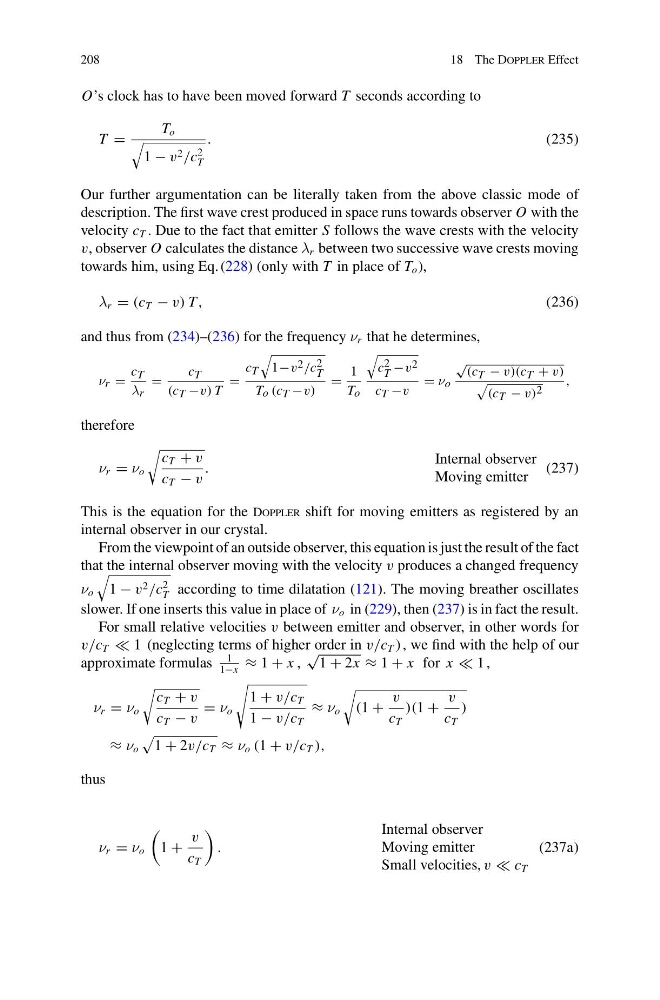
O’s clock has to have been moved forward T seconds according to
T =
T o
1 − v 2 /c
2
T
.
(235)
Our further argumentation can be literally taken from the above classic mode of
description. The first wave crest produced in space runs towards observer O with the
velocity c T . Due to the fact that emitter S follows the wave crests with the velocity
v, observer O calculates the distance λ r between two successive wave crests moving
towards him, using Eq. (228) (only with T in place of T o ),
λ r = (c T − v) T,
(236)
and thus from (234)–(236) for the frequency ν r that he determines,
ν r =
c T
λ r
=
c T
(c T −v) T
=
c T
1−v 2 /c 2
T
T o (c T −v)
=
1
T o
c 2
T −v 2
c T −v
= ν o
√ (c T − v)(c T + v)
(c T − v) 2
,
therefore
ν r = ν o
c T + v
c T − v
.
Internal observer
Moving emitter
(237)
This is the equation for the Doppler shift for moving emitters as registered by an
internal observer in our crystal.
From the viewpoint of an outside observer, this equation is just the result of the fact
that the internal observer moving with the velocity v produces a changed frequency
ν o
1 − v 2 /c
2
T according to time dilatation (121). The moving breather oscillates
slower. If one inserts this value in place of ν o in (229), then (237) is in fact the result.
For small relative velocities v between emitter and observer, in other words for
v/c T 1 (neglecting terms of higher order in v/c T ) , we find with the help of our
approximate formulas
1
1−x
≈ 1 + x ,
√
1 + 2x ≈ 1 + x for x 1 ,
ν r = ν o
c T + v
c T − v
= ν o
1 + v/c T
1 − v/c T
≈ ν o
(1 +
v
c T
)(1 +
v
c T
)
≈ ν o
1 + 2v/c T ≈ ν o (1 + v/c T ),
thus
ν r = ν o
1 +
v
c T
.
Internal observer
Moving emitter
Small velocities, v c T
(237a)
18 The Doppler Effect
O’s clock has to have been moved forward T seconds according to
T =
T o
1 − v 2 /c
2
T
.
(235)
Our further argumentation can be literally taken from the above classic mode of
description. The first wave crest produced in space runs towards observer O with the
velocity c T . Due to the fact that emitter S follows the wave crests with the velocity
v, observer O calculates the distance λ r between two successive wave crests moving
towards him, using Eq. (228) (only with T in place of T o ),
λ r = (c T − v) T,
(236)
and thus from (234)–(236) for the frequency ν r that he determines,
ν r =
c T
λ r
=
c T
(c T −v) T
=
c T
1−v 2 /c 2
T
T o (c T −v)
=
1
T o
c 2
T −v 2
c T −v
= ν o
√ (c T − v)(c T + v)
(c T − v) 2
,
therefore
ν r = ν o
c T + v
c T − v
.
Internal observer
Moving emitter
(237)
This is the equation for the Doppler shift for moving emitters as registered by an
internal observer in our crystal.
From the viewpoint of an outside observer, this equation is just the result of the fact
that the internal observer moving with the velocity v produces a changed frequency
ν o
1 − v 2 /c
2
T according to time dilatation (121). The moving breather oscillates
slower. If one inserts this value in place of ν o in (229), then (237) is in fact the result.
For small relative velocities v between emitter and observer, in other words for
v/c T 1 (neglecting terms of higher order in v/c T ) , we find with the help of our
approximate formulas
1
1−x
≈ 1 + x ,
√
1 + 2x ≈ 1 + x for x 1 ,
ν r = ν o
c T + v
c T − v
= ν o
1 + v/c T
1 − v/c T
≈ ν o
(1 +
v
c T
)(1 +
v
c T
)
≈ ν o
1 + 2v/c T ≈ ν o (1 + v/c T ),
thus
ν r = ν o
1 +
v
c T
.
Internal observer
Moving emitter
Small velocities, v c T
(237a)