

17 The Twin Paradox
191
is not the hand setting of observer B
’s clock U
T
t in
, to whom he has just moved
to and according to whose clock he has just set his. We will come to this in a moment.
All differences in the coordinates for space and time measurements in
remain
unchanged, if the initial point is changed. The difference between the hand settings
t
= t
P − t
T = −
x P
v
2v
2
c 2
o −v 2 , according to (209), also remains unchanged, just as the
difference between the space coordinates of the events T and P in
.
For x
we have once again according to (210) x
= x
P − x
T = x P
c
2
o +v
2
c 2
o −v 2 .
We have displaced the initial point for counting the coordinates in
, according to
(219) by x
P to the right. For event T , we therefore receive in the second case the
coordinates in
,
: T
x
T = x P
c
2
o + v
2
c 2
o − v 2 , t
T =
x P
v
c
2
o + v
2
c 2
o − v 2
.
Second case
(220)
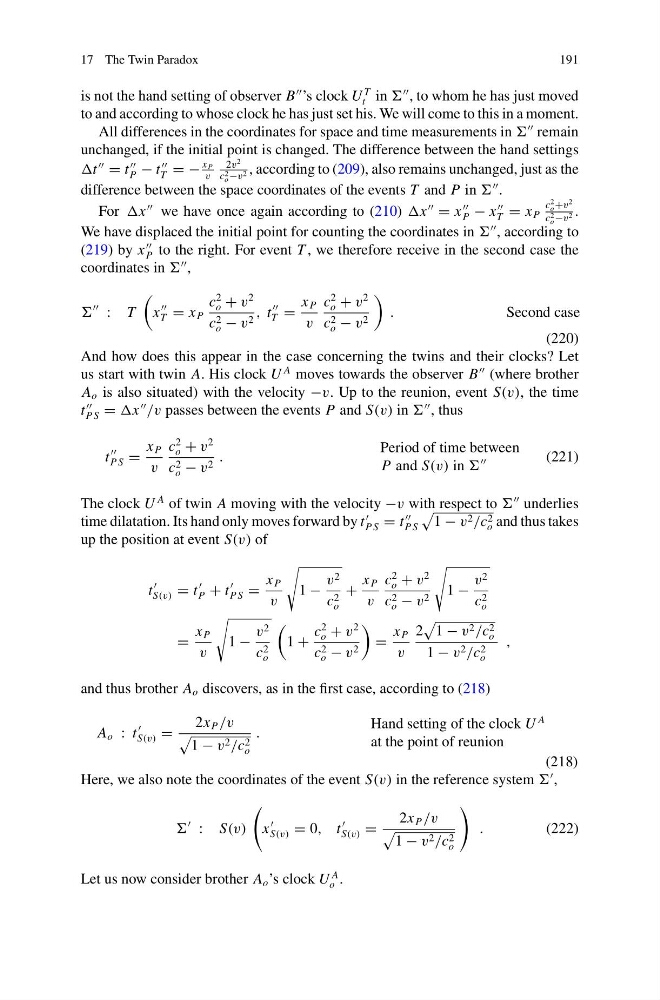
And how does this appear in the case concerning the twins and their clocks? Let
us start with twin A. His clock U
A moves towards the observer B
(where brother
A o is also situated) with the velocity −v. Up to the reunion, event S(v), the time
t
P S = x
/v passes between the events P and S(v) in
, thus
t
P S =
x P
v
c
2
o + v
2
c 2
o − v 2 .
Period of time between
P and S(v) in
(221)
The clock U
A of twin A moving with the velocity −v with respect to
underlies
time dilatation. Its hand only moves forward by t
P S = t
P S
1 − v 2 /c 2
o and thus takes
up the position at event S(v) of
t
S(v) = t
P + t
P S =
x P
v
1 −
v 2
c 2
o
+
x P
v
c
2
o + v
2
c 2
o − v 2
1 −
v 2
c 2
o
=
x P
v
1 −
v 2
c 2
o
1 +
c
2
o + v
2
c 2
o − v 2
=
x P
v
2
1 − v 2 /c 2
o
1 − v 2 /c 2
o
,
and thus brother A o discovers, as in the first case, according to (218)
A o : t
S(v) =
2x P /v
1 − v 2 /c 2
o
.
Hand setting of the clock U
A
at the point of reunion
(218)
Here, we also note the coordinates of the event S(v) in the reference system
,
: S(v)
x
S(v) = 0, t
S(v) =
2x P /v
1 − v 2 /c 2
o
.
(222)
Let us now consider brother A o ’s clock U
A
o .
191
is not the hand setting of observer B
’s clock U
T
t in
, to whom he has just moved
to and according to whose clock he has just set his. We will come to this in a moment.
All differences in the coordinates for space and time measurements in
remain
unchanged, if the initial point is changed. The difference between the hand settings
t
= t
P − t
T = −
x P
v
2v
2
c 2
o −v 2 , according to (209), also remains unchanged, just as the
difference between the space coordinates of the events T and P in
.
For x
we have once again according to (210) x
= x
P − x
T = x P
c
2
o +v
2
c 2
o −v 2 .
We have displaced the initial point for counting the coordinates in
, according to
(219) by x
P to the right. For event T , we therefore receive in the second case the
coordinates in
,
: T
x
T = x P
c
2
o + v
2
c 2
o − v 2 , t
T =
x P
v
c
2
o + v
2
c 2
o − v 2
.
Second case
(220)
And how does this appear in the case concerning the twins and their clocks? Let
us start with twin A. His clock U
A moves towards the observer B
(where brother
A o is also situated) with the velocity −v. Up to the reunion, event S(v), the time
t
P S = x
/v passes between the events P and S(v) in
, thus
t
P S =
x P
v
c
2
o + v
2
c 2
o − v 2 .
Period of time between
P and S(v) in
(221)
The clock U
A of twin A moving with the velocity −v with respect to
underlies
time dilatation. Its hand only moves forward by t
P S = t
P S
1 − v 2 /c 2
o and thus takes
up the position at event S(v) of
t
S(v) = t
P + t
P S =
x P
v
1 −
v 2
c 2
o
+
x P
v
c
2
o + v
2
c 2
o − v 2
1 −
v 2
c 2
o
=
x P
v
1 −
v 2
c 2
o
1 +
c
2
o + v
2
c 2
o − v 2
=
x P
v
2
1 − v 2 /c 2
o
1 − v 2 /c 2
o
,
and thus brother A o discovers, as in the first case, according to (218)
A o : t
S(v) =
2x P /v
1 − v 2 /c 2
o
.
Hand setting of the clock U
A
at the point of reunion
(218)
Here, we also note the coordinates of the event S(v) in the reference system
,
: S(v)
x
S(v) = 0, t
S(v) =
2x P /v
1 − v 2 /c 2
o
.
(222)
Let us now consider brother A o ’s clock U
A
o .