

190
17 The Twin Paradox
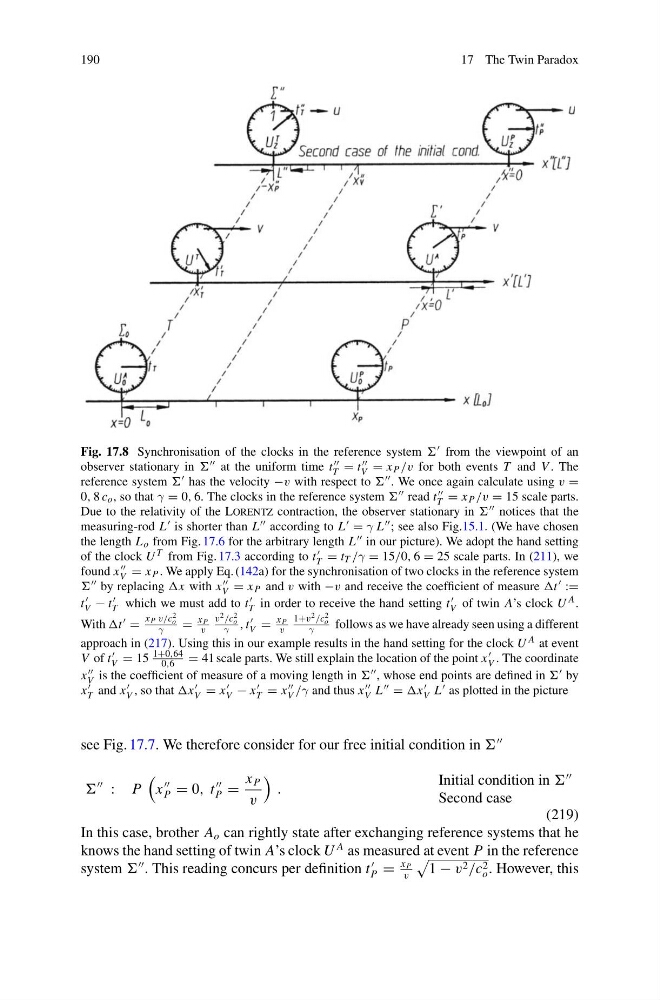
Fig. 17.8 Synchronisation of the clocks in the reference system from the viewpoint of an
observer stationary in at the uniform time t
T = t
V = x P /v for both events T and V . The
reference system has the velocity −v with respect to . We once again calculate using v =
0, 8 c o , so that γ = 0, 6. The clocks in the reference system read t
T = x P /v = 15 scale parts.
Due to the relativity of the Lorentz contraction, the observer stationary in notices that the
measuring-rod L is shorter than L according to L = γ L ; see also Fig.15.1. (We have chosen
the length L o from Fig. 17.6 for the arbitrary length L in our picture). We adopt the hand setting
of the clock U T from Fig. 17.3 according to t
T = t T /γ = 15/0, 6 = 25 scale parts. In (211), we
found x
V = x P . We apply Eq. (142a) for the synchronisation of two clocks in the reference system
by replacing x with x
V = x P and v with −v and receive the coefficient of measure t :=
t
V − t
T which we must add to t
T in order to receive the hand setting t
V of twin A’s clock U A .
With t =
x P v/c 2
o
γ
=
x P
v
v 2 /c 2
o
γ , t
V =
x P
v
1+v 2 /c 2
o
γ
follows as we have already seen using a different
approach in (217). Using this in our example results in the hand setting for the clock U A at event
V of t
V = 15
1+0,64
0,6 = 41 scale parts. We still explain the location of the point x
V . The coordinate
x
V is the coefficient of measure of a moving length in , whose end points are defined in by
x
T and x
V , so that x
V = x
V − x
T = x
V /γ and thus x
V L = x
V L as plotted in the picture
see Fig. 17.7. We therefore consider for our free initial condition in
: P
x
P = 0, t
P =
x P
v
.
Initial condition in
Second case
(219)
In this case, brother A o can rightly state after exchanging reference systems that he
knows the hand setting of twin A’s clock U
A as measured at event P in the reference
system
. This reading concurs per definition t
P =
x P
v
1 − v 2 /c 2
o . However, this
17 The Twin Paradox
Fig. 17.8 Synchronisation of the clocks in the reference system from the viewpoint of an
observer stationary in at the uniform time t
T = t
V = x P /v for both events T and V . The
reference system has the velocity −v with respect to . We once again calculate using v =
0, 8 c o , so that γ = 0, 6. The clocks in the reference system read t
T = x P /v = 15 scale parts.
Due to the relativity of the Lorentz contraction, the observer stationary in notices that the
measuring-rod L is shorter than L according to L = γ L ; see also Fig.15.1. (We have chosen
the length L o from Fig. 17.6 for the arbitrary length L in our picture). We adopt the hand setting
of the clock U T from Fig. 17.3 according to t
T = t T /γ = 15/0, 6 = 25 scale parts. In (211), we
found x
V = x P . We apply Eq. (142a) for the synchronisation of two clocks in the reference system
by replacing x with x
V = x P and v with −v and receive the coefficient of measure t :=
t
V − t
T which we must add to t
T in order to receive the hand setting t
V of twin A’s clock U A .
With t =
x P v/c 2
o
γ
=
x P
v
v 2 /c 2
o
γ , t
V =
x P
v
1+v 2 /c 2
o
γ
follows as we have already seen using a different
approach in (217). Using this in our example results in the hand setting for the clock U A at event
V of t
V = 15
1+0,64
0,6 = 41 scale parts. We still explain the location of the point x
V . The coordinate
x
V is the coefficient of measure of a moving length in , whose end points are defined in by
x
T and x
V , so that x
V = x
V − x
T = x
V /γ and thus x
V L = x
V L as plotted in the picture
see Fig. 17.7. We therefore consider for our free initial condition in
: P
x
P = 0, t
P =
x P
v
.
Initial condition in
Second case
(219)
In this case, brother A o can rightly state after exchanging reference systems that he
knows the hand setting of twin A’s clock U
A as measured at event P in the reference
system
. This reading concurs per definition t
P =
x P
v
1 − v 2 /c 2
o . However, this