

192
17 The Twin Paradox
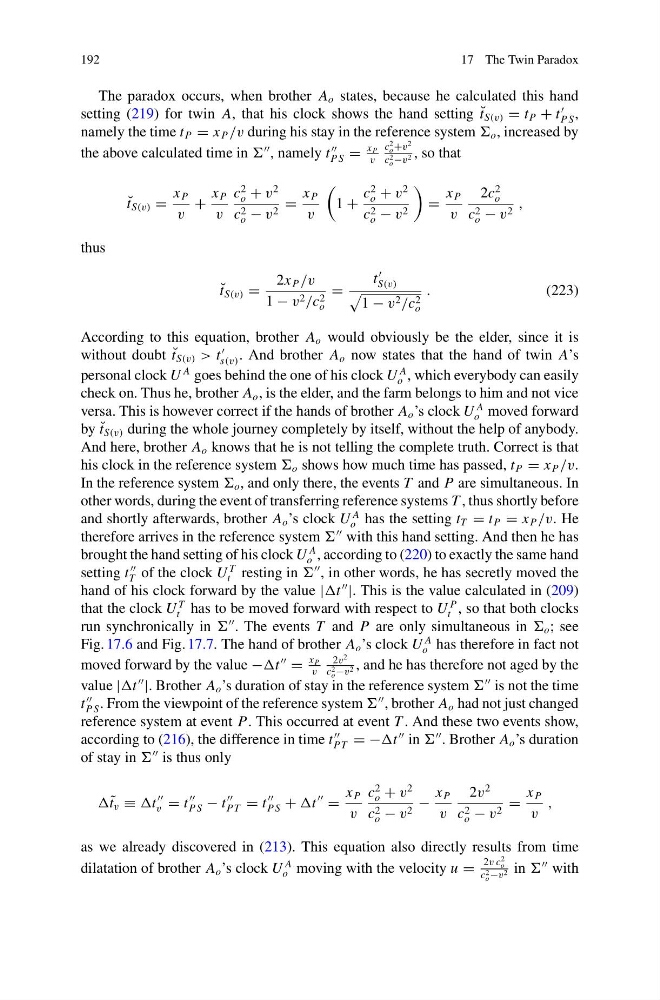
The paradox occurs, when brother A o states, because he calculated this hand
setting (219) for twin A, that his clock shows the hand setting ˘
t S(v) = t P + t
P S ,
namely the time t P = x P /v during his stay in the reference system o , increased by
the above calculated time in
, namely t
P S =
x P
v
c
2
o +v
2
c 2
o −v 2 , so that
˘
t S(v) =
x P
v
+
x P
v
c
2
o + v
2
c 2
o − v 2 =
x P
v
1 +
c
2
o + v
2
c 2
o − v 2
=
x P
v
2c
2
o
c 2
o − v 2 ,
thus
˘
t S(v) =
2x P /v
1 − v 2 /c 2
o
=
t
S(v)
1 − v 2 /c 2
o
.
(223)
According to this equation, brother A o would obviously be the elder, since it is
without doubt ˘
t S(v) > t
s(v) . And brother A o now states that the hand of twin A’s
personal clock U
A goes behind the one of his clock U
A
o , which everybody can easily
check on. Thus he, brother A o , is the elder, and the farm belongs to him and not vice
versa. This is however correct if the hands of brother A o ’s clock U
A
o moved forward
by ˘
t S(v) during the whole journey completely by itself, without the help of anybody.
And here, brother A o knows that he is not telling the complete truth. Correct is that
his clock in the reference system o shows how much time has passed, t P = x P /v.
In the reference system o , and only there, the events T and P are simultaneous. In
other words, during the event of transferring reference systems T , thus shortly before
and shortly afterwards, brother A o ’s clock U
A
o has the setting t T = t P = x P /v. He
therefore arrives in the reference system
with this hand setting. And then he has
brought the hand setting of his clock U
A
o , according to (220) to exactly the same hand
setting t
T of the clock U
T
t resting in
, in other words, he has secretly moved the
hand of his clock forward by the value |t
|. This is the value calculated in (209)
that the clock U
T
t has to be moved forward with respect to U
P
t , so that both clocks
run synchronically in
. The events T and P are only simultaneous in o ; see
Fig. 17.6 and Fig. 17.7. The hand of brother A o ’s clock U
A
o has therefore in fact not
moved forward by the value −t
=
x P
v
2v
2
c 2
o −v 2 , and he has therefore not aged by the
value |t
|. Brother A o ’s duration of stay in the reference system
is not the time
t
P S . From the viewpoint of the reference system
, brother A o had not just changed
reference system at event P. This occurred at event T . And these two events show,
according to (216), the difference in time t
PT = −t
in
. Brother A o ’s duration
of stay in
is thus only
˜ t v ≡ t
v = t
P S − t
PT = t
P S + t
=
x P
v
c
2
o + v
2
c 2
o − v 2 −
x P
v
2v
2
c 2
o − v 2 =
x P
v
,
as we already discovered in (213). This equation also directly results from time
dilatation of brother A o ’s clock U
A
o moving with the velocity u =
2v c
2
o
c 2
o −v 2 in
with
17 The Twin Paradox
The paradox occurs, when brother A o states, because he calculated this hand
setting (219) for twin A, that his clock shows the hand setting ˘
t S(v) = t P + t
P S ,
namely the time t P = x P /v during his stay in the reference system o , increased by
the above calculated time in
, namely t
P S =
x P
v
c
2
o +v
2
c 2
o −v 2 , so that
˘
t S(v) =
x P
v
+
x P
v
c
2
o + v
2
c 2
o − v 2 =
x P
v
1 +
c
2
o + v
2
c 2
o − v 2
=
x P
v
2c
2
o
c 2
o − v 2 ,
thus
˘
t S(v) =
2x P /v
1 − v 2 /c 2
o
=
t
S(v)
1 − v 2 /c 2
o
.
(223)
According to this equation, brother A o would obviously be the elder, since it is
without doubt ˘
t S(v) > t
s(v) . And brother A o now states that the hand of twin A’s
personal clock U
A goes behind the one of his clock U
A
o , which everybody can easily
check on. Thus he, brother A o , is the elder, and the farm belongs to him and not vice
versa. This is however correct if the hands of brother A o ’s clock U
A
o moved forward
by ˘
t S(v) during the whole journey completely by itself, without the help of anybody.
And here, brother A o knows that he is not telling the complete truth. Correct is that
his clock in the reference system o shows how much time has passed, t P = x P /v.
In the reference system o , and only there, the events T and P are simultaneous. In
other words, during the event of transferring reference systems T , thus shortly before
and shortly afterwards, brother A o ’s clock U
A
o has the setting t T = t P = x P /v. He
therefore arrives in the reference system
with this hand setting. And then he has
brought the hand setting of his clock U
A
o , according to (220) to exactly the same hand
setting t
T of the clock U
T
t resting in
, in other words, he has secretly moved the
hand of his clock forward by the value |t
|. This is the value calculated in (209)
that the clock U
T
t has to be moved forward with respect to U
P
t , so that both clocks
run synchronically in
. The events T and P are only simultaneous in o ; see
Fig. 17.6 and Fig. 17.7. The hand of brother A o ’s clock U
A
o has therefore in fact not
moved forward by the value −t
=
x P
v
2v
2
c 2
o −v 2 , and he has therefore not aged by the
value |t
|. Brother A o ’s duration of stay in the reference system
is not the time
t
P S . From the viewpoint of the reference system
, brother A o had not just changed
reference system at event P. This occurred at event T . And these two events show,
according to (216), the difference in time t
PT = −t
in
. Brother A o ’s duration
of stay in
is thus only
˜ t v ≡ t
v = t
P S − t
PT = t
P S + t
=
x P
v
c
2
o + v
2
c 2
o − v 2 −
x P
v
2v
2
c 2
o − v 2 =
x P
v
,
as we already discovered in (213). This equation also directly results from time
dilatation of brother A o ’s clock U
A
o moving with the velocity u =
2v c
2
o
c 2
o −v 2 in
with