

17 The Twin Paradox
179
its own reference system
. The space and time coordinates measured from out of
this reference system are once again defined as x
and t
. We now measure the motion
of a second object in
, moving through the positions x
= x
(t
) (e.g. the conductor
moving through the train). In
, object L has the velocity u
= dx
/dt
. We now
ask for the velocity u = dx/dt that is measured for the same object L (the conductor
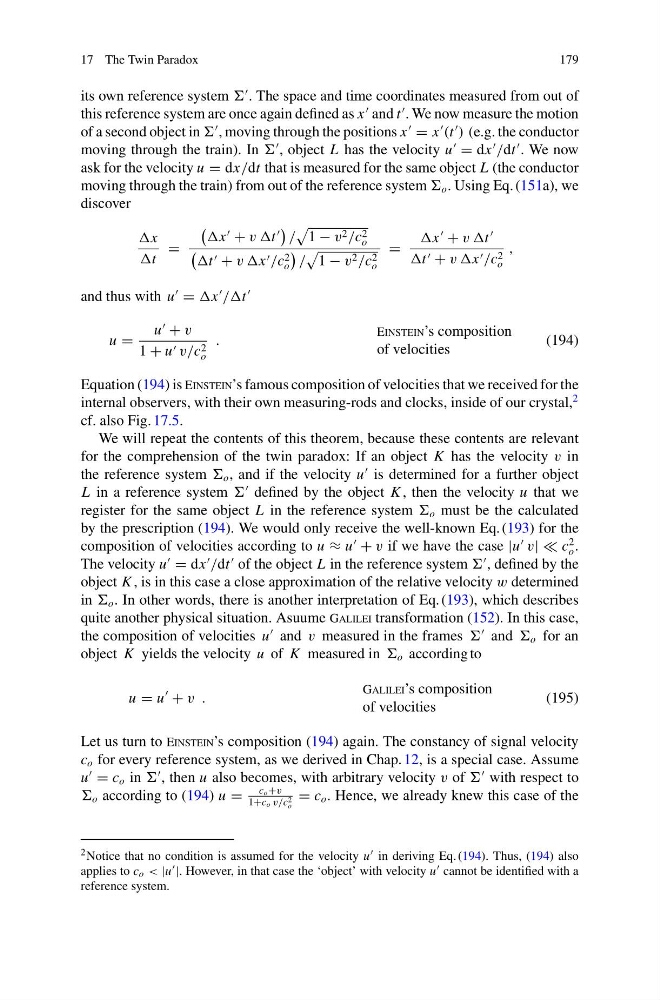
moving through the train) from out of the reference system o . Using Eq. (151a), we
discover
x
t
=
x
+ v vt
/
1 − v 2 /c 2
o
t + v vx /c 2
o
/
1 − v 2 /c 2
o
=
x
+ v vt
t + v vx /c 2
o
,
and thus with u
= x
//t
u =
u
+ v
1 + u v/c 2
o
.
Einstein’s composition
of velocities
(194)
Equation (194) is Einstein’s famous composition of velocities that we received for the
internal observers, with their own measuring-rods and clocks, inside of our crystal,
2
cf. also Fig. 17.5.
We will repeat the contents of this theorem, because these contents are relevant
for the comprehension of the twin paradox: If an object K has the velocity v in
the reference system o , and if the velocity u
is determined for a further object
L in a reference system
defined by the object K , then the velocity u that we
register for the same object L in the reference system o must be the calculated
by the prescription (194). We would only receive the well-known Eq. (193) for the
composition of velocities according to u ≈ u
+ v if we have the case |u
v| | c
2
o .
The velocity u
= dx
/dt
of the object L in the reference system
, defined by the
object K , is in this case a close approximation of the relative velocity w determined
in o . In other words, there is another interpretation of Eq. (193), which describes
quite another physical situation. Asuume Galilei transformation (152). In this case,
the composition of velocities u
and v measured in the frames
and o for an
object K yields the velocity u of K measured in o according to
u = u
+ v .
Galilei’s composition
of velocities
(195)
Let us turn to Einstein’s composition (194) again. The constancy of signal velocity
c o for every reference system, as we derived in Chap. 12, is a special case. Assume
u
= c o in
, then u also becomes, with arbitrary velocity v of
with respect to
o according to (194) u =
c o +v
1+c o v/c 2
o
= c o . Hence, we already knew this case of the
2 Notice that no condition is assumed for the velocity u in deriving Eq. (194). Thus, (194) also
applies to c o < |u |. However, in that case the ‘object’ with velocity u cannot be identified with a
reference system.
179
its own reference system
. The space and time coordinates measured from out of
this reference system are once again defined as x
and t
. We now measure the motion
of a second object in
, moving through the positions x
= x
(t
) (e.g. the conductor
moving through the train). In
, object L has the velocity u
= dx
/dt
. We now
ask for the velocity u = dx/dt that is measured for the same object L (the conductor
moving through the train) from out of the reference system o . Using Eq. (151a), we
discover
x
t
=
x
+ v vt
/
1 − v 2 /c 2
o
t + v vx /c 2
o
/
1 − v 2 /c 2
o
=
x
+ v vt
t + v vx /c 2
o
,
and thus with u
= x
//t
u =
u
+ v
1 + u v/c 2
o
.
Einstein’s composition
of velocities
(194)
Equation (194) is Einstein’s famous composition of velocities that we received for the
internal observers, with their own measuring-rods and clocks, inside of our crystal,
2
cf. also Fig. 17.5.
We will repeat the contents of this theorem, because these contents are relevant
for the comprehension of the twin paradox: If an object K has the velocity v in
the reference system o , and if the velocity u
is determined for a further object
L in a reference system
defined by the object K , then the velocity u that we
register for the same object L in the reference system o must be the calculated
by the prescription (194). We would only receive the well-known Eq. (193) for the
composition of velocities according to u ≈ u
+ v if we have the case |u
v| | c
2
o .
The velocity u
= dx
/dt
of the object L in the reference system
, defined by the
object K , is in this case a close approximation of the relative velocity w determined
in o . In other words, there is another interpretation of Eq. (193), which describes
quite another physical situation. Asuume Galilei transformation (152). In this case,
the composition of velocities u
and v measured in the frames
and o for an
object K yields the velocity u of K measured in o according to
u = u
+ v .
Galilei’s composition
of velocities
(195)
Let us turn to Einstein’s composition (194) again. The constancy of signal velocity
c o for every reference system, as we derived in Chap. 12, is a special case. Assume
u
= c o in
, then u also becomes, with arbitrary velocity v of
with respect to
o according to (194) u =
c o +v
1+c o v/c 2
o
= c o . Hence, we already knew this case of the
2 Notice that no condition is assumed for the velocity u in deriving Eq. (194). Thus, (194) also
applies to c o < |u |. However, in that case the ‘object’ with velocity u cannot be identified with a
reference system.