

178
17 The Twin Paradox
So much to the observations made by B o in the reference system o .
From twin A’s point of view, who is in the reference system
, it is also clear
that brother A o has to be younger than A when they meet, because only A o moved
with respect to
. With respect to the inequality, all of the calculations made by
observer B o in o correspond with the expectations of twin A in
. However,
if we numerically compare the statement (192) made by the observer B o with the
measurements made by the twin A in
moving with an arbitrary velocity u > v,
as we did in the case of the super-train, a new problem arises. This problem even
arises if we observe this whole process from the viewpoint of the brother A o , which
we will save up for the end.
Here, the problem has to do with the composition of velocities. We will firstly have
to deal with this. The main essence here is to differentiate between two completely
different situations.
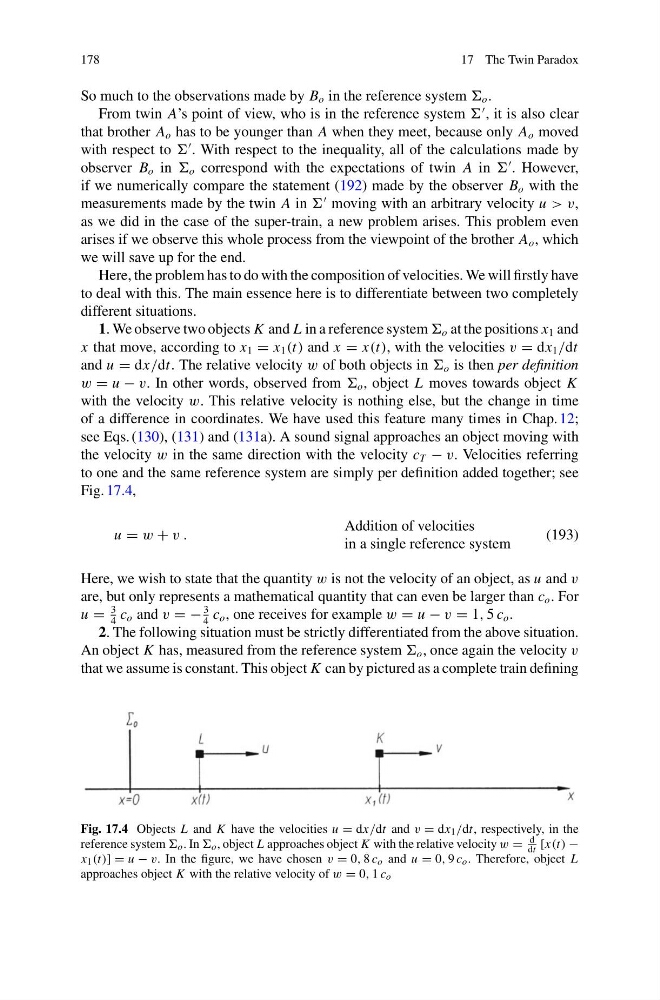
1. We observe two objects K and L in a reference system o at the positions x 1 and
x that move, according to x 1 = x 1 (t) and x = x(t), with the velocities v = dx 1 /dt
and u = dx/dt. The relative velocity w of both objects in o is then per definition
w = u − v. In other words, observed from o , object L moves towards object K
with the velocity w. This relative velocity is nothing else, but the change in time
of a difference in coordinates. We have used this feature many times in Chap. 12;
see Eqs. (130), (131) and (131a). A sound signal approaches an object moving with
the velocity w in the same direction with the velocity c T − v. Velocities referring
to one and the same reference system are simply per definition added together; see
Fig. 17.4,
u = w + v .
Addition of velocities
in a single reference system
(193)
Here, we wish to state that the quantity w is not the velocity of an object, as u and v
are, but only represents a mathematical quantity that can even be larger than c o . For
u =
3
4
c o and v = −
3
4
c o , one receives for example w = u − v = 1, 5 c o .
2. The following situation must be strictly differentiated from the above situation.
An object K has, measured from the reference system o , once again the velocity v
that we assume is constant. This object K can by pictured as a complete train defining
Fig. 17.4 Objects L and K have the velocities u = dx/dt and v = dx 1 /dt, respectively, in the
reference system o . In o , object L approaches object K with the relative velocity w =
d
dt [x(t) −
x 1 (t)] = u − v. In the figure, we have chosen v = 0, 8 c o and u = 0, 9 c o . Therefore, object L
approaches object K with the relative velocity of w = 0, 1 c o
17 The Twin Paradox
So much to the observations made by B o in the reference system o .
From twin A’s point of view, who is in the reference system
, it is also clear
that brother A o has to be younger than A when they meet, because only A o moved
with respect to
. With respect to the inequality, all of the calculations made by
observer B o in o correspond with the expectations of twin A in
. However,
if we numerically compare the statement (192) made by the observer B o with the
measurements made by the twin A in
moving with an arbitrary velocity u > v,
as we did in the case of the super-train, a new problem arises. This problem even
arises if we observe this whole process from the viewpoint of the brother A o , which
we will save up for the end.
Here, the problem has to do with the composition of velocities. We will firstly have
to deal with this. The main essence here is to differentiate between two completely
different situations.
1. We observe two objects K and L in a reference system o at the positions x 1 and
x that move, according to x 1 = x 1 (t) and x = x(t), with the velocities v = dx 1 /dt
and u = dx/dt. The relative velocity w of both objects in o is then per definition
w = u − v. In other words, observed from o , object L moves towards object K
with the velocity w. This relative velocity is nothing else, but the change in time
of a difference in coordinates. We have used this feature many times in Chap. 12;
see Eqs. (130), (131) and (131a). A sound signal approaches an object moving with
the velocity w in the same direction with the velocity c T − v. Velocities referring
to one and the same reference system are simply per definition added together; see
Fig. 17.4,
u = w + v .
Addition of velocities
in a single reference system
(193)
Here, we wish to state that the quantity w is not the velocity of an object, as u and v
are, but only represents a mathematical quantity that can even be larger than c o . For
u =
3
4
c o and v = −
3
4
c o , one receives for example w = u − v = 1, 5 c o .
2. The following situation must be strictly differentiated from the above situation.
An object K has, measured from the reference system o , once again the velocity v
that we assume is constant. This object K can by pictured as a complete train defining
Fig. 17.4 Objects L and K have the velocities u = dx/dt and v = dx 1 /dt, respectively, in the
reference system o . In o , object L approaches object K with the relative velocity w =
d
dt [x(t) −
x 1 (t)] = u − v. In the figure, we have chosen v = 0, 8 c o and u = 0, 9 c o . Therefore, object L
approaches object K with the relative velocity of w = 0, 1 c o