

180
17 The Twin Paradox
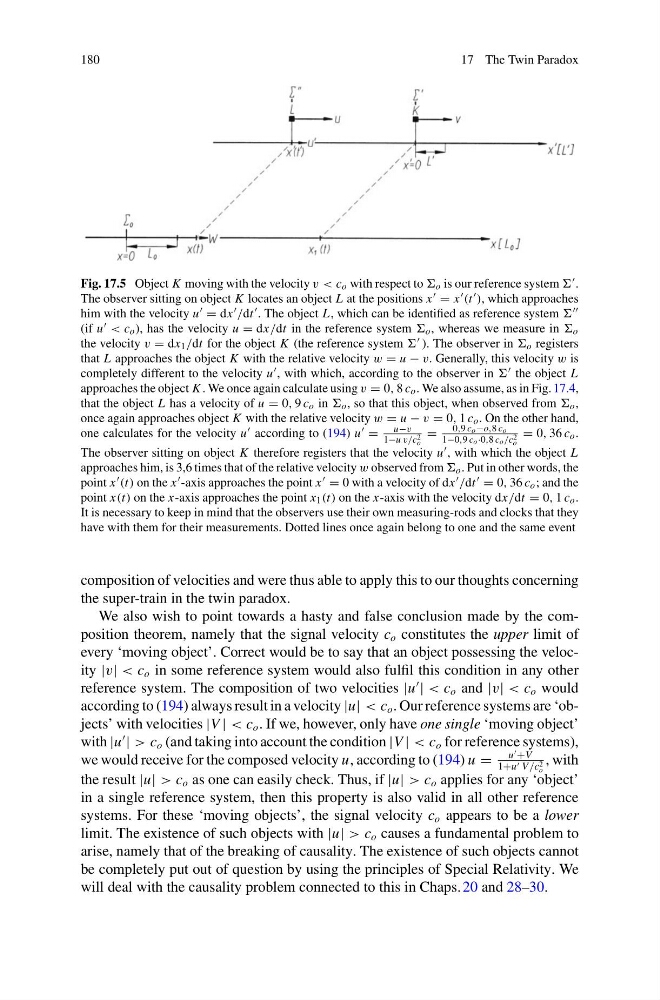
Fig. 17.5 Object K moving with the velocity v < c o with respect to o is our reference system .
The observer sitting on object K locates an object L at the positions x = x (t ), which approaches
him with the velocity u = dx /dt . The object L, which can be identified as reference system
(if u < c o ), has the velocity u = dx/dt in the reference system o , whereas we measure in o
the velocity v = dx 1 /dt for the object K (the reference system ). The observer in o registers
that L approaches the object K with the relative velocity w = u − v. Generally, this velocity w is
completely different to the velocity u , with which, according to the observer in the object L
approaches the object K . We once again calculate using v = 0, 8 c o . We also assume, as in Fig. 17.4,
that the object L has a velocity of u = 0, 9 c o in o , so that this object, when observed from o ,
once again approaches object K with the relative velocity w = u − v = 0, 1 c o . On the other hand,
one calculates for the velocity u according to (194) u =
u−v
1−u v/c 2
o
=
0,9 co−o,8 co
1−0,9 co·0,8 co/c 2
o
= 0, 36 c o .
The observer sitting on object K therefore registers that the velocity u , with which the object L
approaches him, is 3,6 times that of the relative velocity w observed from o . Put in other words, the
point x (t) on the x -axis approaches the point x = 0 with a velocity of dx /dt = 0, 36 c o ; and the
point x(t) on the x-axis approaches the point x 1 (t) on the x-axis with the velocity dx/dt = 0, 1 c o .
It is necessary to keep in mind that the observers use their own measuring-rods and clocks that they
have with them for their measurements. Dotted lines once again belong to one and the same event
composition of velocities and were thus able to apply this to our thoughts concerning
the super-train in the twin paradox.
We also wish to point towards a hasty and false conclusion made by the composition theorem, namely that the signal velocity c o constitutes the upper limit of
every ‘moving object’. Correct would be to say that an object possessing the velocity |v| < c o in some reference system would also fulfil this condition in any other
reference system. The composition of two velocities |u
| < c o and |v| < c o would
according to (194) always result in a velocity |u| < c o . Our reference systems are ‘objects’ with velocities |V | < c o . If we, however, only have one single ‘moving object’
with |u
| > c o (and taking into account the condition |V | < c o for reference systems),
we would receive for the composed velocity u, according to (194) u =
u
+V
1+u V /c 2
o
, with
the result |u| > c o as one can easily check. Thus, if |u| > c o applies for any ‘object’
in a single reference system, then this property is also valid in all other reference
systems. For these ‘moving objects’, the signal velocity c o appears to be a lower
limit. The existence of such objects with |u| > c o causes a fundamental problem to
arise, namely that of the breaking of causality. The existence of such objects cannot
be completely put out of question by using the principles of Special Relativity. We
will deal with the causality problem connected to this in Chaps. 20 and 28–30.
17 The Twin Paradox
Fig. 17.5 Object K moving with the velocity v < c o with respect to o is our reference system .
The observer sitting on object K locates an object L at the positions x = x (t ), which approaches
him with the velocity u = dx /dt . The object L, which can be identified as reference system
(if u < c o ), has the velocity u = dx/dt in the reference system o , whereas we measure in o
the velocity v = dx 1 /dt for the object K (the reference system ). The observer in o registers
that L approaches the object K with the relative velocity w = u − v. Generally, this velocity w is
completely different to the velocity u , with which, according to the observer in the object L
approaches the object K . We once again calculate using v = 0, 8 c o . We also assume, as in Fig. 17.4,
that the object L has a velocity of u = 0, 9 c o in o , so that this object, when observed from o ,
once again approaches object K with the relative velocity w = u − v = 0, 1 c o . On the other hand,
one calculates for the velocity u according to (194) u =
u−v
1−u v/c 2
o
=
0,9 co−o,8 co
1−0,9 co·0,8 co/c 2
o
= 0, 36 c o .
The observer sitting on object K therefore registers that the velocity u , with which the object L
approaches him, is 3,6 times that of the relative velocity w observed from o . Put in other words, the
point x (t) on the x -axis approaches the point x = 0 with a velocity of dx /dt = 0, 36 c o ; and the
point x(t) on the x-axis approaches the point x 1 (t) on the x-axis with the velocity dx/dt = 0, 1 c o .
It is necessary to keep in mind that the observers use their own measuring-rods and clocks that they
have with them for their measurements. Dotted lines once again belong to one and the same event
composition of velocities and were thus able to apply this to our thoughts concerning
the super-train in the twin paradox.
We also wish to point towards a hasty and false conclusion made by the composition theorem, namely that the signal velocity c o constitutes the upper limit of
every ‘moving object’. Correct would be to say that an object possessing the velocity |v| < c o in some reference system would also fulfil this condition in any other
reference system. The composition of two velocities |u
| < c o and |v| < c o would
according to (194) always result in a velocity |u| < c o . Our reference systems are ‘objects’ with velocities |V | < c o . If we, however, only have one single ‘moving object’
with |u
| > c o (and taking into account the condition |V | < c o for reference systems),
we would receive for the composed velocity u, according to (194) u =
u
+V
1+u V /c 2
o
, with
the result |u| > c o as one can easily check. Thus, if |u| > c o applies for any ‘object’
in a single reference system, then this property is also valid in all other reference
systems. For these ‘moving objects’, the signal velocity c o appears to be a lower
limit. The existence of such objects with |u| > c o causes a fundamental problem to
arise, namely that of the breaking of causality. The existence of such objects cannot
be completely put out of question by using the principles of Special Relativity. We
will deal with the causality problem connected to this in Chaps. 20 and 28–30.