

68
Electrochemical Supercapacitors for Energy Storage and Delivery
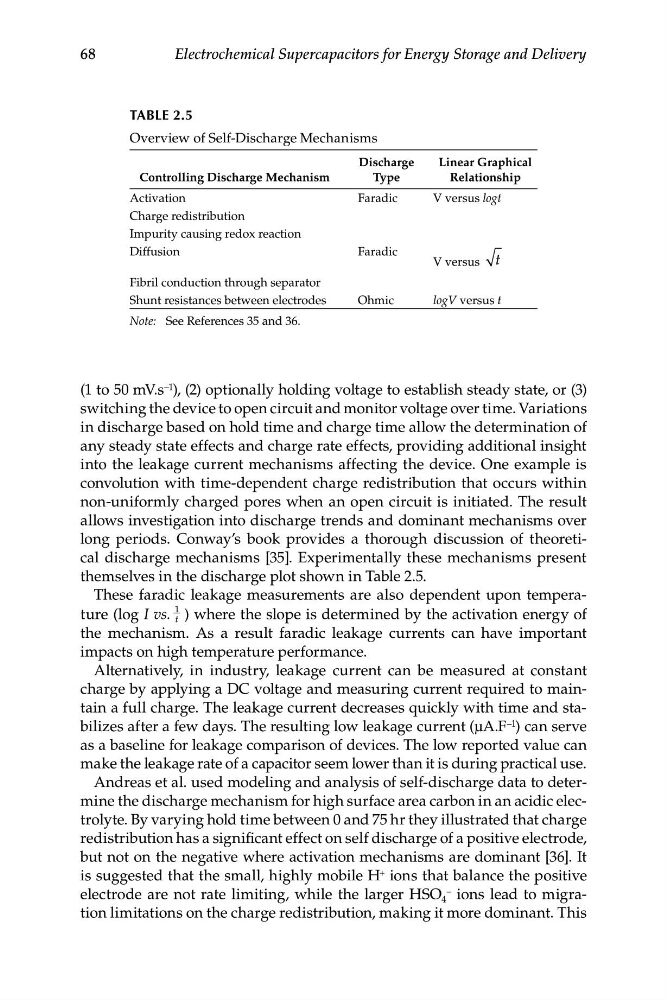
TABLE 2.5
Overview of Self-Discharge Mechanisms
Discharge
Linear Graphical
Controlling Discharge Mechanism
Type
Relationship
Activation
Faradic
V versus logt
Charge redistribution
Impurity causing redox reaction
Diffusion
Faradic
V versus t
Fibril conduction through separator
Shunt resistances between electrodes
Ohmic
logV versus t
Note: See References 35 and 36.
(1 to 50 mV.s –1 ), (2) optionally holding voltage to establish steady state, or (3)
switching the device to open circuit and monitor voltage over time. Variations
in discharge based on hold time and charge time allow the determination of
any steady state effects and charge rate effects, providing additional insight
into the leakage current mechanisms affecting the device. One example is
convolution with time-dependent charge redistribution that occurs within
non-uniformly charged pores when an open circuit is initiated. The result
allows investigation into discharge trends and dominant mechanisms over
long periods. Conway’s book provides a thorough discussion of theoretical discharge mechanisms [35]. Experimentally these mechanisms present
themselves in the discharge plot shown in Table 2.5.
These faradic leakage measurements are also dependent upon temperature (log I vs.
1
t ) where the slope is determined by the activation energy of
the mechanism. As a result faradic leakage currents can have important
impacts on high temperature performance.
Alternatively, in industry, leakage current can be measured at constant
charge by applying a DC voltage and measuring current required to maintain a full charge. The leakage current decreases quickly with time and stabilizes after a few days. The resulting low leakage current (μA.F –1 ) can serve
as a baseline for leakage comparison of devices. The low reported value can
make the leakage rate of a capacitor seem lower than it is during practical use.
Andreas et al. used modeling and analysis of self-discharge data to determine the discharge mechanism for high surface area carbon in an acidic electrolyte. By varying hold time between 0 and 75 hr they illustrated that charge
redistribution has a significant effect on self discharge of a positive electrode,
but not on the negative where activation mechanisms are dominant [36]. It
is suggested that the small, highly mobile H + ions that balance the positive
–
electrode are not rate limiting, while the larger HSO 4 ions lead to migration limitations on the charge redistribution, making it more dominant. This
Electrochemical Supercapacitors for Energy Storage and Delivery
TABLE 2.5
Overview of Self-Discharge Mechanisms
Discharge
Linear Graphical
Controlling Discharge Mechanism
Type
Relationship
Activation
Faradic
V versus logt
Charge redistribution
Impurity causing redox reaction
Diffusion
Faradic
V versus t
Fibril conduction through separator
Shunt resistances between electrodes
Ohmic
logV versus t
Note: See References 35 and 36.
(1 to 50 mV.s –1 ), (2) optionally holding voltage to establish steady state, or (3)
switching the device to open circuit and monitor voltage over time. Variations
in discharge based on hold time and charge time allow the determination of
any steady state effects and charge rate effects, providing additional insight
into the leakage current mechanisms affecting the device. One example is
convolution with time-dependent charge redistribution that occurs within
non-uniformly charged pores when an open circuit is initiated. The result
allows investigation into discharge trends and dominant mechanisms over
long periods. Conway’s book provides a thorough discussion of theoretical discharge mechanisms [35]. Experimentally these mechanisms present
themselves in the discharge plot shown in Table 2.5.
These faradic leakage measurements are also dependent upon temperature (log I vs.
1
t ) where the slope is determined by the activation energy of
the mechanism. As a result faradic leakage currents can have important
impacts on high temperature performance.
Alternatively, in industry, leakage current can be measured at constant
charge by applying a DC voltage and measuring current required to maintain a full charge. The leakage current decreases quickly with time and stabilizes after a few days. The resulting low leakage current (μA.F –1 ) can serve
as a baseline for leakage comparison of devices. The low reported value can
make the leakage rate of a capacitor seem lower than it is during practical use.
Andreas et al. used modeling and analysis of self-discharge data to determine the discharge mechanism for high surface area carbon in an acidic electrolyte. By varying hold time between 0 and 75 hr they illustrated that charge
redistribution has a significant effect on self discharge of a positive electrode,
but not on the negative where activation mechanisms are dominant [36]. It
is suggested that the small, highly mobile H + ions that balance the positive
–
electrode are not rate limiting, while the larger HSO 4 ions lead to migration limitations on the charge redistribution, making it more dominant. This