

67
Fundamentals of Electrochemical Double-Layer Supercapacitors
R esr
C
T
dl
R p
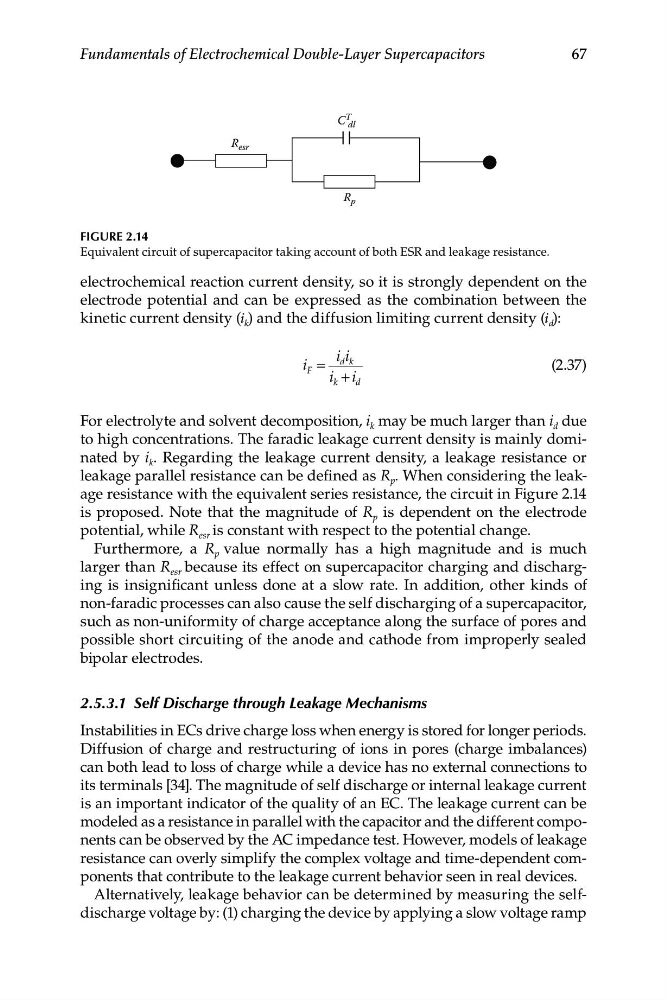
FIGURE 2.14
Equivalent circuit of supercapacitor taking account of both ESR and leakage resistance.
electrochemical reaction current density, so it is strongly dependent on the
electrode potential and can be expressed as the combination between the
kinetic current density (i k ) and the diffusion limiting current density (i d ):
i i
i F =
d k
(2.37)
i k + i d
For electrolyte and solvent decomposition, i k may be much larger than i d due
to high concentrations. The faradic leakage current density is mainly dominated by i k . Regarding the leakage current density, a leakage resistance or
leakage parallel resistance can be defined as R p . When considering the leakage resistance with the equivalent series resistance, the circuit in Figure 2.14
is proposed. Note that the magnitude of R p is dependent on the electrode
potential, while R esr is constant with respect to the potential change.
Furthermore, a R p value normally has a high magnitude and is much
larger than R esr because its effect on supercapacitor charging and discharging is insignificant unless done at a slow rate. In addition, other kinds of
non-faradic processes can also cause the self discharging of a supercapacitor,
such as non-uniformity of charge acceptance along the surface of pores and
possible short circuiting of the anode and cathode from improperly sealed
bipolar electrodes.
2.5.3.1 Self Discharge through Leakage Mechanisms
Instabilities in ECs drive charge loss when energy is stored for longer periods.
Diffusion of charge and restructuring of ions in pores (charge imbalances)
can both lead to loss of charge while a device has no external connections to
its terminals [34]. The magnitude of self discharge or internal leakage current
is an important indicator of the quality of an EC. The leakage current can be
modeled as a resistance in parallel with the capacitor and the different components can be observed by the AC impedance test. However, models of leakage
resistance can overly simplify the complex voltage and time-dependent components that contribute to the leakage current behavior seen in real devices.
Alternatively, leakage behavior can be determined by measuring the selfdischarge voltage by: (1) charging the device by applying a slow voltage ramp
Fundamentals of Electrochemical Double-Layer Supercapacitors
R esr
C
T
dl
R p
FIGURE 2.14
Equivalent circuit of supercapacitor taking account of both ESR and leakage resistance.
electrochemical reaction current density, so it is strongly dependent on the
electrode potential and can be expressed as the combination between the
kinetic current density (i k ) and the diffusion limiting current density (i d ):
i i
i F =
d k
(2.37)
i k + i d
For electrolyte and solvent decomposition, i k may be much larger than i d due
to high concentrations. The faradic leakage current density is mainly dominated by i k . Regarding the leakage current density, a leakage resistance or
leakage parallel resistance can be defined as R p . When considering the leakage resistance with the equivalent series resistance, the circuit in Figure 2.14
is proposed. Note that the magnitude of R p is dependent on the electrode
potential, while R esr is constant with respect to the potential change.
Furthermore, a R p value normally has a high magnitude and is much
larger than R esr because its effect on supercapacitor charging and discharging is insignificant unless done at a slow rate. In addition, other kinds of
non-faradic processes can also cause the self discharging of a supercapacitor,
such as non-uniformity of charge acceptance along the surface of pores and
possible short circuiting of the anode and cathode from improperly sealed
bipolar electrodes.
2.5.3.1 Self Discharge through Leakage Mechanisms
Instabilities in ECs drive charge loss when energy is stored for longer periods.
Diffusion of charge and restructuring of ions in pores (charge imbalances)
can both lead to loss of charge while a device has no external connections to
its terminals [34]. The magnitude of self discharge or internal leakage current
is an important indicator of the quality of an EC. The leakage current can be
modeled as a resistance in parallel with the capacitor and the different components can be observed by the AC impedance test. However, models of leakage
resistance can overly simplify the complex voltage and time-dependent components that contribute to the leakage current behavior seen in real devices.
Alternatively, leakage behavior can be determined by measuring the selfdischarge voltage by: (1) charging the device by applying a slow voltage ramp