

66
Electrochemical Supercapacitors for Energy Storage and Delivery
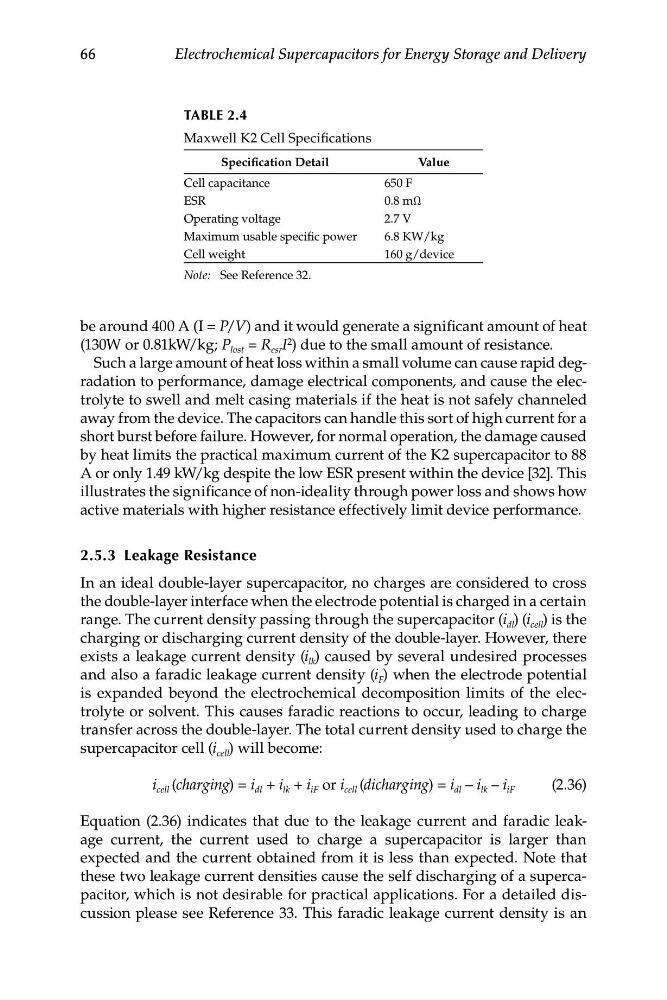
TABLE 2.4
Maxwell K2 Cell Specifications
Specification Detail
Value
Cell capacitance
ESR
650 F
0.8 mΩ
Operating voltage
Maximum usable specific power
Cell weight
2.7 V
6.8 KW/kg
160 g/device
Note: See Reference 32.
be around 400 A (I = P/V) and it would generate a significant amount of heat
(130W or 0.81kW/kg; P lost = R esr I 2 ) due to the small amount of resistance.
Such a large amount of heat loss within a small volume can cause rapid degradation to performance, damage electrical components, and cause the electrolyte to swell and melt casing materials if the heat is not safely channeled
away from the device. The capacitors can handle this sort of high current for a
short burst before failure. However, for normal operation, the damage caused
by heat limits the practical maximum current of the K2 supercapacitor to 88
A or only 1.49 kW/kg despite the low ESR present within the device [32]. This
illustrates the significance of non-ideality through power loss and shows how
active materials with higher resistance effectively limit device performance.
2.5.3 Leakage Resistance
In an ideal double-layer supercapacitor, no charges are considered to cross
the double-layer interface when the electrode potential is charged in a certain
range. The current density passing through the supercapacitor (i dl ) (i cell ) is the
charging or discharging current density of the double-layer. However, there
exists a leakage current density (i lk ) caused by several undesired processes
and also a faradic leakage current density (i F ) when the electrode potential
is expanded beyond the electrochemical decomposition limits of the electrolyte or solvent. This causes faradic reactions to occur, leading to charge
transfer across the double-layer. The total current density used to charge the
supercapacitor cell (i cell ) will become:
i cell (charging) = i dl + i lk + i iF or i cell (dicharging) = i dl – i lk – i iF
(2.36)
Equation (2.36) indicates that due to the leakage current and faradic leakage current, the current used to charge a supercapacitor is larger than
expected and the current obtained from it is less than expected. Note that
these two leakage current densities cause the self discharging of a supercapacitor, which is not desirable for practical applications. For a detailed discussion please see Reference 33. This faradic leakage current density is an
Electrochemical Supercapacitors for Energy Storage and Delivery
TABLE 2.4
Maxwell K2 Cell Specifications
Specification Detail
Value
Cell capacitance
ESR
650 F
0.8 mΩ
Operating voltage
Maximum usable specific power
Cell weight
2.7 V
6.8 KW/kg
160 g/device
Note: See Reference 32.
be around 400 A (I = P/V) and it would generate a significant amount of heat
(130W or 0.81kW/kg; P lost = R esr I 2 ) due to the small amount of resistance.
Such a large amount of heat loss within a small volume can cause rapid degradation to performance, damage electrical components, and cause the electrolyte to swell and melt casing materials if the heat is not safely channeled
away from the device. The capacitors can handle this sort of high current for a
short burst before failure. However, for normal operation, the damage caused
by heat limits the practical maximum current of the K2 supercapacitor to 88
A or only 1.49 kW/kg despite the low ESR present within the device [32]. This
illustrates the significance of non-ideality through power loss and shows how
active materials with higher resistance effectively limit device performance.
2.5.3 Leakage Resistance
In an ideal double-layer supercapacitor, no charges are considered to cross
the double-layer interface when the electrode potential is charged in a certain
range. The current density passing through the supercapacitor (i dl ) (i cell ) is the
charging or discharging current density of the double-layer. However, there
exists a leakage current density (i lk ) caused by several undesired processes
and also a faradic leakage current density (i F ) when the electrode potential
is expanded beyond the electrochemical decomposition limits of the electrolyte or solvent. This causes faradic reactions to occur, leading to charge
transfer across the double-layer. The total current density used to charge the
supercapacitor cell (i cell ) will become:
i cell (charging) = i dl + i lk + i iF or i cell (dicharging) = i dl – i lk – i iF
(2.36)
Equation (2.36) indicates that due to the leakage current and faradic leakage current, the current used to charge a supercapacitor is larger than
expected and the current obtained from it is less than expected. Note that
these two leakage current densities cause the self discharging of a supercapacitor, which is not desirable for practical applications. For a detailed discussion please see Reference 33. This faradic leakage current density is an