

Fundamentals of Electrochemical Double-Layer Supercapacitors
69
extremely long charge redistribution time is in opposition to the view based
on porous transmission line models that suggests redistribution is complete
after only 100 to 600 sec. Further work by Andreas et al. used self discharge
to verify that water electrolysis is not a dominant discharge mechanism on
either electrode [37]. Their work shows that the discharge is controlled by a
combination of activation and charge redistribution mechanisms.
2.5.4 Supercapacitor Charging and Discharging
For a detailed discussion of supercapacitor charging and discharging, see
Reference 33. When charging and discharging a supercapacitor, the two
options are: (1) charge or discharge at a constant cell voltage to record the
cell current changes over time, (2) charge or discharge at a constant current
to record cell voltage changes over time, and (3) discharge at constant power,
varying current as voltage decreases. The following discussion will use the
circuit shown in Figure 2.15 to derive the charging and discharging behaviors
of a supercapacitor. It is important to note that a mathematical treatment of the
potential dependent leakage resistance (R p ) in Figure 2.15 is difficult and complicated due to its uncertain expression of potential dependence. However, it
is important to understand that R p changes with electrode potential [33].
2.5.4.1 Charging at Constant Cell Voltage
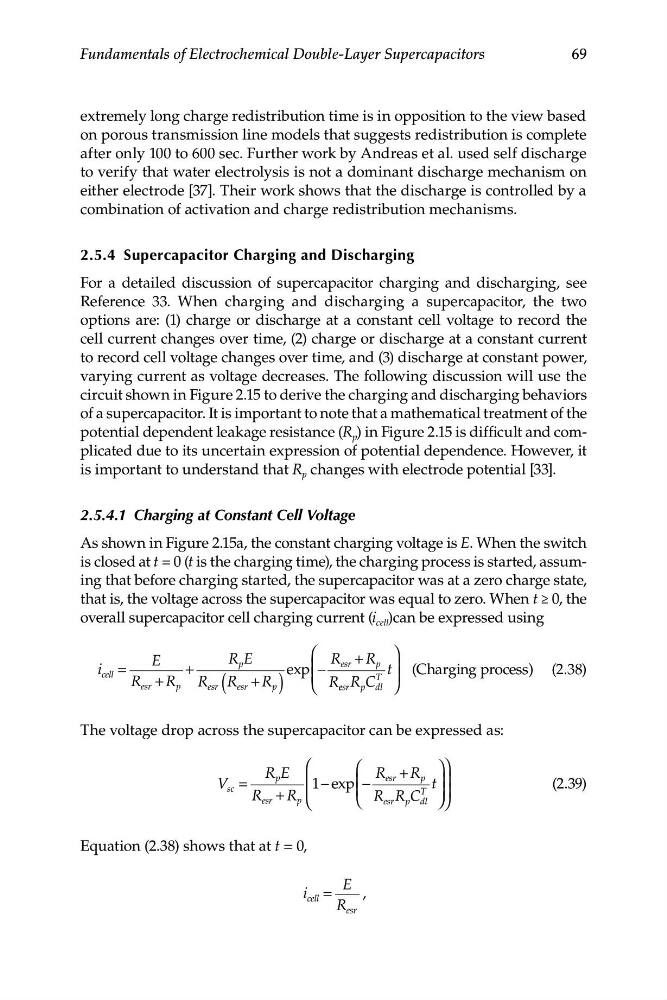
As shown in Figure 2.15a, the constant charging voltage is E. When the switch
is closed at t = 0 (t is the charging time), the charging process is started, assuming that before charging started, the supercapacitor was at a zero charge state,
that is, the voltage across the supercapacitor was equal to zero. When t ≥ 0, the
overall supercapacitor cell charging current (i cell )can be expressed using
⎛
R ⎞
E
R E
R +
i cell =
+
(
p
)
exp ⎜ −
esr
p
T
t ⎟ (Charging process) (2.38)
+
R esr R p R esr R esr +
⎜
⎟
R p
⎝ R e esr R C
p dl ⎠
The voltage drop across the supercapacitor can be expressed as:
⎛
R E
⎛
⎞ ⎞
R + R
V
p
esr
p
sc =
⎜ 1 e
− xp ⎜ −
t ⎟ ⎟
T
(2.39)
⎜
R
R
⎜
⎟
+
R R C
⎟
esr
p ⎝
⎝ esr p dl ⎠ ⎠⎠
Equation (2.38) shows that at t = 0,
E
i cell =
,
R esr
69
extremely long charge redistribution time is in opposition to the view based
on porous transmission line models that suggests redistribution is complete
after only 100 to 600 sec. Further work by Andreas et al. used self discharge
to verify that water electrolysis is not a dominant discharge mechanism on
either electrode [37]. Their work shows that the discharge is controlled by a
combination of activation and charge redistribution mechanisms.
2.5.4 Supercapacitor Charging and Discharging
For a detailed discussion of supercapacitor charging and discharging, see
Reference 33. When charging and discharging a supercapacitor, the two
options are: (1) charge or discharge at a constant cell voltage to record the
cell current changes over time, (2) charge or discharge at a constant current
to record cell voltage changes over time, and (3) discharge at constant power,
varying current as voltage decreases. The following discussion will use the
circuit shown in Figure 2.15 to derive the charging and discharging behaviors
of a supercapacitor. It is important to note that a mathematical treatment of the
potential dependent leakage resistance (R p ) in Figure 2.15 is difficult and complicated due to its uncertain expression of potential dependence. However, it
is important to understand that R p changes with electrode potential [33].
2.5.4.1 Charging at Constant Cell Voltage
As shown in Figure 2.15a, the constant charging voltage is E. When the switch
is closed at t = 0 (t is the charging time), the charging process is started, assuming that before charging started, the supercapacitor was at a zero charge state,
that is, the voltage across the supercapacitor was equal to zero. When t ≥ 0, the
overall supercapacitor cell charging current (i cell )can be expressed using
⎛
R ⎞
E
R E
R +
i cell =
+
(
p
)
exp ⎜ −
esr
p
T
t ⎟ (Charging process) (2.38)
+
R esr R p R esr R esr +
⎜
⎟
R p
⎝ R e esr R C
p dl ⎠
The voltage drop across the supercapacitor can be expressed as:
⎛
R E
⎛
⎞ ⎞
R + R
V
p
esr
p
sc =
⎜ 1 e
− xp ⎜ −
t ⎟ ⎟
T
(2.39)
⎜
R
R
⎜
⎟
+
R R C
⎟
esr
p ⎝
⎝ esr p dl ⎠ ⎠⎠
Equation (2.38) shows that at t = 0,
E
i cell =
,
R esr