

51
Fundamentals of Electrochemical Double-Layer Supercapacitors
0.00001 M
0.001 M
0.1 M
5.0 M
1.6
1.2
0.8
0.4
0
–0.4
–0.30 –0.25 –0.20 –0.15 –0.10 –0.05 0.00 0.05 0.10 0.15 0.20 0.25 0.30
–0.8
–1.2
–1.6
Potential Drop Across the Helmholtz Layer, V
Potential Drop Across the Diffuse Layer, V
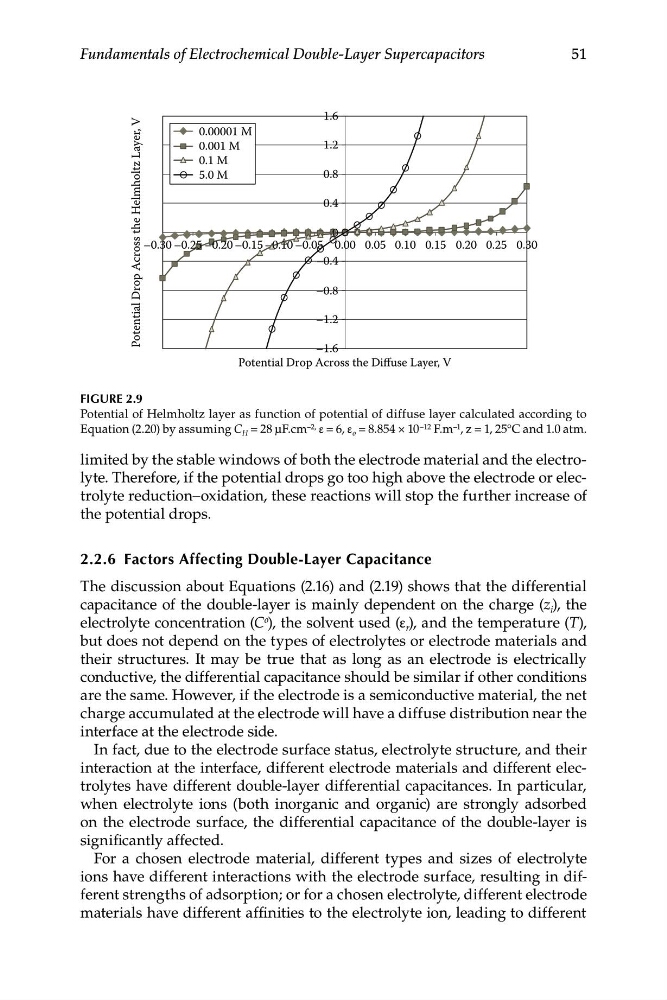
FIGURE 2.9
Potential of Helmholtz layer as function of potential of diffuse layer calculated according to
Equation (2.20) by assuming C H = 28 μF.cm –2, ε = 6, ε o = 8.854 × 10 −12 F.m –1 , z = 1, 25°C and 1.0 atm.
limited by the stable windows of both the electrode material and the electrolyte. Therefore, if the potential drops go too high above the electrode or electrolyte reduction–oxidation, these reactions will stop the further increase of
the potential drops.
2.2.6 Factors Affecting Double-Layer Capacitance
The discussion about Equations (2.16) and (2.19) shows that the differential
capacitance of the double-layer is mainly dependent on the charge (z i ), the
electrolyte concentration (C o ), the solvent used (ε r ), and the temperature (T),
but does not depend on the types of electrolytes or electrode materials and
their structures. It may be true that as long as an electrode is electrically
conductive, the differential capacitance should be similar if other conditions
are the same. However, if the electrode is a semiconductive material, the net
charge accumulated at the electrode will have a diffuse distribution near the
interface at the electrode side.
In fact, due to the electrode surface status, electrolyte structure, and their
interaction at the interface, different electrode materials and different electrolytes have different double-layer differential capacitances. In particular,
when electrolyte ions (both inorganic and organic) are strongly adsorbed
on the electrode surface, the differential capacitance of the double-layer is
significantly affected.
For a chosen electrode material, different types and sizes of electrolyte
ions have different interactions with the electrode surface, resulting in different strengths of adsorption; or for a chosen electrolyte, different electrode
materials have different affinities to the electrolyte ion, leading to different
Fundamentals of Electrochemical Double-Layer Supercapacitors
0.00001 M
0.001 M
0.1 M
5.0 M
1.6
1.2
0.8
0.4
0
–0.4
–0.30 –0.25 –0.20 –0.15 –0.10 –0.05 0.00 0.05 0.10 0.15 0.20 0.25 0.30
–0.8
–1.2
–1.6
Potential Drop Across the Helmholtz Layer, V
Potential Drop Across the Diffuse Layer, V
FIGURE 2.9
Potential of Helmholtz layer as function of potential of diffuse layer calculated according to
Equation (2.20) by assuming C H = 28 μF.cm –2, ε = 6, ε o = 8.854 × 10 −12 F.m –1 , z = 1, 25°C and 1.0 atm.
limited by the stable windows of both the electrode material and the electrolyte. Therefore, if the potential drops go too high above the electrode or electrolyte reduction–oxidation, these reactions will stop the further increase of
the potential drops.
2.2.6 Factors Affecting Double-Layer Capacitance
The discussion about Equations (2.16) and (2.19) shows that the differential
capacitance of the double-layer is mainly dependent on the charge (z i ), the
electrolyte concentration (C o ), the solvent used (ε r ), and the temperature (T),
but does not depend on the types of electrolytes or electrode materials and
their structures. It may be true that as long as an electrode is electrically
conductive, the differential capacitance should be similar if other conditions
are the same. However, if the electrode is a semiconductive material, the net
charge accumulated at the electrode will have a diffuse distribution near the
interface at the electrode side.
In fact, due to the electrode surface status, electrolyte structure, and their
interaction at the interface, different electrode materials and different electrolytes have different double-layer differential capacitances. In particular,
when electrolyte ions (both inorganic and organic) are strongly adsorbed
on the electrode surface, the differential capacitance of the double-layer is
significantly affected.
For a chosen electrode material, different types and sizes of electrolyte
ions have different interactions with the electrode surface, resulting in different strengths of adsorption; or for a chosen electrolyte, different electrode
materials have different affinities to the electrolyte ion, leading to different