

50
Electrochemical Supercapacitors for Energy Storage and Delivery
approaching that of the Helmholtz layer. Therefore, if a very dilute electrolyte solution is used, the capacitance obtained should represent that of the
diffuse layer; if a highly concentrated electrolyte solution is used, the capacitance obtained should represent that of the Helmholtz layer, except for values near the potential of the point of zero charge.
In addition, Equation (2.19) demonstrates that the dielectric constant has
the same weight as that of the electrolyte concentration, meaning that the
differential capacitance of the diffuse layer is also proportional to the square
root of the dielectric constant. Therefore, using different electrolyte solutions
such as aqueous, non-aqueous, and ion liquid solutions can produce different capacitances of the double-layer.
2.2.5 Potential Drop Distribution within Electric Double-Layer
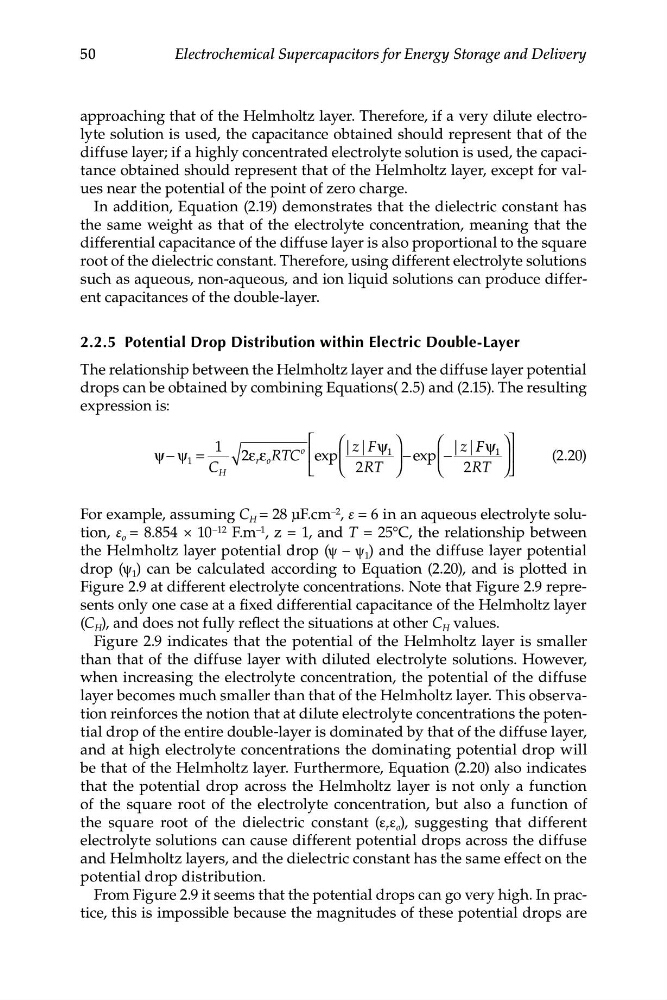
The relationship between the Helmholtz layer and the diffuse layer potential
drops can be obtained by combining Equations( 2.5) and (2.15). The resulting
expression is:
1
⎡
z F
ψ ψ
o
⎛ | | ψ ⎞
⎛
⎞ ⎤
− =
2ε ε RTC ⎢exp⎜
1
| |
z F F ψ
1
⎟ − ex
1
r o
p ⎜ −
⎟⎥
(2.20)
C H
⎣
⎝ 2RT ⎠
⎝ 2RT ⎠⎦
For example, assuming C H = 28 μF.cm –2 , ε = 6 in an aqueous electrolyte solution, ε o = 8.854 × 10 −12 F.m –1 , z = 1, and T = 25°C, the relationship between
the Helmholtz layer potential drop (ψ – ψ 1 ) and the diffuse layer potential
drop (ψ 1 ) can be calculated according to Equation (2.20), and is plotted in
Figure 2.9 at different electrolyte concentrations. Note that Figure 2.9 represents only one case at a fixed differential capacitance of the Helmholtz layer
(C H ), and does not fully reflect the situations at other C H values.
Figure 2.9 indicates that the potential of the Helmholtz layer is smaller
than that of the diffuse layer with diluted electrolyte solutions. However,
when increasing the electrolyte concentration, the potential of the diffuse
layer becomes much smaller than that of the Helmholtz layer. This observation reinforces the notion that at dilute electrolyte concentrations the potential drop of the entire double-layer is dominated by that of the diffuse layer,
and at high electrolyte concentrations the dominating potential drop will
be that of the Helmholtz layer. Furthermore, Equation (2.20) also indicates
that the potential drop across the Helmholtz layer is not only a function
of the square root of the electrolyte concentration, but also a function of
the square root of the dielectric constant (ε r ε o ), suggesting that different
electrolyte solutions can cause different potential drops across the diffuse
and Helmholtz layers, and the dielectric constant has the same effect on the
potential drop distribution.
From Figure 2.9 it seems that the potential drops can go very high. In practice, this is impossible because the magnitudes of these potential drops are
Electrochemical Supercapacitors for Energy Storage and Delivery
approaching that of the Helmholtz layer. Therefore, if a very dilute electrolyte solution is used, the capacitance obtained should represent that of the
diffuse layer; if a highly concentrated electrolyte solution is used, the capacitance obtained should represent that of the Helmholtz layer, except for values near the potential of the point of zero charge.
In addition, Equation (2.19) demonstrates that the dielectric constant has
the same weight as that of the electrolyte concentration, meaning that the
differential capacitance of the diffuse layer is also proportional to the square
root of the dielectric constant. Therefore, using different electrolyte solutions
such as aqueous, non-aqueous, and ion liquid solutions can produce different capacitances of the double-layer.
2.2.5 Potential Drop Distribution within Electric Double-Layer
The relationship between the Helmholtz layer and the diffuse layer potential
drops can be obtained by combining Equations( 2.5) and (2.15). The resulting
expression is:
1
⎡
z F
ψ ψ
o
⎛ | | ψ ⎞
⎛
⎞ ⎤
− =
2ε ε RTC ⎢exp⎜
1
| |
z F F ψ
1
⎟ − ex
1
r o
p ⎜ −
⎟⎥
(2.20)
C H
⎣
⎝ 2RT ⎠
⎝ 2RT ⎠⎦
For example, assuming C H = 28 μF.cm –2 , ε = 6 in an aqueous electrolyte solution, ε o = 8.854 × 10 −12 F.m –1 , z = 1, and T = 25°C, the relationship between
the Helmholtz layer potential drop (ψ – ψ 1 ) and the diffuse layer potential
drop (ψ 1 ) can be calculated according to Equation (2.20), and is plotted in
Figure 2.9 at different electrolyte concentrations. Note that Figure 2.9 represents only one case at a fixed differential capacitance of the Helmholtz layer
(C H ), and does not fully reflect the situations at other C H values.
Figure 2.9 indicates that the potential of the Helmholtz layer is smaller
than that of the diffuse layer with diluted electrolyte solutions. However,
when increasing the electrolyte concentration, the potential of the diffuse
layer becomes much smaller than that of the Helmholtz layer. This observation reinforces the notion that at dilute electrolyte concentrations the potential drop of the entire double-layer is dominated by that of the diffuse layer,
and at high electrolyte concentrations the dominating potential drop will
be that of the Helmholtz layer. Furthermore, Equation (2.20) also indicates
that the potential drop across the Helmholtz layer is not only a function
of the square root of the electrolyte concentration, but also a function of
the square root of the dielectric constant (ε r ε o ), suggesting that different
electrolyte solutions can cause different potential drops across the diffuse
and Helmholtz layers, and the dielectric constant has the same effect on the
potential drop distribution.
From Figure 2.9 it seems that the potential drops can go very high. In practice, this is impossible because the magnitudes of these potential drops are