

Aqueous Electrolyte Organic Electrolyte
Specific
Surface Area
Density
Materials
(m 2 .g –1 )
(g.cm –3 )
F . g –1
F.cm –3
F.g –1
F.cm –3
Carbon Materials
Commercial
1000 to 3500
0.4 to 0.7
< 200
< 80
< 100
< 50
activated
carbons (ACs)
Particulate
1000 to 2000
0.5 to 0.7
170 to 220 < 120
100 to 120 < 70
carbon from
SiC/TiC
Functionalized
300 to 2200
0.5 to 0.9
150 to 300 < 180
100 to 150 < 90
porous carbons
Carbon nanotube 120 to 500
0.6
50 to 100
< 60
< 60
< 30
(CNT)
Templated
500 to 3000
0.5 to 1
120 to 350 < 200
60 to 140
< 100
porous carbons
(TC)
Activated carbon 1000 to 3000
0.3 to 0.8
120 to 370 < 150
80 to 200
< 120
fibers (ACF)
Carbon cloths
2500
0.4
100 to 200 40 to 80 60 to 100
24 to 40
Carbon aerogels
400 to 1000
0.5 to 0.7
100 to 125 < 80
< 80
40
Carbon-Based Composites
TC-RuO 2
600
1
630
630
—
—
CNT-MnO 2
234
1.5
199
300
—
—
AC-polyaniline
1000
—
300
—
—
—
52
Electrochemical Supercapacitors for Energy Storage and Delivery
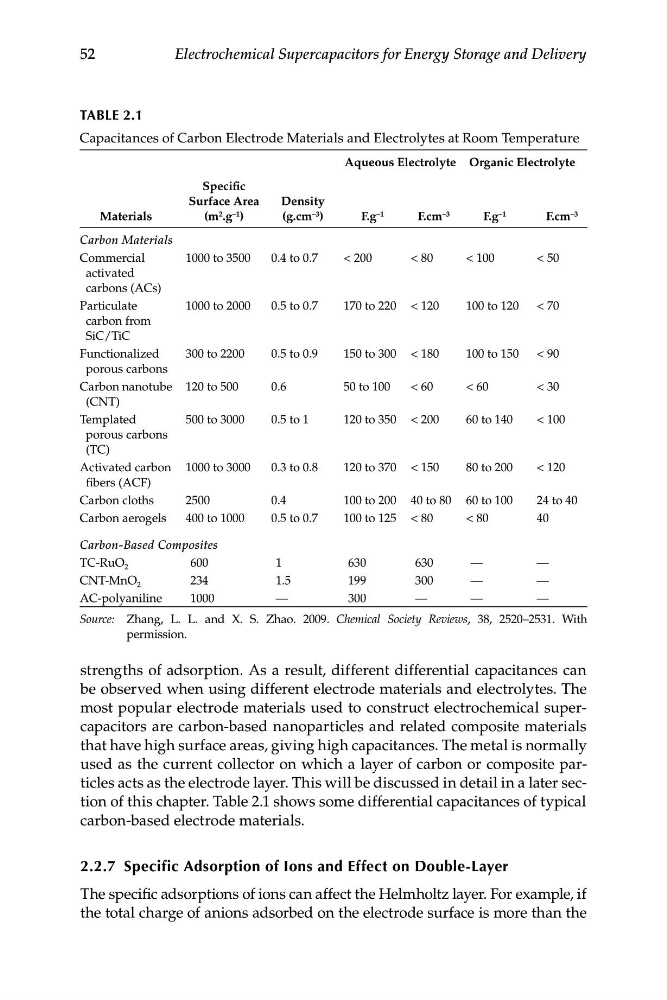
TABLE 2.1
Capacitances of Carbon Electrode Materials and Electrolytes at Room Temperature
Source: Zhang, L. L. and X. S. Zhao. 2009. Chemical Society Reviews, 38, 2520–2531. With
permission.
strengths of adsorption. As a result, different differential capacitances can
be observed when using different electrode materials and electrolytes. The
most popular electrode materials used to construct electrochemical supercapacitors are carbon-based nanoparticles and related composite materials
that have high surface areas, giving high capacitances. The metal is normally
used as the current collector on which a layer of carbon or composite particles acts as the electrode layer. This will be discussed in detail in a later section of this chapter. Table 2.1 shows some differential capacitances of typical
carbon-based electrode materials.
2.2.7 Specific Adsorption of Ions and Effect on Double-Layer
The specific adsorptions of ions can affect the Helmholtz layer. For example, if
the total charge of anions adsorbed on the electrode surface is more than the
Specific
Surface Area
Density
Materials
(m 2 .g –1 )
(g.cm –3 )
F . g –1
F.cm –3
F.g –1
F.cm –3
Carbon Materials
Commercial
1000 to 3500
0.4 to 0.7
< 200
< 80
< 100
< 50
activated
carbons (ACs)
Particulate
1000 to 2000
0.5 to 0.7
170 to 220 < 120
100 to 120 < 70
carbon from
SiC/TiC
Functionalized
300 to 2200
0.5 to 0.9
150 to 300 < 180
100 to 150 < 90
porous carbons
Carbon nanotube 120 to 500
0.6
50 to 100
< 60
< 60
< 30
(CNT)
Templated
500 to 3000
0.5 to 1
120 to 350 < 200
60 to 140
< 100
porous carbons
(TC)
Activated carbon 1000 to 3000
0.3 to 0.8
120 to 370 < 150
80 to 200
< 120
fibers (ACF)
Carbon cloths
2500
0.4
100 to 200 40 to 80 60 to 100
24 to 40
Carbon aerogels
400 to 1000
0.5 to 0.7
100 to 125 < 80
< 80
40
Carbon-Based Composites
TC-RuO 2
600
1
630
630
—
—
CNT-MnO 2
234
1.5
199
300
—
—
AC-polyaniline
1000
—
300
—
—
—
52
Electrochemical Supercapacitors for Energy Storage and Delivery
TABLE 2.1
Capacitances of Carbon Electrode Materials and Electrolytes at Room Temperature
Source: Zhang, L. L. and X. S. Zhao. 2009. Chemical Society Reviews, 38, 2520–2531. With
permission.
strengths of adsorption. As a result, different differential capacitances can
be observed when using different electrode materials and electrolytes. The
most popular electrode materials used to construct electrochemical supercapacitors are carbon-based nanoparticles and related composite materials
that have high surface areas, giving high capacitances. The metal is normally
used as the current collector on which a layer of carbon or composite particles acts as the electrode layer. This will be discussed in detail in a later section of this chapter. Table 2.1 shows some differential capacitances of typical
carbon-based electrode materials.
2.2.7 Specific Adsorption of Ions and Effect on Double-Layer
The specific adsorptions of ions can affect the Helmholtz layer. For example, if
the total charge of anions adsorbed on the electrode surface is more than the