

48
Electrochemical Supercapacitors for Energy Storage and Delivery
z F
C d iff ≈
i
2ε ε RTC
o
r o
(2.17)
RT
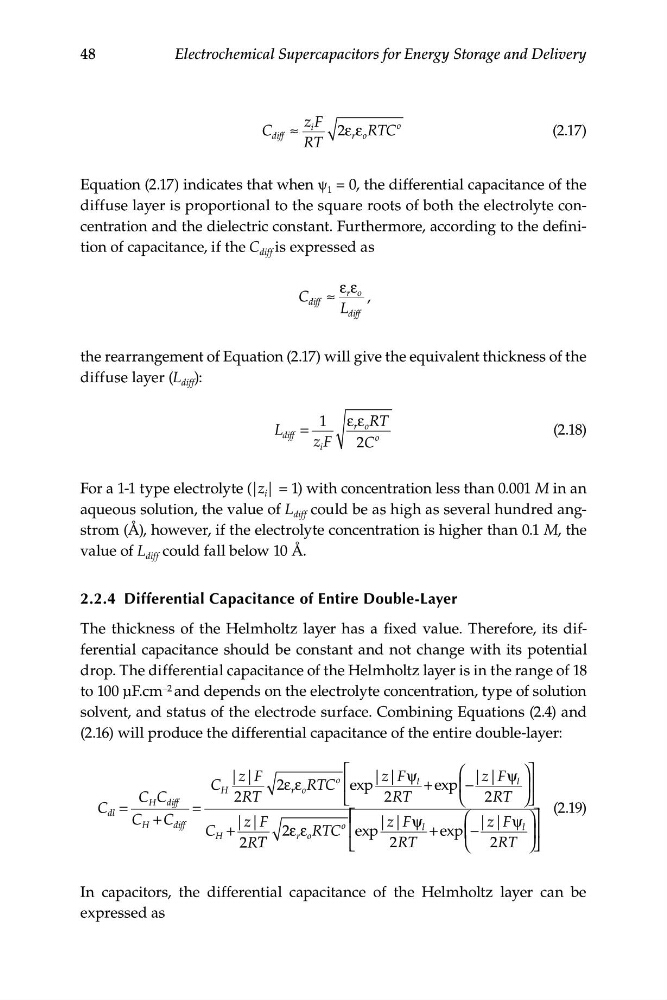
Equation (2.17) indicates that when ψ 1 = 0, the differential capacitance of the
diffuse layer is proportional to the square roots of both the electrolyte concentration and the dielectric constant. Furthermore, according to the definition of capacitance, if the C diff is expressed as
ε ε
C ≈
r o
diff
,
L diff
the rearrangement of Equation (2.17) will give the equivalent thickness of the
diffuse layer (L diff ):
1 ε ε RT
L diff =
r o
o
(2.18)
z F
i
2C
For a 1-1 type electrolyte (|z i | = 1) with concentration less than 0.001 M in an
aqueous solution, the value of L diff could be as high as several hundred angstrom (Å), however, if the electrolyte concentration is higher than 0.1 M, the
value of L diff could fall below 10 Å.
2.2.4 Differential Capacitance of Entire Double-Layer
The thickness of the Helmholtz layer has a fixed value. Therefore, its differential capacitance should be constant and not change with its potential
drop. The differential capacitance of the Helmholtz layer is in the range of 18
to 100 μF.cm –2 and depends on the electrolyte concentration, type of solution
solvent, and status of the electrode surface. Combining Equations (2.4) and
(2.16) will produce the differential capacitance of the entire double-layer:
| |
z F
⎡
|z| |F ψ
⎤
C
2ε ε RTC
o ⎢exp
l
⎛ | |
z F ψ ⎞
+ exp ⎜ −
l
H
r o
⎟⎥
C C
H diff
2RT
⎣
2RT
⎝ 2RT ⎠⎦
C dl =
=
(2.19)
C H + C diff
| |
z F
o
⎡ ⎡
| |
z F ψ
⎛
⎞⎤
C +
2ε ε RTC ⎢ex p
l
| |
z F ψ
+ exp −
l
H
r o
⎜
⎟⎥
2RT T
⎣
2RT
⎝ 2RT ⎠⎦
In capacitors, the differential capacitance of the Helmholtz layer can be
expressed as
Electrochemical Supercapacitors for Energy Storage and Delivery
z F
C d iff ≈
i
2ε ε RTC
o
r o
(2.17)
RT
Equation (2.17) indicates that when ψ 1 = 0, the differential capacitance of the
diffuse layer is proportional to the square roots of both the electrolyte concentration and the dielectric constant. Furthermore, according to the definition of capacitance, if the C diff is expressed as
ε ε
C ≈
r o
diff
,
L diff
the rearrangement of Equation (2.17) will give the equivalent thickness of the
diffuse layer (L diff ):
1 ε ε RT
L diff =
r o
o
(2.18)
z F
i
2C
For a 1-1 type electrolyte (|z i | = 1) with concentration less than 0.001 M in an
aqueous solution, the value of L diff could be as high as several hundred angstrom (Å), however, if the electrolyte concentration is higher than 0.1 M, the
value of L diff could fall below 10 Å.
2.2.4 Differential Capacitance of Entire Double-Layer
The thickness of the Helmholtz layer has a fixed value. Therefore, its differential capacitance should be constant and not change with its potential
drop. The differential capacitance of the Helmholtz layer is in the range of 18
to 100 μF.cm –2 and depends on the electrolyte concentration, type of solution
solvent, and status of the electrode surface. Combining Equations (2.4) and
(2.16) will produce the differential capacitance of the entire double-layer:
| |
z F
⎡
|z| |F ψ
⎤
C
2ε ε RTC
o ⎢exp
l
⎛ | |
z F ψ ⎞
+ exp ⎜ −
l
H
r o
⎟⎥
C C
H diff
2RT
⎣
2RT
⎝ 2RT ⎠⎦
C dl =
=
(2.19)
C H + C diff
| |
z F
o
⎡ ⎡
| |
z F ψ
⎛
⎞⎤
C +
2ε ε RTC ⎢ex p
l
| |
z F ψ
+ exp −
l
H
r o
⎜
⎟⎥
2RT T
⎣
2RT
⎝ 2RT ⎠⎦
In capacitors, the differential capacitance of the Helmholtz layer can be
expressed as