

300
2
250
Differential Capacitance, F/cm
200
0.00001 M
0.0001 M
0.001 M
150
0.01 M
0.1 M
100
1.0 M
50
0
–0.35
–0.25
–0.15
–0.05
0.05
0.15
0.25
0.35
Potential Drop Across the Diffuse Layer, V
47
Fundamentals of Electrochemical Double-Layer Supercapacitors
2.2.3 Theoretical Differential Capacitance of Electric Double-Layer
To determine differential capacitance of the diffuse layer, Equation (2.15) can
be differentiated with respect to the potential drop, leading to:
dq
z F
⎡
o
⎛
i
z F
i ψ 1 ⎞
⎛ z F ⎞ ⎤
C =
=
2ε ε RTC ⎢exp⎜
⎟ + exp ⎜ −
i ψ 1
diff
⎟⎥
(2.16)
dψ
r o
H S
−
2RT
⎣
⎝ RT ⎠ ⎠
⎝ RT ⎠⎦
Equation (2.16) shows the differential capacitance of the diffuse layer as a
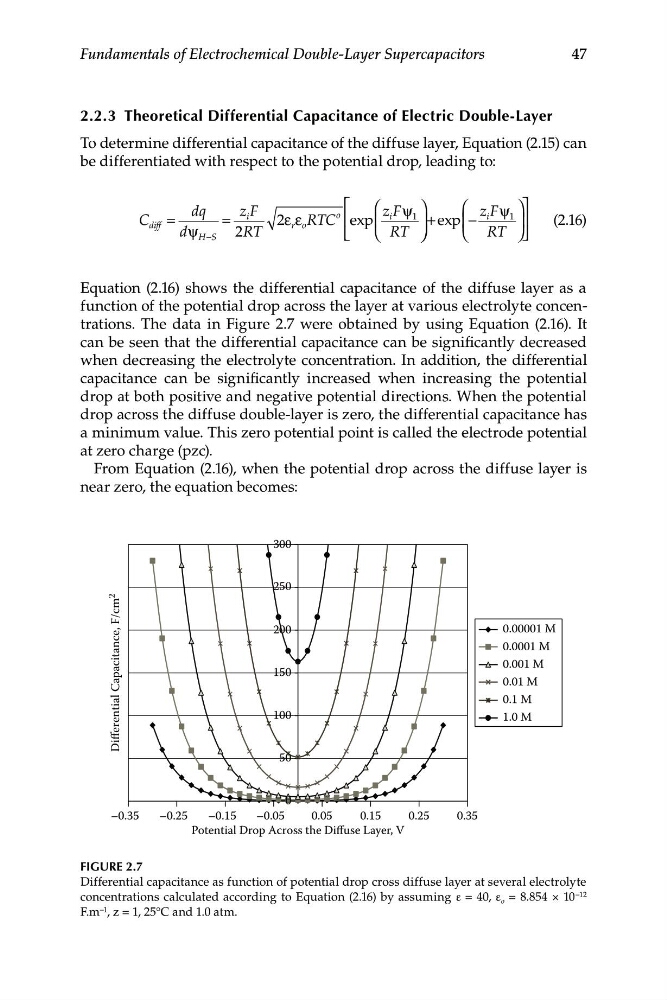
function of the potential drop across the layer at various electrolyte concentrations. The data in Figure 2.7 were obtained by using Equation (2.16). It
can be seen that the differential capacitance can be significantly decreased
when decreasing the electrolyte concentration. In addition, the differential
capacitance can be significantly increased when increasing the potential
drop at both positive and negative potential directions. When the potential
drop across the diffuse double-layer is zero, the differential capacitance has
a minimum value. This zero potential point is called the electrode potential
at zero charge (pzc).
From Equation (2.16), when the potential drop across the diffuse layer is
near zero, the equation becomes:
FIGURE 2.7
Differential capacitance as function of potential drop cross diffuse layer at several electrolyte
concentrations calculated according to Equation (2.16) by assuming ε = 40, ε o = 8.854 × 10 −12
F.m –1 , z = 1, 25°C and 1.0 atm.
2
250
Differential Capacitance, F/cm
200
0.00001 M
0.0001 M
0.001 M
150
0.01 M
0.1 M
100
1.0 M
50
0
–0.35
–0.25
–0.15
–0.05
0.05
0.15
0.25
0.35
Potential Drop Across the Diffuse Layer, V
47
Fundamentals of Electrochemical Double-Layer Supercapacitors
2.2.3 Theoretical Differential Capacitance of Electric Double-Layer
To determine differential capacitance of the diffuse layer, Equation (2.15) can
be differentiated with respect to the potential drop, leading to:
dq
z F
⎡
o
⎛
i
z F
i ψ 1 ⎞
⎛ z F ⎞ ⎤
C =
=
2ε ε RTC ⎢exp⎜
⎟ + exp ⎜ −
i ψ 1
diff
⎟⎥
(2.16)
dψ
r o
H S
−
2RT
⎣
⎝ RT ⎠ ⎠
⎝ RT ⎠⎦
Equation (2.16) shows the differential capacitance of the diffuse layer as a
function of the potential drop across the layer at various electrolyte concentrations. The data in Figure 2.7 were obtained by using Equation (2.16). It
can be seen that the differential capacitance can be significantly decreased
when decreasing the electrolyte concentration. In addition, the differential
capacitance can be significantly increased when increasing the potential
drop at both positive and negative potential directions. When the potential
drop across the diffuse double-layer is zero, the differential capacitance has
a minimum value. This zero potential point is called the electrode potential
at zero charge (pzc).
From Equation (2.16), when the potential drop across the diffuse layer is
near zero, the equation becomes:
FIGURE 2.7
Differential capacitance as function of potential drop cross diffuse layer at several electrolyte
concentrations calculated according to Equation (2.16) by assuming ε = 40, ε o = 8.854 × 10 −12
F.m –1 , z = 1, 25°C and 1.0 atm.