

19
Fundamentals of Electric Capacitors
power source is the fully charged capacitor [3]. The sum of the potentials in
this discharge loop is
q dq
+ R = 0
C dt
(1.28)
The solution to this first-order differential in terms of charge q is
q = q t/RC
0 e –
(1.29)
where the initial charge q 0 of the capacitor is equal to V 0 C. Additionally,
a function describing the discharge current is derived by differentiating
Equation (1.29) with respect to t
q
I = −
0 e
−t R
/ C
RC
(1.30)
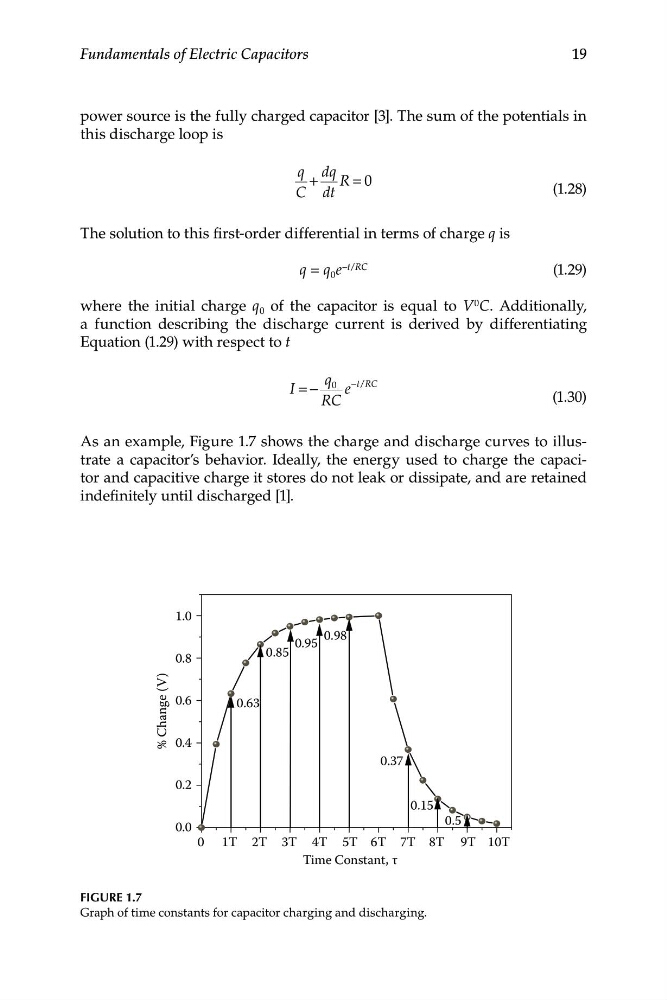
As an example, Figure 1.7 shows the charge and discharge curves to illustrate a capacitor’s behavior. Ideally, the energy used to charge the capacitor and capacitive charge it stores do not leak or dissipate, and are retained
indefinitely until discharged [1].
1.0
0.98
0.95
0.85
0.8
)
V
% Change (
0.6
0.63
0.4
0.37
0.2
0.15
0.5
0.0
0 1T 2T 3T 4T 5T 6T 7T 8T 9T 10T
Time Constant, τ
FIGURE 1.7
Graph of time constants for capacitor charging and discharging.
Fundamentals of Electric Capacitors
power source is the fully charged capacitor [3]. The sum of the potentials in
this discharge loop is
q dq
+ R = 0
C dt
(1.28)
The solution to this first-order differential in terms of charge q is
q = q t/RC
0 e –
(1.29)
where the initial charge q 0 of the capacitor is equal to V 0 C. Additionally,
a function describing the discharge current is derived by differentiating
Equation (1.29) with respect to t
q
I = −
0 e
−t R
/ C
RC
(1.30)
As an example, Figure 1.7 shows the charge and discharge curves to illustrate a capacitor’s behavior. Ideally, the energy used to charge the capacitor and capacitive charge it stores do not leak or dissipate, and are retained
indefinitely until discharged [1].
1.0
0.98
0.95
0.85
0.8
)
V
% Change (
0.6
0.63
0.4
0.37
0.2
0.15
0.5
0.0
0 1T 2T 3T 4T 5T 6T 7T 8T 9T 10T
Time Constant, τ
FIGURE 1.7
Graph of time constants for capacitor charging and discharging.