

20
Electrochemical Supercapacitors for Energy Storage and Delivery
1.5 Energy Storage in Capacitor
For an electrostatic charge to develop along the plates of a capacitor, work
must be done by an external driving force. At the beginning of the charging,
the net charge between the plates of the capacitor is zero. When a potential
is applied, the charge will accumulate on the conducting plates. However,
as an electric field develops between the plates it becomes more difficult to
accumulate like charges and subsequently the process requires more work.
This work, done by an external power source such as a battery, transfers
energy into electric potential energy E and is stored in an electrical field
within the dielectric material. Recovery of this stored energy is achieved
by discharging the capacitor into a circuit. To calculate the work done by
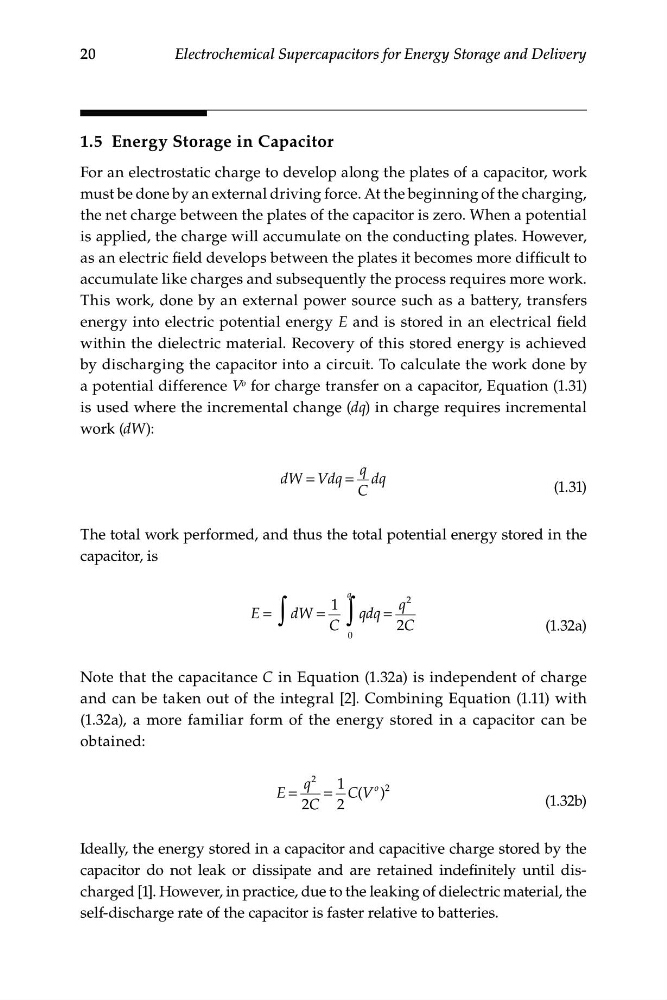
a potential difference V o for charge transfer on a capacitor, Equation (1.31)
is used where the incremental change (dq) in charge requires incremental
work (dW):
q
dW = Vdq = dq
C
(1.31)
The total work performed, and thus the total potential energy stored in the
capacitor, is
∫
∫
q
1
q
2
E = dW=
qdq =
C
2C
(1.32a)
0
Note that the capacitance C in Equation (1.32a) is independent of charge
and can be taken out of the integral [2]. Combining Equation (1.11) with
(1.32a), a more familiar form of the energy stored in a capacitor can be
obtained:
q
2
1
E =
= C V
( )
o 2
2C 2
(1.32b)
Ideally, the energy stored in a capacitor and capacitive charge stored by the
capacitor do not leak or dissipate and are retained indefinitely until discharged [1]. However, in practice, due to the leaking of dielectric material, the
self-discharge rate of the capacitor is faster relative to batteries.
Electrochemical Supercapacitors for Energy Storage and Delivery
1.5 Energy Storage in Capacitor
For an electrostatic charge to develop along the plates of a capacitor, work
must be done by an external driving force. At the beginning of the charging,
the net charge between the plates of the capacitor is zero. When a potential
is applied, the charge will accumulate on the conducting plates. However,
as an electric field develops between the plates it becomes more difficult to
accumulate like charges and subsequently the process requires more work.
This work, done by an external power source such as a battery, transfers
energy into electric potential energy E and is stored in an electrical field
within the dielectric material. Recovery of this stored energy is achieved
by discharging the capacitor into a circuit. To calculate the work done by
a potential difference V o for charge transfer on a capacitor, Equation (1.31)
is used where the incremental change (dq) in charge requires incremental
work (dW):
q
dW = Vdq = dq
C
(1.31)
The total work performed, and thus the total potential energy stored in the
capacitor, is
∫
∫
q
1
q
2
E = dW=
qdq =
C
2C
(1.32a)
0
Note that the capacitance C in Equation (1.32a) is independent of charge
and can be taken out of the integral [2]. Combining Equation (1.11) with
(1.32a), a more familiar form of the energy stored in a capacitor can be
obtained:
q
2
1
E =
= C V
( )
o 2
2C 2
(1.32b)
Ideally, the energy stored in a capacitor and capacitive charge stored by the
capacitor do not leak or dissipate and are retained indefinitely until discharged [1]. However, in practice, due to the leaking of dielectric material, the
self-discharge rate of the capacitor is faster relative to batteries.