

17
Fundamentals of Electric Capacitors
S
L
I
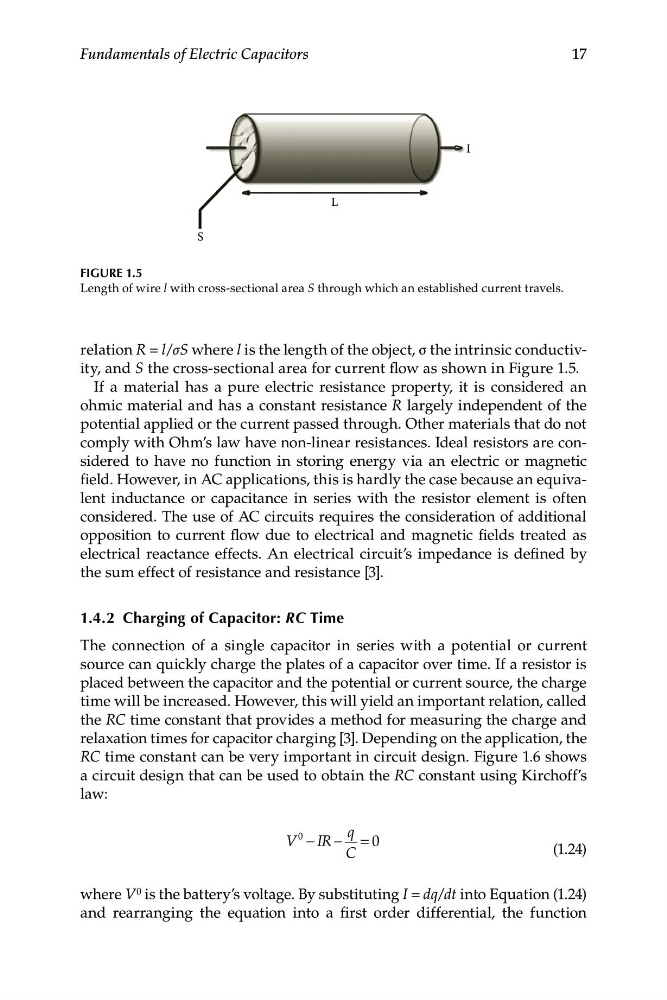
FIGURE 1.5
Length of wire l with cross-sectional area S through which an established current travels.
relation R = l/σS where l is the length of the object, σ the intrinsic conductivity, and S the cross-sectional area for current flow as shown in Figure 1.5.
If a material has a pure electric resistance property, it is considered an
ohmic material and has a constant resistance R largely independent of the
potential applied or the current passed through. Other materials that do not
comply with Ohm’s law have non-linear resistances. Ideal resistors are considered to have no function in storing energy via an electric or magnetic
field. However, in AC applications, this is hardly the case because an equivalent inductance or capacitance in series with the resistor element is often
considered. The use of AC circuits requires the consideration of additional
opposition to current flow due to electrical and magnetic fields treated as
electrical reactance effects. An electrical circuit’s impedance is defined by
the sum effect of resistance and resistance [3].
1.4.2 Charging of Capacitor: RC Time
The connection of a single capacitor in series with a potential or current
source can quickly charge the plates of a capacitor over time. If a resistor is
placed between the capacitor and the potential or current source, the charge
time will be increased. However, this will yield an important relation, called
the RC time constant that provides a method for measuring the charge and
relaxation times for capacitor charging [3]. Depending on the application, the
RC time constant can be very important in circuit design. Figure 1.6 shows
a circuit design that can be used to obtain the RC constant using Kirchoff’s
law:
0
q
V − IR − = 0
C
(1.24)
where V 0 is the battery’s voltage. By substituting I = dq/dt into Equation (1.24)
and rearranging the equation into a first order differential, the function