

�
�
� �
�
16
Electrochemical Supercapacitors for Energy Storage and Delivery
necessary. The two types are (1) direct current (DC) and (2) alternating
current (AC).
Direct current (DC) in an electric circuit describes a unidirectional flow of
electrons traveling continuously from a low to high potential area. The relationship between the direct current I and the difference between high and
low potentials V are described as follows. If there are two points designated
1 and 2 along a circuit wire loop, the potential of Point 1 is V 1 and that of
Point 2 is V 2 (i.e., the potential difference or voltage difference between these
two points is V = |V 2 – V 1 |); when a current (I) flows from Point 1 to Point 2,
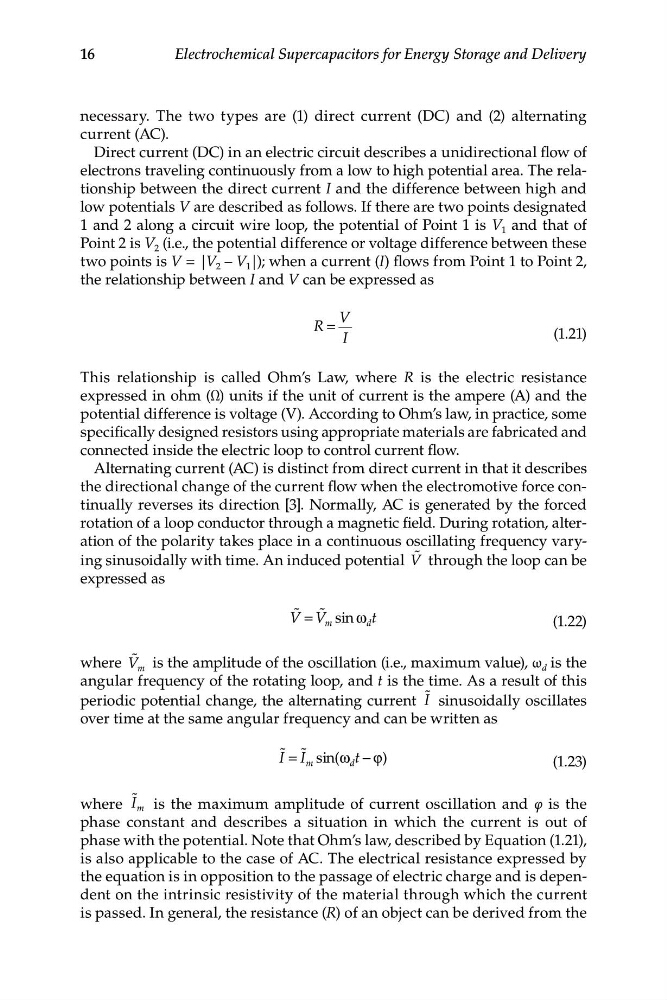
the relationship between I and V can be expressed as
V
R =
(1.21)
I
This relationship is called Ohm’s Law, where R is the electric resistance
expressed in ohm (Ω) units if the unit of current is the ampere (A) and the
potential difference is voltage (V). According to Ohm’s law, in practice, some
specifically designed resistors using appropriate materials are fabricated and
connected inside the electric loop to control current flow.
Alternating current (AC) is distinct from direct current in that it describes
the directional change of the current flow when the electromotive force continually reverses its direction [3]. Normally, AC is generated by the forced
rotation of a loop conductor through a magnetic field. During rotation, alteration of the polarity takes place in a continuous oscillating frequency varying sinusoidally with time. An induced potential V through the loop can be
expressed as
� �
V V sin ω t
= m
d
(1.22)
where V m is the amplitude of the oscillation (i.e., maximum value), ω d is the
angular frequency of the rotating loop, and t is the time. As a result of this
periodic potential change, the alternating current I � sinusoidally oscillates
over time at the same angular frequency and can be written as
I I
= m sin( ω d t − ϕ)
(1.23)
where I m is the maximum amplitude of current oscillation and φ is the
phase constant and describes a situation in which the current is out of
phase with the potential. Note that Ohm’s law, described by Equation (1.21),
is also applicable to the case of AC. The electrical resistance expressed by
the equation is in opposition to the passage of electric charge and is dependent on the intrinsic resistivity of the material through which the current
is passed. In general, the resistance (R) of an object can be derived from the
�
� �
�
16
Electrochemical Supercapacitors for Energy Storage and Delivery
necessary. The two types are (1) direct current (DC) and (2) alternating
current (AC).
Direct current (DC) in an electric circuit describes a unidirectional flow of
electrons traveling continuously from a low to high potential area. The relationship between the direct current I and the difference between high and
low potentials V are described as follows. If there are two points designated
1 and 2 along a circuit wire loop, the potential of Point 1 is V 1 and that of
Point 2 is V 2 (i.e., the potential difference or voltage difference between these
two points is V = |V 2 – V 1 |); when a current (I) flows from Point 1 to Point 2,
the relationship between I and V can be expressed as
V
R =
(1.21)
I
This relationship is called Ohm’s Law, where R is the electric resistance
expressed in ohm (Ω) units if the unit of current is the ampere (A) and the
potential difference is voltage (V). According to Ohm’s law, in practice, some
specifically designed resistors using appropriate materials are fabricated and
connected inside the electric loop to control current flow.
Alternating current (AC) is distinct from direct current in that it describes
the directional change of the current flow when the electromotive force continually reverses its direction [3]. Normally, AC is generated by the forced
rotation of a loop conductor through a magnetic field. During rotation, alteration of the polarity takes place in a continuous oscillating frequency varying sinusoidally with time. An induced potential V through the loop can be
expressed as
� �
V V sin ω t
= m
d
(1.22)
where V m is the amplitude of the oscillation (i.e., maximum value), ω d is the
angular frequency of the rotating loop, and t is the time. As a result of this
periodic potential change, the alternating current I � sinusoidally oscillates
over time at the same angular frequency and can be written as
I I
= m sin( ω d t − ϕ)
(1.23)
where I m is the maximum amplitude of current oscillation and φ is the
phase constant and describes a situation in which the current is out of
phase with the potential. Note that Ohm’s law, described by Equation (1.21),
is also applicable to the case of AC. The electrical resistance expressed by
the equation is in opposition to the passage of electric charge and is dependent on the intrinsic resistivity of the material through which the current
is passed. In general, the resistance (R) of an object can be derived from the