

331
Applications of Electrochemical Supercapacitors
8.11 Military and Aerospace Applications
With the development of ES technology, the military market segment has
demonstrated increasing needs for ES devices to address a variety of power
challenges based on the unique characteristics of ESs. They provide quick
power delivery, superior low temperature operation, and the ability to handle up to a million cycles.
In military applications, the most frequent ES use is providing backup
power for electronics in military vehicles, fire control systems in tanks
and armored vehicles, airbag deployments and black boxes on helicopters,
and backup power and memory devices for handheld emergency radios.
ES-based modules are also appropriate in peak power applications to facilitate reliable communication transmission on land-based vehicles, active suspension for vehicle stabilization, GPS guided missiles and projectile systems,
cold engine starts, and bus voltage hold-up during peak currents.
In marine applications, ES-based modules are used for high power discharge of unmanned boats in naval warfare, all-electric launches on aircraft
carriers, power sources for magnetic drivers that power munitions elevators on aircraft carriers, and bridging power when switching from ground
to onboard aircraft subsystems for data retention. ES components are also
commonly employed in pulsed laser radar systems and unmanned aerial
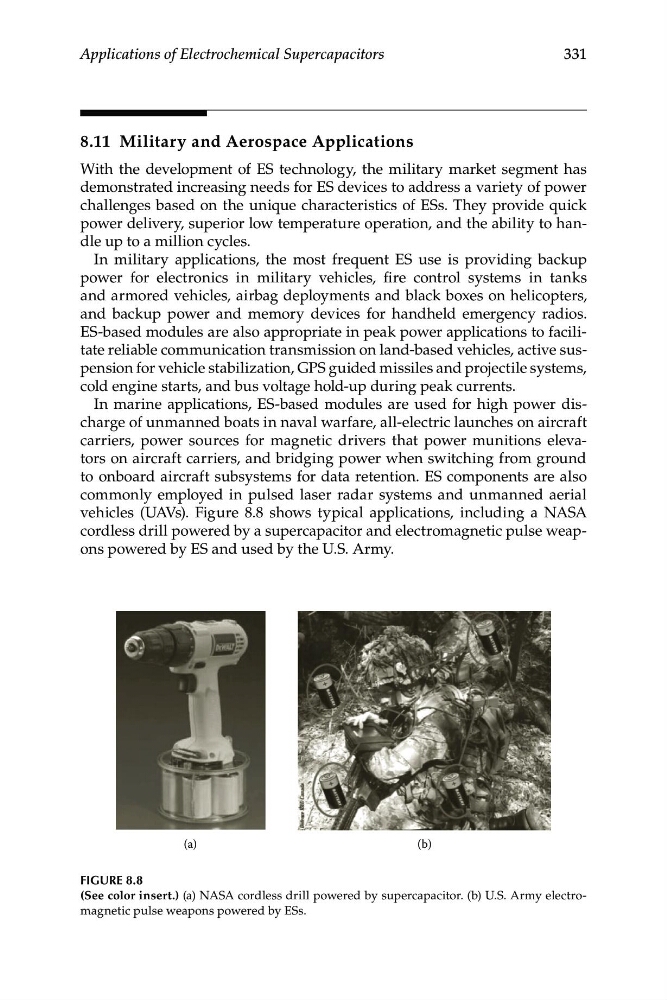
vehicles (UAVs). Figure 8.8 shows typical applications, including a NASA
cordless drill powered by a supercapacitor and electromagnetic pulse weapons powered by ES and used by the U.S. Army.
(a)
(b)
FIGURE 8.8
(See color insert.) (a) NASA cordless drill powered by supercapacitor. (b) U.S. Army electromagnetic pulse weapons powered by ESs.
Applications of Electrochemical Supercapacitors
8.11 Military and Aerospace Applications
With the development of ES technology, the military market segment has
demonstrated increasing needs for ES devices to address a variety of power
challenges based on the unique characteristics of ESs. They provide quick
power delivery, superior low temperature operation, and the ability to handle up to a million cycles.
In military applications, the most frequent ES use is providing backup
power for electronics in military vehicles, fire control systems in tanks
and armored vehicles, airbag deployments and black boxes on helicopters,
and backup power and memory devices for handheld emergency radios.
ES-based modules are also appropriate in peak power applications to facilitate reliable communication transmission on land-based vehicles, active suspension for vehicle stabilization, GPS guided missiles and projectile systems,
cold engine starts, and bus voltage hold-up during peak currents.
In marine applications, ES-based modules are used for high power discharge of unmanned boats in naval warfare, all-electric launches on aircraft
carriers, power sources for magnetic drivers that power munitions elevators on aircraft carriers, and bridging power when switching from ground
to onboard aircraft subsystems for data retention. ES components are also
commonly employed in pulsed laser radar systems and unmanned aerial
vehicles (UAVs). Figure 8.8 shows typical applications, including a NASA
cordless drill powered by a supercapacitor and electromagnetic pulse weapons powered by ES and used by the U.S. Army.
(a)
(b)
FIGURE 8.8
(See color insert.) (a) NASA cordless drill powered by supercapacitor. (b) U.S. Army electromagnetic pulse weapons powered by ESs.