

288
Electrochemical Supercapacitors for Energy Storage and Delivery
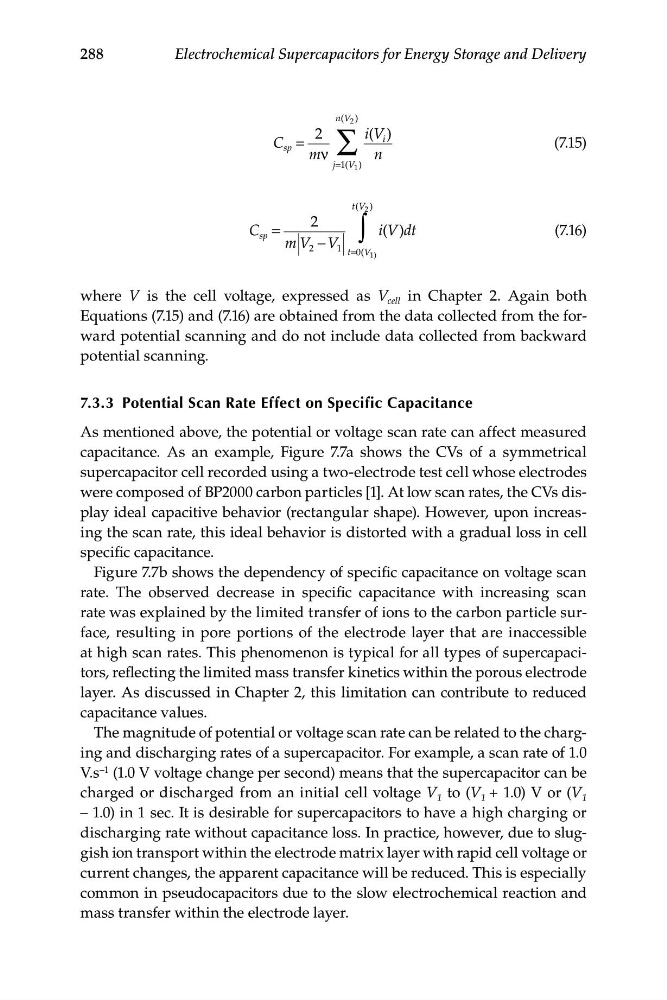
n V
2
i V
C sp =
∑
( )
2
( )
i
(7.15)
mν
n
j=1( )
V 1
t V
( )
2
2
C sp =
( )
.16)
m V 2 − V 1
i V dt
(7
t=0
∫
(V 1)
where V is the cell voltage, expressed as V cell in Chapter 2. Again both
Equations (7.15) and (7.16) are obtained from the data collected from the forward potential scanning and do not include data collected from backward
potential scanning.
7.3.3 Potential Scan Rate Effect on Specific Capacitance
As mentioned above, the potential or voltage scan rate can affect measured
capacitance. As an example, Figure 7.7a shows the CVs of a symmetrical
supercapacitor cell recorded using a two-electrode test cell whose electrodes
were composed of BP2000 carbon particles [1]. At low scan rates, the CVs display ideal capacitive behavior (rectangular shape). However, upon increasing the scan rate, this ideal behavior is distorted with a gradual loss in cell
specific capacitance.
Figure 7.7b shows the dependency of specific capacitance on voltage scan
rate. The observed decrease in specific capacitance with increasing scan
rate was explained by the limited transfer of ions to the carbon particle surface, resulting in pore portions of the electrode layer that are inaccessible
at high scan rates. This phenomenon is typical for all types of supercapacitors, reflecting the limited mass transfer kinetics within the porous electrode
layer. As discussed in Chapter 2, this limitation can contribute to reduced
capacitance values.
The magnitude of potential or voltage scan rate can be related to the charging and discharging rates of a supercapacitor. For example, a scan rate of 1.0
V.s –1 (1.0 V voltage change per second) means that the supercapacitor can be
charged or discharged from an initial cell voltage V 1 to (V 1 + 1.0) V or (V 1
– 1.0) in 1 sec. It is desirable for supercapacitors to have a high charging or
discharging rate without capacitance loss. In practice, however, due to sluggish ion transport within the electrode matrix layer with rapid cell voltage or
current changes, the apparent capacitance will be reduced. This is especially
common in pseudocapacitors due to the slow electrochemical reaction and
mass transfer within the electrode layer.
Electrochemical Supercapacitors for Energy Storage and Delivery
n V
2
i V
C sp =
∑
( )
2
( )
i
(7.15)
mν
n
j=1( )
V 1
t V
( )
2
2
C sp =
( )
.16)
m V 2 − V 1
i V dt
(7
t=0
∫
(V 1)
where V is the cell voltage, expressed as V cell in Chapter 2. Again both
Equations (7.15) and (7.16) are obtained from the data collected from the forward potential scanning and do not include data collected from backward
potential scanning.
7.3.3 Potential Scan Rate Effect on Specific Capacitance
As mentioned above, the potential or voltage scan rate can affect measured
capacitance. As an example, Figure 7.7a shows the CVs of a symmetrical
supercapacitor cell recorded using a two-electrode test cell whose electrodes
were composed of BP2000 carbon particles [1]. At low scan rates, the CVs display ideal capacitive behavior (rectangular shape). However, upon increasing the scan rate, this ideal behavior is distorted with a gradual loss in cell
specific capacitance.
Figure 7.7b shows the dependency of specific capacitance on voltage scan
rate. The observed decrease in specific capacitance with increasing scan
rate was explained by the limited transfer of ions to the carbon particle surface, resulting in pore portions of the electrode layer that are inaccessible
at high scan rates. This phenomenon is typical for all types of supercapacitors, reflecting the limited mass transfer kinetics within the porous electrode
layer. As discussed in Chapter 2, this limitation can contribute to reduced
capacitance values.
The magnitude of potential or voltage scan rate can be related to the charging and discharging rates of a supercapacitor. For example, a scan rate of 1.0
V.s –1 (1.0 V voltage change per second) means that the supercapacitor can be
charged or discharged from an initial cell voltage V 1 to (V 1 + 1.0) V or (V 1
– 1.0) in 1 sec. It is desirable for supercapacitors to have a high charging or
discharging rate without capacitance loss. In practice, however, due to sluggish ion transport within the electrode matrix layer with rapid cell voltage or
current changes, the apparent capacitance will be reduced. This is especially
common in pseudocapacitors due to the slow electrochemical reaction and
mass transfer within the electrode layer.