

Current Density, A/cm 2
0.02
0.01
0
–0.01
0.8
1.0
1.2
100 mVps
50 mVps
20 mVps
10 mVps
5 mVps
2 mVps
–0.02
–0.2
0.0
0.2
0.4
0.6
Cell Voltage, Volt
(a)
120
100
Specific Capacitance, F/g
80
60
40
0
2 0
40
6 0
Scan Rate, mV/s
(b)
80
100
120
289
Characterization and Diagnosis Techniques
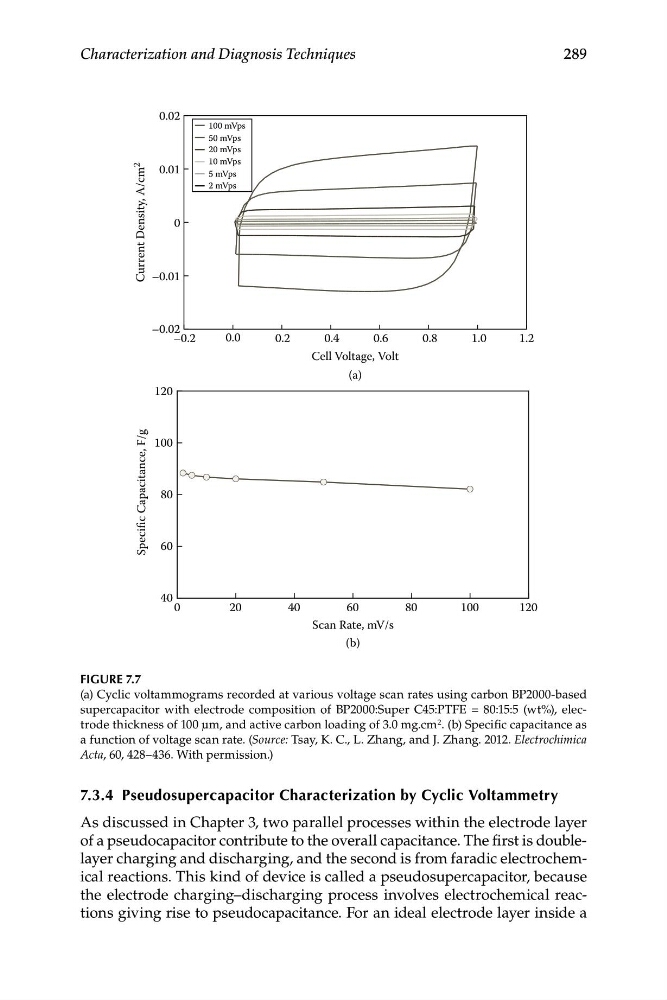
FIGURE 7.7
(a) Cyclic voltammograms recorded at various voltage scan rates using carbon BP2000-based
supercapacitor with electrode composition of BP2000:Super C45:PTFE = 80:15:5 (wt%), electrode thickness of 100 μm, and active carbon loading of 3.0 mg.cm 2 . (b) Specific capacitance as
a function of voltage scan rate. (Source: Tsay, K. C., L. Zhang, and J. Zhang. 2012. Electrochimica
Acta, 60, 428–436. With permission.)
7.3.4 Pseudosupercapacitor Characterization by Cyclic Voltammetry
As discussed in Chapter 3, two parallel processes within the electrode layer
of a pseudocapacitor contribute to the overall capacitance. The first is doublelayer charging and discharging, and the second is from faradic electrochemical reactions. This kind of device is called a pseudosupercapacitor, because
the electrode charging–discharging process involves electrochemical reactions giving rise to pseudocapacitance. For an ideal electrode layer inside a
0.02
0.01
0
–0.01
0.8
1.0
1.2
100 mVps
50 mVps
20 mVps
10 mVps
5 mVps
2 mVps
–0.02
–0.2
0.0
0.2
0.4
0.6
Cell Voltage, Volt
(a)
120
100
Specific Capacitance, F/g
80
60
40
0
2 0
40
6 0
Scan Rate, mV/s
(b)
80
100
120
289
Characterization and Diagnosis Techniques
FIGURE 7.7
(a) Cyclic voltammograms recorded at various voltage scan rates using carbon BP2000-based
supercapacitor with electrode composition of BP2000:Super C45:PTFE = 80:15:5 (wt%), electrode thickness of 100 μm, and active carbon loading of 3.0 mg.cm 2 . (b) Specific capacitance as
a function of voltage scan rate. (Source: Tsay, K. C., L. Zhang, and J. Zhang. 2012. Electrochimica
Acta, 60, 428–436. With permission.)
7.3.4 Pseudosupercapacitor Characterization by Cyclic Voltammetry
As discussed in Chapter 3, two parallel processes within the electrode layer
of a pseudocapacitor contribute to the overall capacitance. The first is doublelayer charging and discharging, and the second is from faradic electrochemical reactions. This kind of device is called a pseudosupercapacitor, because
the electrode charging–discharging process involves electrochemical reactions giving rise to pseudocapacitance. For an ideal electrode layer inside a