

286
Electrochemical Supercapacitors for Energy Storage and Delivery
i E
( )
C E
sp ( ) =
(7.7)
mν
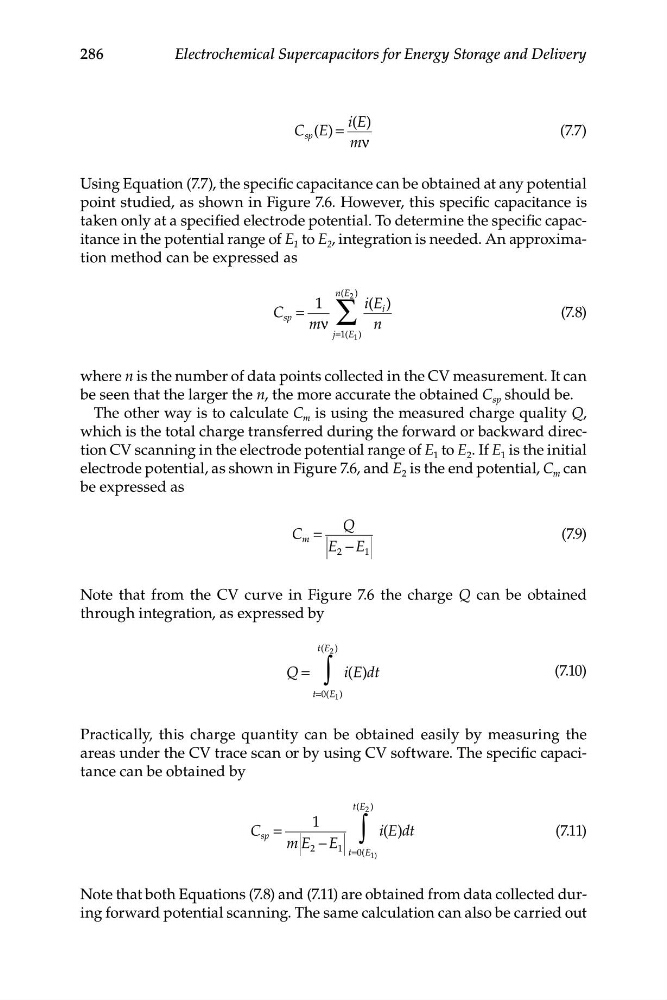
Using Equation (7.7), the specific capacitance can be obtained at any potential
point studied, as shown in Figure 7.6. However, this specific capacitance is
taken only at a specified electrode potential. To determine the specific capacitance in the potential range of E 1 to E 2 , integration is needed. An approximation method can be expressed as
n E
( )
1
2 i E
( )
C sp =
i
(7.8)
mν ∑ n
j=1( )
E 1
where n is the number of data points collected in the CV measurement. It can
be seen that the larger the n, the more accurate the obtained C sp should be.
The other way is to calculate C m is using the measured charge quality Q,
which is the total charge transferred during the forward or backward direction CV scanning in the electrode potential range of E 1 to E 2 . If E 1 is the initial
electrode potential, as shown in Figure 7.6, and E 2 is the end potential, C m can
be expressed as
Q
C m =
(7.9)
E 2 − E 1
Note that from the CV curve in Figure 7.6 the charge Q can be obtained
through integration, as expressed by
t E
( )
2
Q = ∫ i ( )
Ed t
(7.10)
t=0( )
E 1
Practically, this charge quantity can be obtained easily by measuring the
areas under the CV trace scan or by using CV software. The specific capacitance can be obtained by
t E
( )
2
1
C sp =
∫ i E
( )dt
(7 .11)
m E 2 − E 1 t=0(E 1)
Note that both Equations (7.8) and (7.11) are obtained from data collected during forward potential scanning. The same calculation can also be carried out
Electrochemical Supercapacitors for Energy Storage and Delivery
i E
( )
C E
sp ( ) =
(7.7)
mν
Using Equation (7.7), the specific capacitance can be obtained at any potential
point studied, as shown in Figure 7.6. However, this specific capacitance is
taken only at a specified electrode potential. To determine the specific capacitance in the potential range of E 1 to E 2 , integration is needed. An approximation method can be expressed as
n E
( )
1
2 i E
( )
C sp =
i
(7.8)
mν ∑ n
j=1( )
E 1
where n is the number of data points collected in the CV measurement. It can
be seen that the larger the n, the more accurate the obtained C sp should be.
The other way is to calculate C m is using the measured charge quality Q,
which is the total charge transferred during the forward or backward direction CV scanning in the electrode potential range of E 1 to E 2 . If E 1 is the initial
electrode potential, as shown in Figure 7.6, and E 2 is the end potential, C m can
be expressed as
Q
C m =
(7.9)
E 2 − E 1
Note that from the CV curve in Figure 7.6 the charge Q can be obtained
through integration, as expressed by
t E
( )
2
Q = ∫ i ( )
Ed t
(7.10)
t=0( )
E 1
Practically, this charge quantity can be obtained easily by measuring the
areas under the CV trace scan or by using CV software. The specific capacitance can be obtained by
t E
( )
2
1
C sp =
∫ i E
( )dt
(7 .11)
m E 2 − E 1 t=0(E 1)
Note that both Equations (7.8) and (7.11) are obtained from data collected during forward potential scanning. The same calculation can also be carried out