

Voltage (V)
Voltage (V)
2.65
2.64
Experimental result
Ideal electrode model
Non-ideal electrode model
190
210
230
250
270
290
2.63
2.58
2.57
2.56
320
340
360
380
400
420
Time (sec)
273
Coupling with Batteries and Fuel Cells
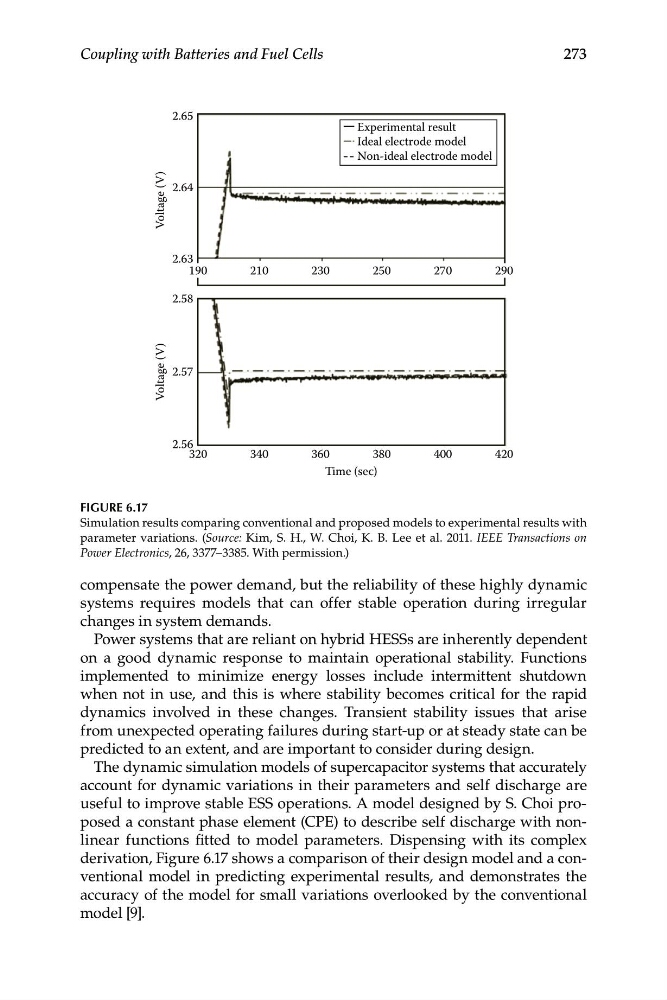
FIGURE 6.17
Simulation results comparing conventional and proposed models to experimental results with
parameter variations. (Source: Kim, S. H., W. Choi, K. B. Lee et al. 2011. IEEE Transactions on
Power Electronics, 26, 3377–3385. With permission.)
compensate the power demand, but the reliability of these highly dynamic
systems requires models that can offer stable operation during irregular
changes in system demands.
Power systems that are reliant on hybrid HESSs are inherently dependent
on a good dynamic response to maintain operational stability. Functions
implemented to minimize energy losses include intermittent shutdown
when not in use, and this is where stability becomes critical for the rapid
dynamics involved in these changes. Transient stability issues that arise
from unexpected operating failures during start-up or at steady state can be
predicted to an extent, and are important to consider during design.
The dynamic simulation models of supercapacitor systems that accurately
account for dynamic variations in their parameters and self discharge are
useful to improve stable ESS operations. A model designed by S. Choi proposed a constant phase element (CPE) to describe self discharge with nonlinear functions fitted to model parameters. Dispensing with its complex
derivation, Figure 6.17 shows a comparison of their design model and a conventional model in predicting experimental results, and demonstrates the
accuracy of the model for small variations overlooked by the conventional
model [9].
Voltage (V)
2.65
2.64
Experimental result
Ideal electrode model
Non-ideal electrode model
190
210
230
250
270
290
2.63
2.58
2.57
2.56
320
340
360
380
400
420
Time (sec)
273
Coupling with Batteries and Fuel Cells
FIGURE 6.17
Simulation results comparing conventional and proposed models to experimental results with
parameter variations. (Source: Kim, S. H., W. Choi, K. B. Lee et al. 2011. IEEE Transactions on
Power Electronics, 26, 3377–3385. With permission.)
compensate the power demand, but the reliability of these highly dynamic
systems requires models that can offer stable operation during irregular
changes in system demands.
Power systems that are reliant on hybrid HESSs are inherently dependent
on a good dynamic response to maintain operational stability. Functions
implemented to minimize energy losses include intermittent shutdown
when not in use, and this is where stability becomes critical for the rapid
dynamics involved in these changes. Transient stability issues that arise
from unexpected operating failures during start-up or at steady state can be
predicted to an extent, and are important to consider during design.
The dynamic simulation models of supercapacitor systems that accurately
account for dynamic variations in their parameters and self discharge are
useful to improve stable ESS operations. A model designed by S. Choi proposed a constant phase element (CPE) to describe self discharge with nonlinear functions fitted to model parameters. Dispensing with its complex
derivation, Figure 6.17 shows a comparison of their design model and a conventional model in predicting experimental results, and demonstrates the
accuracy of the model for small variations overlooked by the conventional
model [9].