

272
Electrochemical Supercapacitors for Energy Storage and Delivery
⎛ V ⎞
C = ceil ⎜
high
s
⎟
⎜
⎟
(6.5)
⎝ V cellc ⎠
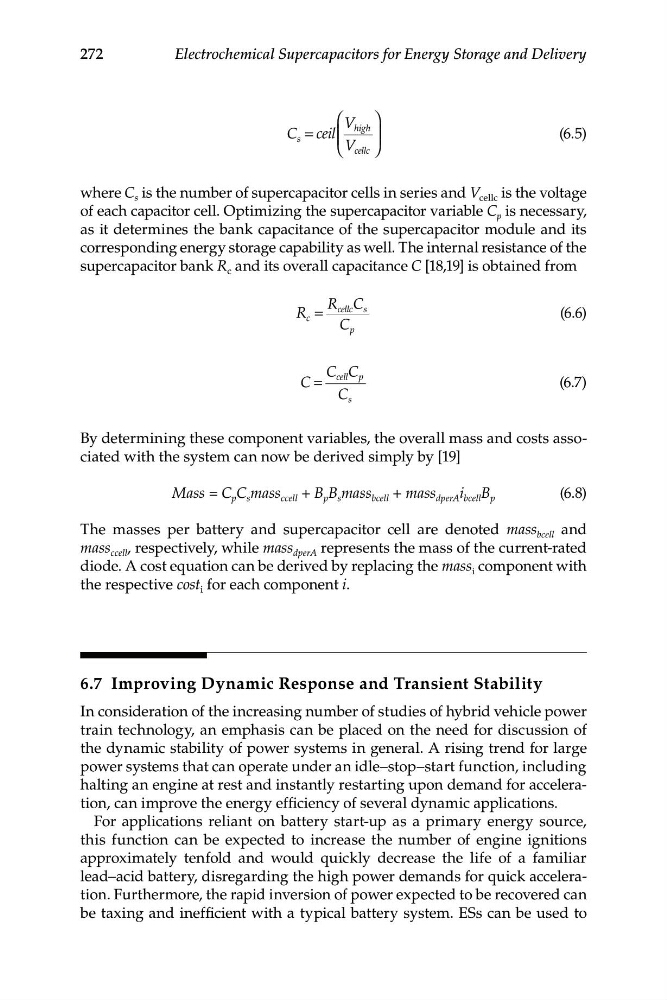
where C s is the number of supercapacitor cells in series and V cellc is the voltage
of each capacitor cell. Optimizing the supercapacitor variable C p is necessary,
as it determines the bank capacitance of the supercapacitor module and its
corresponding energy storage capability as well. The internal resistance of the
supercapacitor bank R c and its overall capacitance C [18,19] is obtained from
R C
R c =
cellc s
(6.6)
C p
C C
C =
cell p
(6.7)
C s
By determining these component variables, the overall mass and costs associated with the system can now be derived simply by [19]
Mass = C p C s mass ccell + B p B s mass bcell + mass dperA i bcell B p
(6.8)
The masses per battery and supercapacitor cell are denoted mass bcell and
mass ccell , respectively, while mass dperA represents the mass of the current-rated
diode. A cost equation can be derived by replacing the mass i component with
the respective cost i for each component i.
6.7 Improving Dynamic Response and Transient Stability
In consideration of the increasing number of studies of hybrid vehicle power
train technology, an emphasis can be placed on the need for discussion of
the dynamic stability of power systems in general. A rising trend for large
power systems that can operate under an idle–stop–start function, including
halting an engine at rest and instantly restarting upon demand for acceleration, can improve the energy efficiency of several dynamic applications.
For applications reliant on battery start-up as a primary energy source,
this function can be expected to increase the number of engine ignitions
approximately tenfold and would quickly decrease the life of a familiar
lead–acid battery, disregarding the high power demands for quick acceleration. Furthermore, the rapid inversion of power expected to be recovered can
be taxing and inefficient with a typical battery system. ESs can be used to
Electrochemical Supercapacitors for Energy Storage and Delivery
⎛ V ⎞
C = ceil ⎜
high
s
⎟
⎜
⎟
(6.5)
⎝ V cellc ⎠
where C s is the number of supercapacitor cells in series and V cellc is the voltage
of each capacitor cell. Optimizing the supercapacitor variable C p is necessary,
as it determines the bank capacitance of the supercapacitor module and its
corresponding energy storage capability as well. The internal resistance of the
supercapacitor bank R c and its overall capacitance C [18,19] is obtained from
R C
R c =
cellc s
(6.6)
C p
C C
C =
cell p
(6.7)
C s
By determining these component variables, the overall mass and costs associated with the system can now be derived simply by [19]
Mass = C p C s mass ccell + B p B s mass bcell + mass dperA i bcell B p
(6.8)
The masses per battery and supercapacitor cell are denoted mass bcell and
mass ccell , respectively, while mass dperA represents the mass of the current-rated
diode. A cost equation can be derived by replacing the mass i component with
the respective cost i for each component i.
6.7 Improving Dynamic Response and Transient Stability
In consideration of the increasing number of studies of hybrid vehicle power
train technology, an emphasis can be placed on the need for discussion of
the dynamic stability of power systems in general. A rising trend for large
power systems that can operate under an idle–stop–start function, including
halting an engine at rest and instantly restarting upon demand for acceleration, can improve the energy efficiency of several dynamic applications.
For applications reliant on battery start-up as a primary energy source,
this function can be expected to increase the number of engine ignitions
approximately tenfold and would quickly decrease the life of a familiar
lead–acid battery, disregarding the high power demands for quick acceleration. Furthermore, the rapid inversion of power expected to be recovered can
be taxing and inefficient with a typical battery system. ESs can be used to