

–Z imag
ESR
δ
φ
EDR
Z real
260
Electrochemical Supercapacitors for Energy Storage and Delivery
batteries, FCs, etc.) and determining the parameters used in a number of
supercapacitor models that will be treated discretely.
A simplified portrait of this technique describes the use of a small amplitude sinusoidal voltage (often <10 mV) applied to produce a resulting sinusoidal current. Measurement of this current permits the calculation of
impedance and phase angle through which the double-layer capacitance can
then be assessed. Further characterization of capacitance can be achieved
through sweep analysis of the capacitance at various voltages and temperatures to gain practical assessment of device performance.
6.6.1.1 Classic and Advanced Equivalent Series Models
The classic equivalent series model parameters, as discussed in Chapters 2,
3, and 7, are relatively simple to determine and thus have less accuracy in
predicting device behavior in comparison to more complex circuit models.
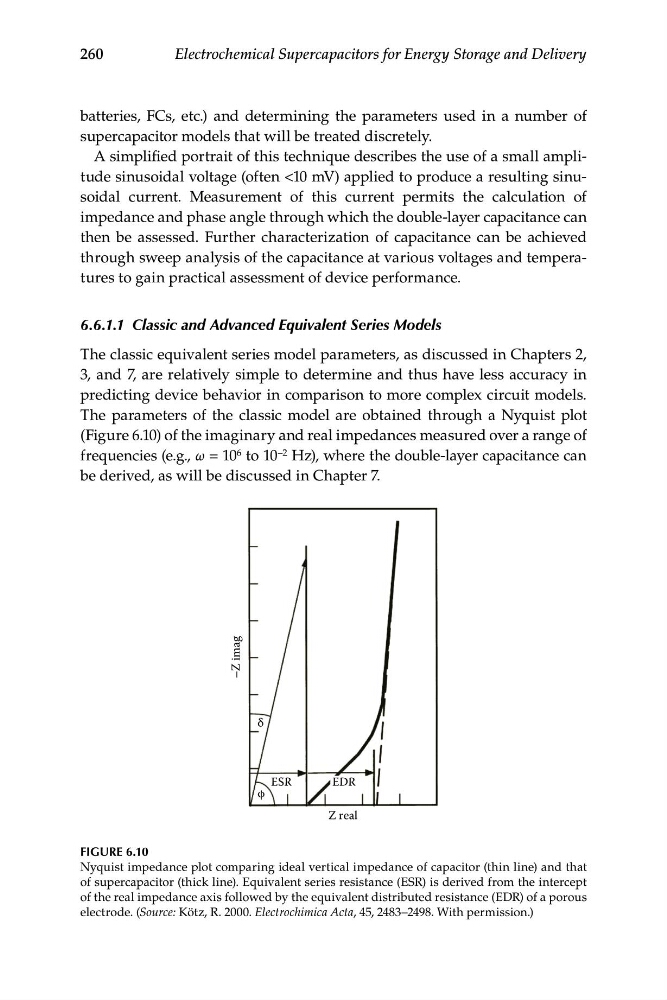
The parameters of the classic model are obtained through a Nyquist plot
(Figure 6.10) of the imaginary and real impedances measured over a range of
frequencies (e.g., ω = 10 6 to 10 –2 Hz), where the double-layer capacitance can
be derived, as will be discussed in Chapter 7.
FIGURE 6.10
Nyquist impedance plot comparing ideal vertical impedance of capacitor (thin line) and that
of supercapacitor (thick line). Equivalent series resistance (ESR) is derived from the intercept
of the real impedance axis followed by the equivalent distributed resistance (EDR) of a porous
electrode. (Source: Kötz, R. 2000. Electrochimica Acta, 45, 2483–2498. With permission.)
ESR
δ
φ
EDR
Z real
260
Electrochemical Supercapacitors for Energy Storage and Delivery
batteries, FCs, etc.) and determining the parameters used in a number of
supercapacitor models that will be treated discretely.
A simplified portrait of this technique describes the use of a small amplitude sinusoidal voltage (often <10 mV) applied to produce a resulting sinusoidal current. Measurement of this current permits the calculation of
impedance and phase angle through which the double-layer capacitance can
then be assessed. Further characterization of capacitance can be achieved
through sweep analysis of the capacitance at various voltages and temperatures to gain practical assessment of device performance.
6.6.1.1 Classic and Advanced Equivalent Series Models
The classic equivalent series model parameters, as discussed in Chapters 2,
3, and 7, are relatively simple to determine and thus have less accuracy in
predicting device behavior in comparison to more complex circuit models.
The parameters of the classic model are obtained through a Nyquist plot
(Figure 6.10) of the imaginary and real impedances measured over a range of
frequencies (e.g., ω = 10 6 to 10 –2 Hz), where the double-layer capacitance can
be derived, as will be discussed in Chapter 7.
FIGURE 6.10
Nyquist impedance plot comparing ideal vertical impedance of capacitor (thin line) and that
of supercapacitor (thick line). Equivalent series resistance (ESR) is derived from the intercept
of the real impedance axis followed by the equivalent distributed resistance (EDR) of a porous
electrode. (Source: Kötz, R. 2000. Electrochimica Acta, 45, 2483–2498. With permission.)