

C
ESR
EPR
259
Coupling with Batteries and Fuel Cells
discussion of models pertaining to general design schemes is presented in
this section.
The modeling of integrated hybrid energy storage systems for applications
often requires an electrochemical model for each component to properly
perform accurate simulation and feasibility studies, particularly with the
use of FCs. In addition, power system studies benefit from simulation studies; this avoids the high costs and technical operating difficulties associated
with prototype testing. Thus, the accuracy gained from model development
is critical for a proper assessment of overall system performance.
A number of models describing supercapacitor resistor and capacitor
behaviors used to mimic their performances in power systems have been
reported and include classical equivalent, ladder circuit, and lumped or
distributed parameter electrical and Debye polarization cell models [6].
An established design of a dynamic model of the often-used polymer
electrolyte membrane fuel cell (PEMFC) is included in MATLAB® and
Simulink software to simulate performance under varying conditions specific to applications.
6.6.1 Supercapacitor Modeling
Predictive operating dynamics of a complex supercapacitor device can be
achieved through the implementation of one of several model circuit analogies. Distributed parameter models are often used; the most common is the
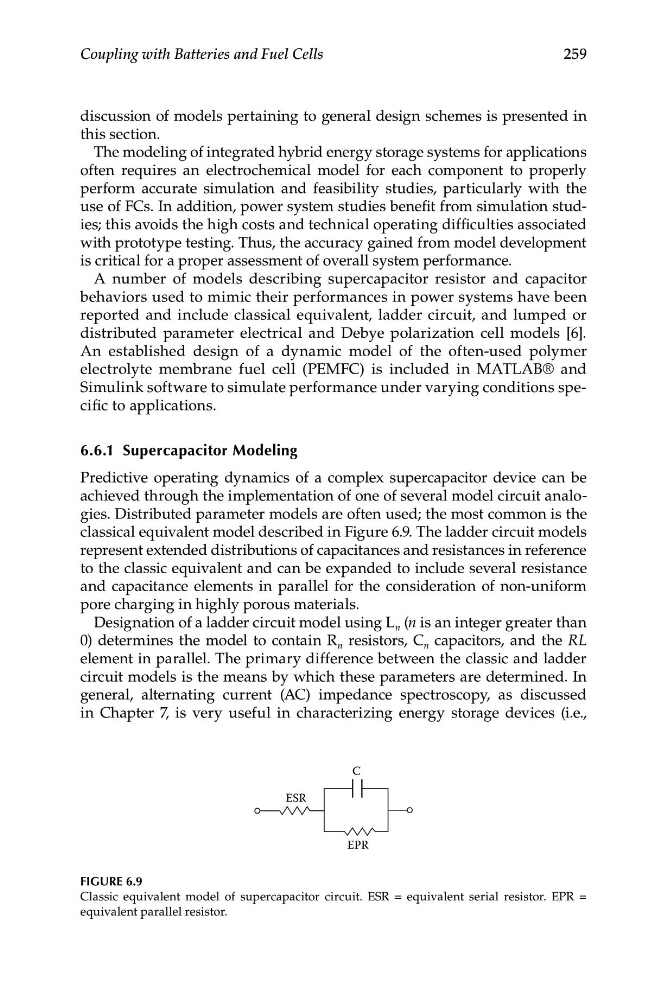
classical equivalent model described in Figure 6.9. The ladder circuit models
represent extended distributions of capacitances and resistances in reference
to the classic equivalent and can be expanded to include several resistance
and capacitance elements in parallel for the consideration of non-uniform
pore charging in highly porous materials.
Designation of a ladder circuit model using L n (n is an integer greater than
0) determines the model to contain R n resistors, C n capacitors, and the RL
element in parallel. The primary difference between the classic and ladder
circuit models is the means by which these parameters are determined. In
general, alternating current (AC) impedance spectroscopy, as discussed
in Chapter 7, is very useful in characterizing energy storage devices (i.e.,
FIGURE 6.9
Classic equivalent model of supercapacitor circuit. ESR = equivalent serial resistor. EPR =
equivalent parallel resistor.
ESR
EPR
259
Coupling with Batteries and Fuel Cells
discussion of models pertaining to general design schemes is presented in
this section.
The modeling of integrated hybrid energy storage systems for applications
often requires an electrochemical model for each component to properly
perform accurate simulation and feasibility studies, particularly with the
use of FCs. In addition, power system studies benefit from simulation studies; this avoids the high costs and technical operating difficulties associated
with prototype testing. Thus, the accuracy gained from model development
is critical for a proper assessment of overall system performance.
A number of models describing supercapacitor resistor and capacitor
behaviors used to mimic their performances in power systems have been
reported and include classical equivalent, ladder circuit, and lumped or
distributed parameter electrical and Debye polarization cell models [6].
An established design of a dynamic model of the often-used polymer
electrolyte membrane fuel cell (PEMFC) is included in MATLAB® and
Simulink software to simulate performance under varying conditions specific to applications.
6.6.1 Supercapacitor Modeling
Predictive operating dynamics of a complex supercapacitor device can be
achieved through the implementation of one of several model circuit analogies. Distributed parameter models are often used; the most common is the
classical equivalent model described in Figure 6.9. The ladder circuit models
represent extended distributions of capacitances and resistances in reference
to the classic equivalent and can be expanded to include several resistance
and capacitance elements in parallel for the consideration of non-uniform
pore charging in highly porous materials.
Designation of a ladder circuit model using L n (n is an integer greater than
0) determines the model to contain R n resistors, C n capacitors, and the RL
element in parallel. The primary difference between the classic and ladder
circuit models is the means by which these parameters are determined. In
general, alternating current (AC) impedance spectroscopy, as discussed
in Chapter 7, is very useful in characterizing energy storage devices (i.e.,
FIGURE 6.9
Classic equivalent model of supercapacitor circuit. ESR = equivalent serial resistor. EPR =
equivalent parallel resistor.