

233
Electrochemical Supercapacitor Design, Fabrication, and Operation
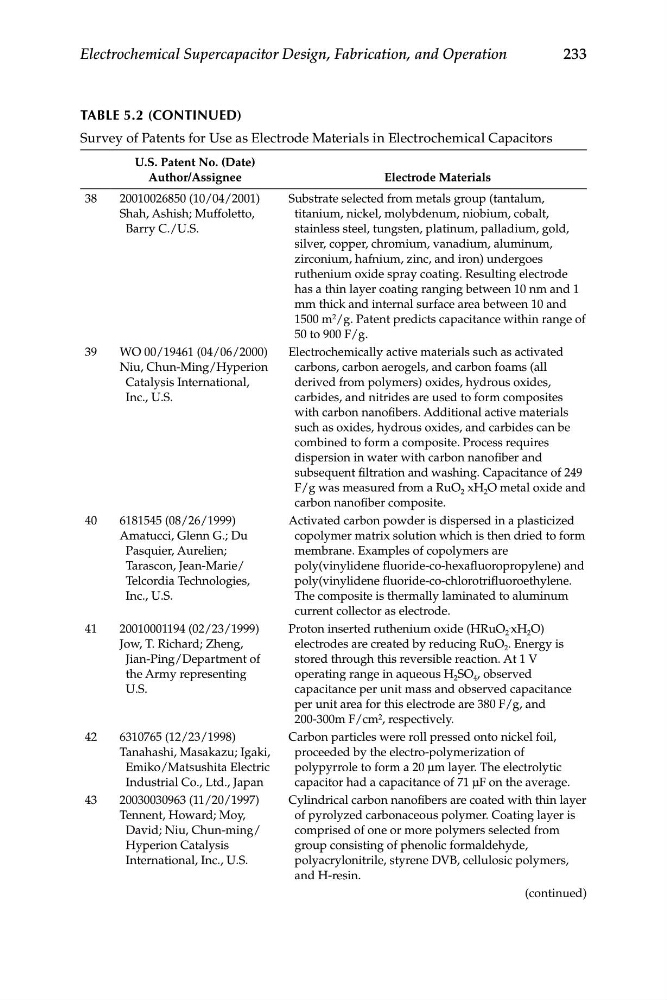
TABLE 5.2 (CONTINUED)
Survey of Patents for Use as Electrode Materials in Electrochemical Capacitors
U.S. Patent No. (Date)
Author/Assignee
Electrode Materials
38
20010026850 (10/04/2001)
Substrate selected from metals group (tantalum,
Shah, Ashish; Muffoletto,
titanium, nickel, molybdenum, niobium, cobalt,
Barry C./U.S.
stainless steel, tungsten, platinum, palladium, gold,
silver, copper, chromium, vanadium, aluminum,
zirconium, hafnium, zinc, and iron) undergoes
ruthenium oxide spray coating. Resulting electrode
has a thin layer coating ranging between 10 nm and 1
mm thick and internal surface area between 10 and
1500 m 2 /g. Patent predicts capacitance within range of
50 to 900 F/g.
39
WO 00/19461 (04/06/2000)
Electrochemically active materials such as activated
Niu, Chun-Ming/Hyperion
carbons, carbon aerogels, and carbon foams (all
Catalysis International,
derived from polymers) oxides, hydrous oxides,
Inc., U.S.
carbides, and nitrides are used to form composites
with carbon nanofibers. Additional active materials
such as oxides, hydrous oxides, and carbides can be
combined to form a composite. Process requires
dispersion in water with carbon nanofiber and
subsequent filtration and washing. Capacitance of 249
F/g was measured from a RuO 2 xH 2 O metal oxide and
carbon nanofiber composite.
40
6181545 (08/26/1999)
Activated carbon powder is dispersed in a plasticized
Amatucci, Glenn G.; Du
copolymer matrix solution which is then dried to form
Pasquier, Aurelien;
membrane. Examples of copolymers are
Tarascon, Jean-Marie/
poly(vinylidene fluoride-co-hexafluoropropylene) and
Telcordia Technologies,
poly(vinylidene fluoride-co-chlorotrifluoroethylene.
Inc., U.S.
The composite is thermally laminated to aluminum
current collector as electrode.
41
20010001194 (02/23/1999)
Proton inserted ruthenium oxide (HRuO 2
. xH 2 O)
Jow, T. Richard; Zheng,
electrodes are created by reducing RuO 2 . Energy is
Jian-Ping/Department of
stored through this reversible reaction. At 1 V
the Army representing
operating range in aqueous H 2 SO 4 , observed
U.S.
capacitance per unit mass and observed capacitance
per unit area for this electrode are 380 F/g, and
200-300m F/cm 2 , respectively.
42
6310765 (12/23/1998)
Carbon particles were roll pressed onto nickel foil,
Tanahashi, Masakazu; Igaki,
proceeded by the electro-polymerization of
Emiko/Matsushita Electric
polypyrrole to form a 20 μm layer. The electrolytic
Industrial Co., Ltd., Japan
capacitor had a capacitance of 71 μF on the average.
43
20030030963 (11/20/1997)
Cylindrical carbon nanofibers are coated with thin layer
Tennent, Howard; Moy,
of pyrolyzed carbonaceous polymer. Coating layer is
David; Niu, Chun-ming/
comprised of one or more polymers selected from
Hyperion Catalysis
group consisting of phenolic formaldehyde,
International, Inc., U.S.
polyacrylonitrile, styrene DVB, cellulosic polymers,
and H-resin.
(continued)
Electrochemical Supercapacitor Design, Fabrication, and Operation
TABLE 5.2 (CONTINUED)
Survey of Patents for Use as Electrode Materials in Electrochemical Capacitors
U.S. Patent No. (Date)
Author/Assignee
Electrode Materials
38
20010026850 (10/04/2001)
Substrate selected from metals group (tantalum,
Shah, Ashish; Muffoletto,
titanium, nickel, molybdenum, niobium, cobalt,
Barry C./U.S.
stainless steel, tungsten, platinum, palladium, gold,
silver, copper, chromium, vanadium, aluminum,
zirconium, hafnium, zinc, and iron) undergoes
ruthenium oxide spray coating. Resulting electrode
has a thin layer coating ranging between 10 nm and 1
mm thick and internal surface area between 10 and
1500 m 2 /g. Patent predicts capacitance within range of
50 to 900 F/g.
39
WO 00/19461 (04/06/2000)
Electrochemically active materials such as activated
Niu, Chun-Ming/Hyperion
carbons, carbon aerogels, and carbon foams (all
Catalysis International,
derived from polymers) oxides, hydrous oxides,
Inc., U.S.
carbides, and nitrides are used to form composites
with carbon nanofibers. Additional active materials
such as oxides, hydrous oxides, and carbides can be
combined to form a composite. Process requires
dispersion in water with carbon nanofiber and
subsequent filtration and washing. Capacitance of 249
F/g was measured from a RuO 2 xH 2 O metal oxide and
carbon nanofiber composite.
40
6181545 (08/26/1999)
Activated carbon powder is dispersed in a plasticized
Amatucci, Glenn G.; Du
copolymer matrix solution which is then dried to form
Pasquier, Aurelien;
membrane. Examples of copolymers are
Tarascon, Jean-Marie/
poly(vinylidene fluoride-co-hexafluoropropylene) and
Telcordia Technologies,
poly(vinylidene fluoride-co-chlorotrifluoroethylene.
Inc., U.S.
The composite is thermally laminated to aluminum
current collector as electrode.
41
20010001194 (02/23/1999)
Proton inserted ruthenium oxide (HRuO 2
. xH 2 O)
Jow, T. Richard; Zheng,
electrodes are created by reducing RuO 2 . Energy is
Jian-Ping/Department of
stored through this reversible reaction. At 1 V
the Army representing
operating range in aqueous H 2 SO 4 , observed
U.S.
capacitance per unit mass and observed capacitance
per unit area for this electrode are 380 F/g, and
200-300m F/cm 2 , respectively.
42
6310765 (12/23/1998)
Carbon particles were roll pressed onto nickel foil,
Tanahashi, Masakazu; Igaki,
proceeded by the electro-polymerization of
Emiko/Matsushita Electric
polypyrrole to form a 20 μm layer. The electrolytic
Industrial Co., Ltd., Japan
capacitor had a capacitance of 71 μF on the average.
43
20030030963 (11/20/1997)
Cylindrical carbon nanofibers are coated with thin layer
Tennent, Howard; Moy,
of pyrolyzed carbonaceous polymer. Coating layer is
David; Niu, Chun-ming/
comprised of one or more polymers selected from
Hyperion Catalysis
group consisting of phenolic formaldehyde,
International, Inc., U.S.
polyacrylonitrile, styrene DVB, cellulosic polymers,
and H-resin.
(continued)