

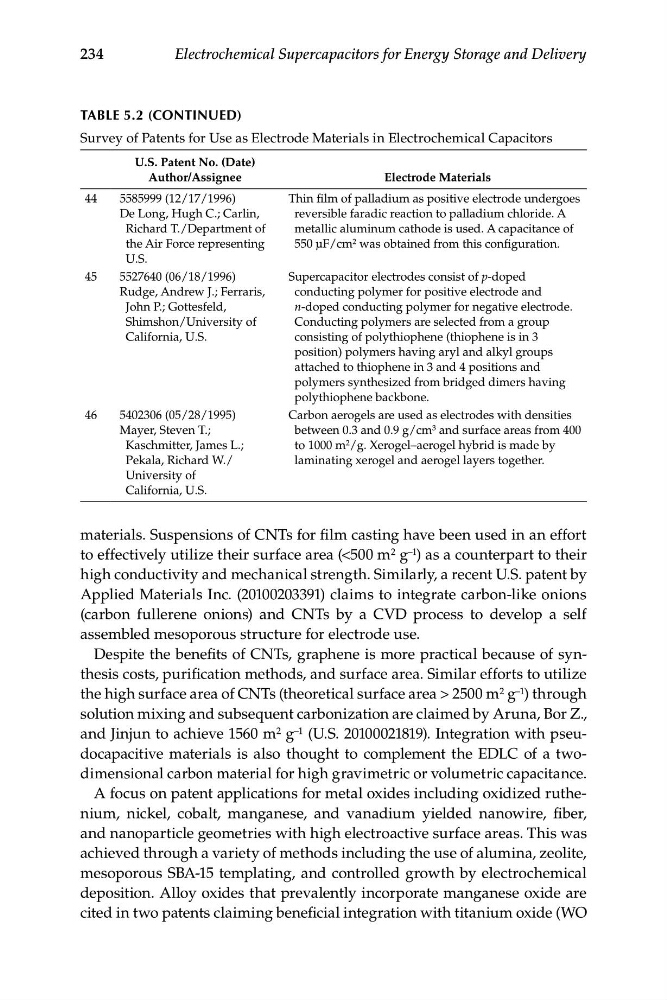
TABLE 5.2 (CONTINUED)
Survey of Patents for Use as Electrode Materials in Electrochemical Capacitors
U.S. Patent No. (Date)
Author/Assignee
Electrode Materials
44
5585999 (12/17/1996)
Thin film of palladium as positive electrode undergoes
De Long, Hugh C.; Carlin,
reversible faradic reaction to palladium chloride. A
Richard T./Department of
metallic aluminum cathode is used. A capacitance of
the Air Force representing
550 μF/cm 2 was obtained from this configuration.
U.S.
45
5527640 (06/18/1996)
Supercapacitor electrodes consist of p-doped
Rudge, Andrew J.; Ferraris,
conducting polymer for positive electrode and
John P.; Gottesfeld,
n-doped conducting polymer for negative electrode.
Shimshon/University of
Conducting polymers are selected from a group
California, U.S.
consisting of polythiophene (thiophene is in 3
position) polymers having aryl and alkyl groups
attached to thiophene in 3 and 4 positions and
polymers synthesized from bridged dimers having
polythiophene backbone.
46
5402306 (05/28/1995)
Carbon aerogels are used as electrodes with densities
Mayer, Steven T.;
between 0.3 and 0.9 g/cm 3 and surface areas from 400
Kaschmitter, James L.;
to 1000 m 2 /g. Xerogel–aerogel hybrid is made by
Pekala, Richard W./
laminating xerogel and aerogel layers together.
University of
California, U.S.
234
Electrochemical Supercapacitors for Energy Storage and Delivery
materials. Suspensions of CNTs for film casting have been used in an effort
to effectively utilize their surface area (<500 m 2 g –1 ) as a counterpart to their
high conductivity and mechanical strength. Similarly, a recent U.S. patent by
Applied Materials Inc. (20100203391) claims to integrate carbon-like onions
(carbon fullerene onions) and CNTs by a CVD process to develop a self
assembled mesoporous structure for electrode use.
Despite the benefits of CNTs, graphene is more practical because of synthesis costs, purification methods, and surface area. Similar efforts to utilize
the high surface area of CNTs (theoretical surface area > 2500 m 2 g –1 ) through
solution mixing and subsequent carbonization are claimed by Aruna, Bor Z.,
and Jinjun to achieve 1560 m 2 g –1 (U.S. 20100021819). Integration with pseudocapacitive materials is also thought to complement the EDLC of a twodimensional carbon material for high gravimetric or volumetric capacitance.
A focus on patent applications for metal oxides including oxidized ruthenium, nickel, cobalt, manganese, and vanadium yielded nanowire, fiber,
and nanoparticle geometries with high electroactive surface areas. This was
achieved through a variety of methods including the use of alumina, zeolite,
mesoporous SBA-15 templating, and controlled growth by electrochemical
deposition. Alloy oxides that prevalently incorporate manganese oxide are
cited in two patents claiming beneficial integration with titanium oxide (WO
Survey of Patents for Use as Electrode Materials in Electrochemical Capacitors
U.S. Patent No. (Date)
Author/Assignee
Electrode Materials
44
5585999 (12/17/1996)
Thin film of palladium as positive electrode undergoes
De Long, Hugh C.; Carlin,
reversible faradic reaction to palladium chloride. A
Richard T./Department of
metallic aluminum cathode is used. A capacitance of
the Air Force representing
550 μF/cm 2 was obtained from this configuration.
U.S.
45
5527640 (06/18/1996)
Supercapacitor electrodes consist of p-doped
Rudge, Andrew J.; Ferraris,
conducting polymer for positive electrode and
John P.; Gottesfeld,
n-doped conducting polymer for negative electrode.
Shimshon/University of
Conducting polymers are selected from a group
California, U.S.
consisting of polythiophene (thiophene is in 3
position) polymers having aryl and alkyl groups
attached to thiophene in 3 and 4 positions and
polymers synthesized from bridged dimers having
polythiophene backbone.
46
5402306 (05/28/1995)
Carbon aerogels are used as electrodes with densities
Mayer, Steven T.;
between 0.3 and 0.9 g/cm 3 and surface areas from 400
Kaschmitter, James L.;
to 1000 m 2 /g. Xerogel–aerogel hybrid is made by
Pekala, Richard W./
laminating xerogel and aerogel layers together.
University of
California, U.S.
234
Electrochemical Supercapacitors for Energy Storage and Delivery
materials. Suspensions of CNTs for film casting have been used in an effort
to effectively utilize their surface area (<500 m 2 g –1 ) as a counterpart to their
high conductivity and mechanical strength. Similarly, a recent U.S. patent by
Applied Materials Inc. (20100203391) claims to integrate carbon-like onions
(carbon fullerene onions) and CNTs by a CVD process to develop a self
assembled mesoporous structure for electrode use.
Despite the benefits of CNTs, graphene is more practical because of synthesis costs, purification methods, and surface area. Similar efforts to utilize
the high surface area of CNTs (theoretical surface area > 2500 m 2 g –1 ) through
solution mixing and subsequent carbonization are claimed by Aruna, Bor Z.,
and Jinjun to achieve 1560 m 2 g –1 (U.S. 20100021819). Integration with pseudocapacitive materials is also thought to complement the EDLC of a twodimensional carbon material for high gravimetric or volumetric capacitance.
A focus on patent applications for metal oxides including oxidized ruthenium, nickel, cobalt, manganese, and vanadium yielded nanowire, fiber,
and nanoparticle geometries with high electroactive surface areas. This was
achieved through a variety of methods including the use of alumina, zeolite,
mesoporous SBA-15 templating, and controlled growth by electrochemical
deposition. Alloy oxides that prevalently incorporate manganese oxide are
cited in two patents claiming beneficial integration with titanium oxide (WO