

232
Electrochemical Supercapacitors for Energy Storage and Delivery
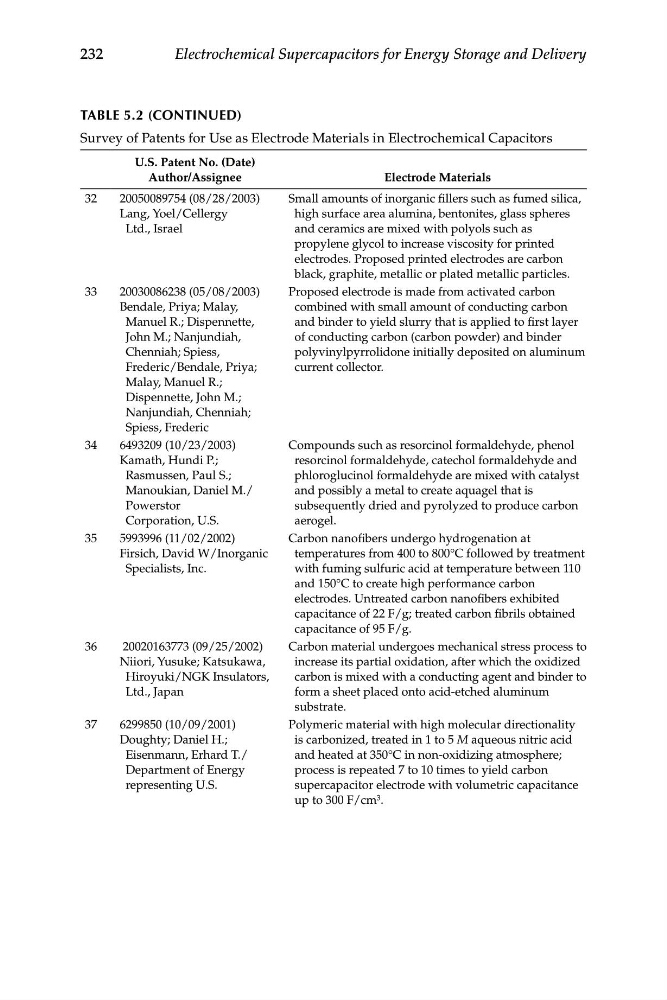
TABLE 5.2 (CONTINUED)
Survey of Patents for Use as Electrode Materials in Electrochemical Capacitors
U.S. Patent No. (Date)
Author/Assignee
Electrode Materials
32
20050089754 (08/28/2003)
Small amounts of inorganic fillers such as fumed silica,
Lang, Yoel/Cellergy
high surface area alumina, bentonites, glass spheres
Ltd., Israel
and ceramics are mixed with polyols such as
propylene glycol to increase viscosity for printed
electrodes. Proposed printed electrodes are carbon
black, graphite, metallic or plated metallic particles.
33
20030086238 (05/08/2003)
Proposed electrode is made from activated carbon
Bendale, Priya; Malay,
combined with small amount of conducting carbon
Manuel R.; Dispennette,
and binder to yield slurry that is applied to first layer
John M.; Nanjundiah,
of conducting carbon (carbon powder) and binder
Chenniah; Spiess,
polyvinylpyrrolidone initially deposited on aluminum
Frederic/Bendale, Priya;
current collector.
Malay, Manuel R.;
Dispennette, John M.;
Nanjundiah, Chenniah;
Spiess, Frederic
34
6493209 (10/23/2003)
Compounds such as resorcinol formaldehyde, phenol
Kamath, Hundi P.;
resorcinol formaldehyde, catechol formaldehyde and
Rasmussen, Paul S.;
phloroglucinol formaldehyde are mixed with catalyst
Manoukian, Daniel M./
and possibly a metal to create aquagel that is
Powerstor
subsequently dried and pyrolyzed to produce carbon
Corporation, U.S.
aerogel.
35
5993996 (11/02/2002)
Carbon nanofibers undergo hydrogenation at
Firsich, David W/Inorganic
temperatures from 400 to 800°C followed by treatment
Specialists, Inc.
with fuming sulfuric acid at temperature between 110
and 150°C to create high performance carbon
electrodes. Untreated carbon nanofibers exhibited
capacitance of 22 F/g; treated carbon fibrils obtained
capacitance of 95 F/g.
36
20020163773 (09/25/2002)
Carbon material undergoes mechanical stress process to
Niiori, Yusuke; Katsukawa,
increase its partial oxidation, after which the oxidized
Hiroyuki/NGK Insulators,
carbon is mixed with a conducting agent and binder to
Ltd., Japan
form a sheet placed onto acid-etched aluminum
substrate.
37
6299850 (10/09/2001)
Polymeric material with high molecular directionality
Doughty; Daniel H.;
is carbonized, treated in 1 to 5 M aqueous nitric acid
Eisenmann, Erhard T./
and heated at 350°C in non-oxidizing atmosphere;
Department of Energy
process is repeated 7 to 10 times to yield carbon
representing U.S.
supercapacitor electrode with volumetric capacitance
up to 300 F/cm 3 .
Electrochemical Supercapacitors for Energy Storage and Delivery
TABLE 5.2 (CONTINUED)
Survey of Patents for Use as Electrode Materials in Electrochemical Capacitors
U.S. Patent No. (Date)
Author/Assignee
Electrode Materials
32
20050089754 (08/28/2003)
Small amounts of inorganic fillers such as fumed silica,
Lang, Yoel/Cellergy
high surface area alumina, bentonites, glass spheres
Ltd., Israel
and ceramics are mixed with polyols such as
propylene glycol to increase viscosity for printed
electrodes. Proposed printed electrodes are carbon
black, graphite, metallic or plated metallic particles.
33
20030086238 (05/08/2003)
Proposed electrode is made from activated carbon
Bendale, Priya; Malay,
combined with small amount of conducting carbon
Manuel R.; Dispennette,
and binder to yield slurry that is applied to first layer
John M.; Nanjundiah,
of conducting carbon (carbon powder) and binder
Chenniah; Spiess,
polyvinylpyrrolidone initially deposited on aluminum
Frederic/Bendale, Priya;
current collector.
Malay, Manuel R.;
Dispennette, John M.;
Nanjundiah, Chenniah;
Spiess, Frederic
34
6493209 (10/23/2003)
Compounds such as resorcinol formaldehyde, phenol
Kamath, Hundi P.;
resorcinol formaldehyde, catechol formaldehyde and
Rasmussen, Paul S.;
phloroglucinol formaldehyde are mixed with catalyst
Manoukian, Daniel M./
and possibly a metal to create aquagel that is
Powerstor
subsequently dried and pyrolyzed to produce carbon
Corporation, U.S.
aerogel.
35
5993996 (11/02/2002)
Carbon nanofibers undergo hydrogenation at
Firsich, David W/Inorganic
temperatures from 400 to 800°C followed by treatment
Specialists, Inc.
with fuming sulfuric acid at temperature between 110
and 150°C to create high performance carbon
electrodes. Untreated carbon nanofibers exhibited
capacitance of 22 F/g; treated carbon fibrils obtained
capacitance of 95 F/g.
36
20020163773 (09/25/2002)
Carbon material undergoes mechanical stress process to
Niiori, Yusuke; Katsukawa,
increase its partial oxidation, after which the oxidized
Hiroyuki/NGK Insulators,
carbon is mixed with a conducting agent and binder to
Ltd., Japan
form a sheet placed onto acid-etched aluminum
substrate.
37
6299850 (10/09/2001)
Polymeric material with high molecular directionality
Doughty; Daniel H.;
is carbonized, treated in 1 to 5 M aqueous nitric acid
Eisenmann, Erhard T./
and heated at 350°C in non-oxidizing atmosphere;
Department of Energy
process is repeated 7 to 10 times to yield carbon
representing U.S.
supercapacitor electrode with volumetric capacitance
up to 300 F/cm 3 .