

176
Electrochemical Supercapacitors for Energy Storage and Delivery
Coelectrodeposition
MnO 2 /PEDOT
Coaxial
Template
Nanowires
removal
Au-sputtered
MnO 2 /PEDOT
MnO 2 /PEDOT Nanowires
Ring-shape Electrodes
Coaxial Nanowire in Template
EDOT monomer
Template
Bottom gold
Mn
2+ ions
MnO 2 core
PEDOT shell
FIGURE 4.27
(See color insert.) Steps of electrochemical co-deposition of high energy density MnO 2 –
PEDOT nanowires. (Source: Liu, R. and S. B. Lee. 2008. Journal of the American Chemical Society,
130, 2942–2943. With permission.)
comparable to EDLC devices. An example of this can be seen in the work of
Xia et al. [104], who reported the growth of loosely packed PANI thorns on
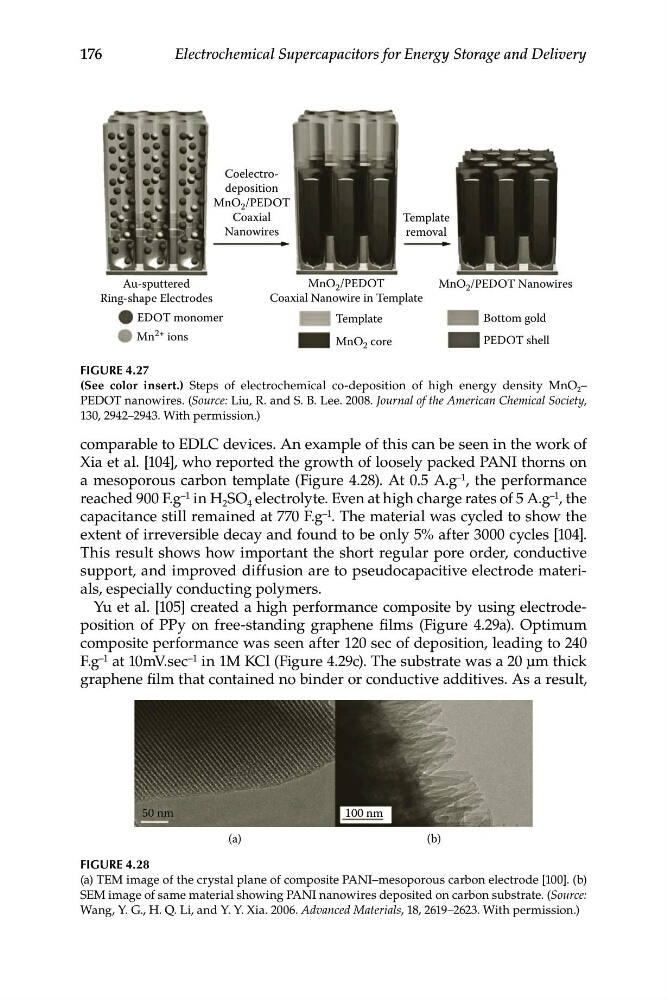
a mesoporous carbon template (Figure 4.28). At 0.5 A.g –1 , the performance
reached 900 F.g –1 in H 2 SO 4 electrolyte. Even at high charge rates of 5 A.g –1 , the
capacitance still remained at 770 F.g –1 . The material was cycled to show the
extent of irreversible decay and found to be only 5% after 3000 cycles [104].
This result shows how important the short regular pore order, conductive
support, and improved diffusion are to pseudocapacitive electrode materials, especially conducting polymers.
Yu et al. [105] created a high performance composite by using electrodeposition of PPy on free-standing graphene films (Figure 4.29a). Optimum
composite performance was seen after 120 sec of deposition, leading to 240
F.g –1 at 10mV.sec –1 in 1M KCl (Figure 4.29c). The substrate was a 20 μm thick
graphene film that contained no binder or conductive additives. As a result,
50 nm
100 nm
(a)
(b)
FIGURE 4.28
(a) TEM image of the crystal plane of composite PANI–mesoporous carbon electrode [100]. (b)
SEM image of same material showing PANI nanowires deposited on carbon substrate. (Source:
Wang, Y. G., H. Q. Li, and Y. Y. Xia. 2006. Advanced Materials, 18, 2619–2623. With permission.)
Electrochemical Supercapacitors for Energy Storage and Delivery
Coelectrodeposition
MnO 2 /PEDOT
Coaxial
Template
Nanowires
removal
Au-sputtered
MnO 2 /PEDOT
MnO 2 /PEDOT Nanowires
Ring-shape Electrodes
Coaxial Nanowire in Template
EDOT monomer
Template
Bottom gold
Mn
2+ ions
MnO 2 core
PEDOT shell
FIGURE 4.27
(See color insert.) Steps of electrochemical co-deposition of high energy density MnO 2 –
PEDOT nanowires. (Source: Liu, R. and S. B. Lee. 2008. Journal of the American Chemical Society,
130, 2942–2943. With permission.)
comparable to EDLC devices. An example of this can be seen in the work of
Xia et al. [104], who reported the growth of loosely packed PANI thorns on
a mesoporous carbon template (Figure 4.28). At 0.5 A.g –1 , the performance
reached 900 F.g –1 in H 2 SO 4 electrolyte. Even at high charge rates of 5 A.g –1 , the
capacitance still remained at 770 F.g –1 . The material was cycled to show the
extent of irreversible decay and found to be only 5% after 3000 cycles [104].
This result shows how important the short regular pore order, conductive
support, and improved diffusion are to pseudocapacitive electrode materials, especially conducting polymers.
Yu et al. [105] created a high performance composite by using electrodeposition of PPy on free-standing graphene films (Figure 4.29a). Optimum
composite performance was seen after 120 sec of deposition, leading to 240
F.g –1 at 10mV.sec –1 in 1M KCl (Figure 4.29c). The substrate was a 20 μm thick
graphene film that contained no binder or conductive additives. As a result,
50 nm
100 nm
(a)
(b)
FIGURE 4.28
(a) TEM image of the crystal plane of composite PANI–mesoporous carbon electrode [100]. (b)
SEM image of same material showing PANI nanowires deposited on carbon substrate. (Source:
Wang, Y. G., H. Q. Li, and Y. Y. Xia. 2006. Advanced Materials, 18, 2619–2623. With permission.)