

Polymer
backbone
–
+
+
P-Doping
–
+
+
+
+
+
–
–
–
–
–
e
–
P-Dedoping
Current
Current
collector Undoped
–
+
Solution
collector
plate conducting
Cations
plate
polymer film
Anions
(a)
N-Doping
–
–
–
–
–
–
–
+
+
+
+
+
+
e
–
N-Dedoping
Current
Current
collector Undoped
–
+
Solution
collector
plate conducting
Cations
plate
Anions
polymer film
(b)
–
–
–
–
–
–
–
–
–
–
–
–
–
–
+
+
+
+
+
+
+
+
+
+
+ +
+
+
P-Doped
Solution
conducting
polymer film
–
– –
–
–
–
–
–
–
–
–
–
+
+
+
+
+
+
+
+
+
+
+
+
N-doped
Solution
conducting
polymer film
175
Components and Materials for Electrochemical Supercapacitors
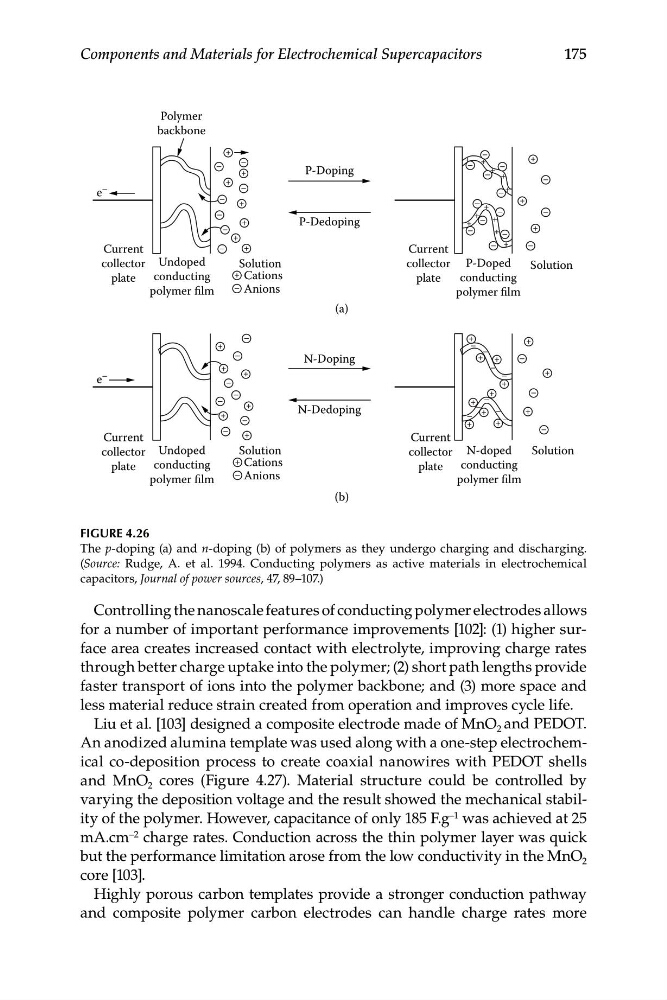
FIGURE 4.26
The p-doping (a) and n-doping (b) of polymers as they undergo charging and discharging.
(Source: Rudge, A. et al. 1994. Conducting polymers as active materials in electrochemical
capacitors, Journal of power sources, 47, 89–107.)
Controlling the nanoscale features of conducting polymer electrodes allows
for a number of important performance improvements [102]: (1) higher surface area creates increased contact with electrolyte, improving charge rates
through better charge uptake into the polymer; (2) short path lengths provide
faster transport of ions into the polymer backbone; and (3) more space and
less material reduce strain created from operation and improves cycle life.
Liu et al. [103] designed a composite electrode made of MnO 2 and PEDOT.
An anodized alumina template was used along with a one-step electrochemical co-deposition process to create coaxial nanowires with PEDOT shells
and MnO 2 cores (Figure 4.27). Material structure could be controlled by
varying the deposition voltage and the result showed the mechanical stability of the polymer. However, capacitance of only 185 F.g –1 was achieved at 25
mA.cm –2 charge rates. Conduction across the thin polymer layer was quick
but the performance limitation arose from the low conductivity in the MnO 2
core [103].
Highly porous carbon templates provide a stronger conduction pathway
and composite polymer carbon electrodes can handle charge rates more
backbone
–
+
+
P-Doping
–
+
+
+
+
+
–
–
–
–
–
e
–
P-Dedoping
Current
Current
collector Undoped
–
+
Solution
collector
plate conducting
Cations
plate
polymer film
Anions
(a)
N-Doping
–
–
–
–
–
–
–
+
+
+
+
+
+
e
–
N-Dedoping
Current
Current
collector Undoped
–
+
Solution
collector
plate conducting
Cations
plate
Anions
polymer film
(b)
–
–
–
–
–
–
–
–
–
–
–
–
–
–
+
+
+
+
+
+
+
+
+
+
+ +
+
+
P-Doped
Solution
conducting
polymer film
–
– –
–
–
–
–
–
–
–
–
–
+
+
+
+
+
+
+
+
+
+
+
+
N-doped
Solution
conducting
polymer film
175
Components and Materials for Electrochemical Supercapacitors
FIGURE 4.26
The p-doping (a) and n-doping (b) of polymers as they undergo charging and discharging.
(Source: Rudge, A. et al. 1994. Conducting polymers as active materials in electrochemical
capacitors, Journal of power sources, 47, 89–107.)
Controlling the nanoscale features of conducting polymer electrodes allows
for a number of important performance improvements [102]: (1) higher surface area creates increased contact with electrolyte, improving charge rates
through better charge uptake into the polymer; (2) short path lengths provide
faster transport of ions into the polymer backbone; and (3) more space and
less material reduce strain created from operation and improves cycle life.
Liu et al. [103] designed a composite electrode made of MnO 2 and PEDOT.
An anodized alumina template was used along with a one-step electrochemical co-deposition process to create coaxial nanowires with PEDOT shells
and MnO 2 cores (Figure 4.27). Material structure could be controlled by
varying the deposition voltage and the result showed the mechanical stability of the polymer. However, capacitance of only 185 F.g –1 was achieved at 25
mA.cm –2 charge rates. Conduction across the thin polymer layer was quick
but the performance limitation arose from the low conductivity in the MnO 2
core [103].
Highly porous carbon templates provide a stronger conduction pathway
and composite polymer carbon electrodes can handle charge rates more