

157
Components and Materials for Electrochemical Supercapacitors
(a)
(b)
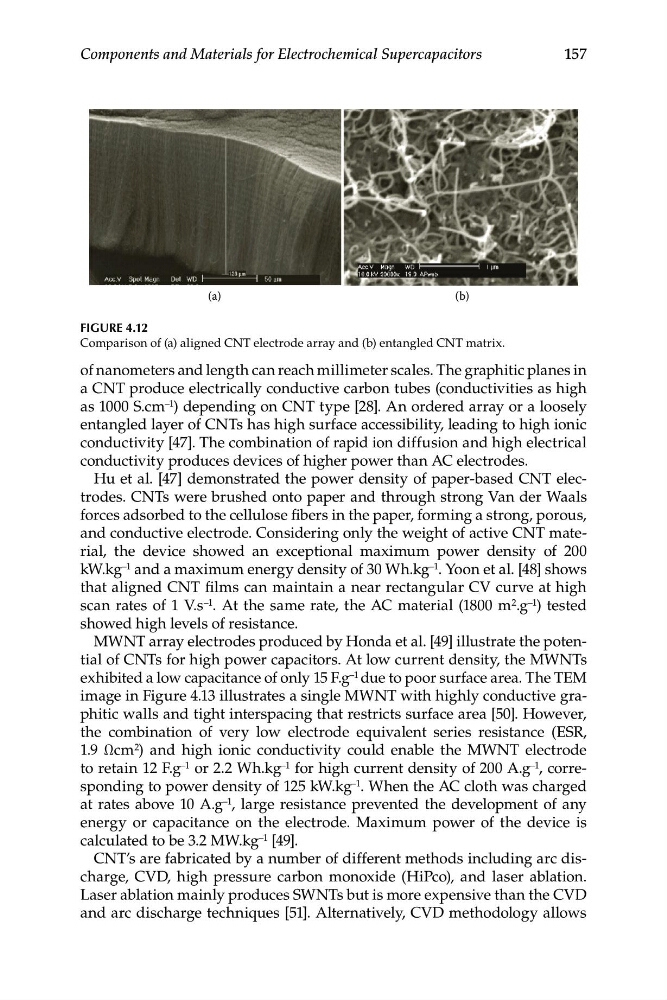
FIGURE 4.12
Comparison of (a) aligned CNT electrode array and (b) entangled CNT matrix.
of nanometers and length can reach millimeter scales. The graphitic planes in
a CNT produce electrically conductive carbon tubes (conductivities as high
as 1000 S.cm –1 ) depending on CNT type [28]. An ordered array or a loosely
entangled layer of CNTs has high surface accessibility, leading to high ionic
conductivity [47]. The combination of rapid ion diffusion and high electrical
conductivity produces devices of higher power than AC electrodes.
Hu et al. [47] demonstrated the power density of paper-based CNT electrodes. CNTs were brushed onto paper and through strong Van der Waals
forces adsorbed to the cellulose fibers in the paper, forming a strong, porous,
and conductive electrode. Considering only the weight of active CNT material, the device showed an exceptional maximum power density of 200
kW.kg –1 and a maximum energy density of 30 Wh.kg –1 . Yoon et al. [48] shows
that aligned CNT films can maintain a near rectangular CV curve at high
scan rates of 1 V.s –1 . At the same rate, the AC material (1800 m 2 .g –1 ) tested
showed high levels of resistance.
MWNT array electrodes produced by Honda et al. [49] illustrate the potential of CNTs for high power capacitors. At low current density, the MWNTs
exhibited a low capacitance of only 15 F.g –1 due to poor surface area. The TEM
image in Figure 4.13 illustrates a single MWNT with highly conductive graphitic walls and tight interspacing that restricts surface area [50]. However,
the combination of very low electrode equivalent series resistance (ESR,
1.9 Ωcm 2 ) and high ionic conductivity could enable the MWNT electrode
to retain 12 F.g –1 or 2.2 Wh.kg –1 for high current density of 200 A.g –1 , corresponding to power density of 125 kW.kg –1 . When the AC cloth was charged
at rates above 10 A.g –1 , large resistance prevented the development of any
energy or capacitance on the electrode. Maximum power of the device is
calculated to be 3.2 MW.kg –1 [49].
CNT’s are fabricated by a number of different methods including arc discharge, CVD, high pressure carbon monoxide (HiPco), and laser ablation.
Laser ablation mainly produces SWNTs but is more expensive than the CVD
and arc discharge techniques [51]. Alternatively, CVD methodology allows
Components and Materials for Electrochemical Supercapacitors
(a)
(b)
FIGURE 4.12
Comparison of (a) aligned CNT electrode array and (b) entangled CNT matrix.
of nanometers and length can reach millimeter scales. The graphitic planes in
a CNT produce electrically conductive carbon tubes (conductivities as high
as 1000 S.cm –1 ) depending on CNT type [28]. An ordered array or a loosely
entangled layer of CNTs has high surface accessibility, leading to high ionic
conductivity [47]. The combination of rapid ion diffusion and high electrical
conductivity produces devices of higher power than AC electrodes.
Hu et al. [47] demonstrated the power density of paper-based CNT electrodes. CNTs were brushed onto paper and through strong Van der Waals
forces adsorbed to the cellulose fibers in the paper, forming a strong, porous,
and conductive electrode. Considering only the weight of active CNT material, the device showed an exceptional maximum power density of 200
kW.kg –1 and a maximum energy density of 30 Wh.kg –1 . Yoon et al. [48] shows
that aligned CNT films can maintain a near rectangular CV curve at high
scan rates of 1 V.s –1 . At the same rate, the AC material (1800 m 2 .g –1 ) tested
showed high levels of resistance.
MWNT array electrodes produced by Honda et al. [49] illustrate the potential of CNTs for high power capacitors. At low current density, the MWNTs
exhibited a low capacitance of only 15 F.g –1 due to poor surface area. The TEM
image in Figure 4.13 illustrates a single MWNT with highly conductive graphitic walls and tight interspacing that restricts surface area [50]. However,
the combination of very low electrode equivalent series resistance (ESR,
1.9 Ωcm 2 ) and high ionic conductivity could enable the MWNT electrode
to retain 12 F.g –1 or 2.2 Wh.kg –1 for high current density of 200 A.g –1 , corresponding to power density of 125 kW.kg –1 . When the AC cloth was charged
at rates above 10 A.g –1 , large resistance prevented the development of any
energy or capacitance on the electrode. Maximum power of the device is
calculated to be 3.2 MW.kg –1 [49].
CNT’s are fabricated by a number of different methods including arc discharge, CVD, high pressure carbon monoxide (HiPco), and laser ablation.
Laser ablation mainly produces SWNTs but is more expensive than the CVD
and arc discharge techniques [51]. Alternatively, CVD methodology allows