

158
Electrochemical Supercapacitors for Energy Storage and Delivery
5 nm
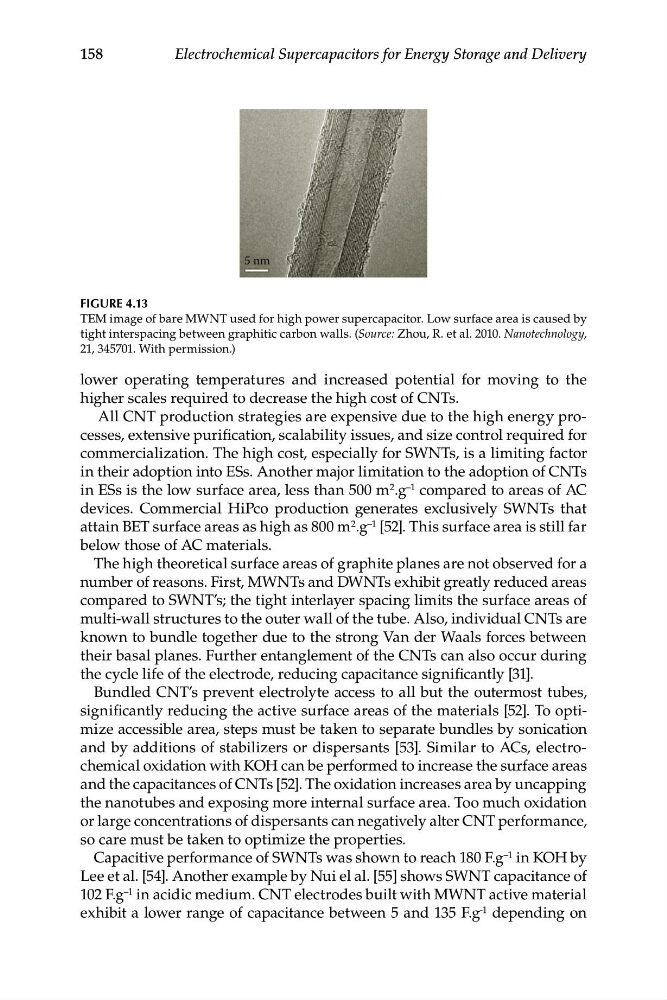
FIGURE 4.13
TEM image of bare MWNT used for high power supercapacitor. Low surface area is caused by
tight interspacing between graphitic carbon walls. (Source: Zhou, R. et al. 2010. Nanotechnology,
21, 345701. With permission.)
lower operating temperatures and increased potential for moving to the
higher scales required to decrease the high cost of CNTs.
All CNT production strategies are expensive due to the high energy processes, extensive purification, scalability issues, and size control required for
commercialization. The high cost, especially for SWNTs, is a limiting factor
in their adoption into ESs. Another major limitation to the adoption of CNTs
in ESs is the low surface area, less than 500 m 2 .g –1 compared to areas of AC
devices. Commercial HiPco production generates exclusively SWNTs that
attain BET surface areas as high as 800 m 2 .g –1 [52]. This surface area is still far
below those of AC materials.
The high theoretical surface areas of graphite planes are not observed for a
number of reasons. First, MWNTs and DWNTs exhibit greatly reduced areas
compared to SWNT’s; the tight interlayer spacing limits the surface areas of
multi-wall structures to the outer wall of the tube. Also, individual CNTs are
known to bundle together due to the strong Van der Waals forces between
their basal planes. Further entanglement of the CNTs can also occur during
the cycle life of the electrode, reducing capacitance significantly [31].
Bundled CNT’s prevent electrolyte access to all but the outermost tubes,
significantly reducing the active surface areas of the materials [52]. To optimize accessible area, steps must be taken to separate bundles by sonication
and by additions of stabilizers or dispersants [53]. Similar to ACs, electrochemical oxidation with KOH can be performed to increase the surface areas
and the capacitances of CNTs [52]. The oxidation increases area by uncapping
the nanotubes and exposing more internal surface area. Too much oxidation
or large concentrations of dispersants can negatively alter CNT performance,
so care must be taken to optimize the properties.
Capacitive performance of SWNTs was shown to reach 180 F.g –1 in KOH by
Lee et al. [54]. Another example by Nui el al. [55] shows SWNT capacitance of
102 F.g –1 in acidic medium. CNT electrodes built with MWNT active material
exhibit a lower range of capacitance between 5 and 135 F.g -1 depending on
Electrochemical Supercapacitors for Energy Storage and Delivery
5 nm
FIGURE 4.13
TEM image of bare MWNT used for high power supercapacitor. Low surface area is caused by
tight interspacing between graphitic carbon walls. (Source: Zhou, R. et al. 2010. Nanotechnology,
21, 345701. With permission.)
lower operating temperatures and increased potential for moving to the
higher scales required to decrease the high cost of CNTs.
All CNT production strategies are expensive due to the high energy processes, extensive purification, scalability issues, and size control required for
commercialization. The high cost, especially for SWNTs, is a limiting factor
in their adoption into ESs. Another major limitation to the adoption of CNTs
in ESs is the low surface area, less than 500 m 2 .g –1 compared to areas of AC
devices. Commercial HiPco production generates exclusively SWNTs that
attain BET surface areas as high as 800 m 2 .g –1 [52]. This surface area is still far
below those of AC materials.
The high theoretical surface areas of graphite planes are not observed for a
number of reasons. First, MWNTs and DWNTs exhibit greatly reduced areas
compared to SWNT’s; the tight interlayer spacing limits the surface areas of
multi-wall structures to the outer wall of the tube. Also, individual CNTs are
known to bundle together due to the strong Van der Waals forces between
their basal planes. Further entanglement of the CNTs can also occur during
the cycle life of the electrode, reducing capacitance significantly [31].
Bundled CNT’s prevent electrolyte access to all but the outermost tubes,
significantly reducing the active surface areas of the materials [52]. To optimize accessible area, steps must be taken to separate bundles by sonication
and by additions of stabilizers or dispersants [53]. Similar to ACs, electrochemical oxidation with KOH can be performed to increase the surface areas
and the capacitances of CNTs [52]. The oxidation increases area by uncapping
the nanotubes and exposing more internal surface area. Too much oxidation
or large concentrations of dispersants can negatively alter CNT performance,
so care must be taken to optimize the properties.
Capacitive performance of SWNTs was shown to reach 180 F.g –1 in KOH by
Lee et al. [54]. Another example by Nui el al. [55] shows SWNT capacitance of
102 F.g –1 in acidic medium. CNT electrodes built with MWNT active material
exhibit a lower range of capacitance between 5 and 135 F.g -1 depending on