

156
Electrochemical Supercapacitors for Energy Storage and Delivery
(a)
(b)
1 μm
100 nm
(c)
(d)
5 nm
20 nm
Mesopore
(e)
Micropore
Macropore
Wall
Core
Core
Carbon particle
Wall
Electrolyte
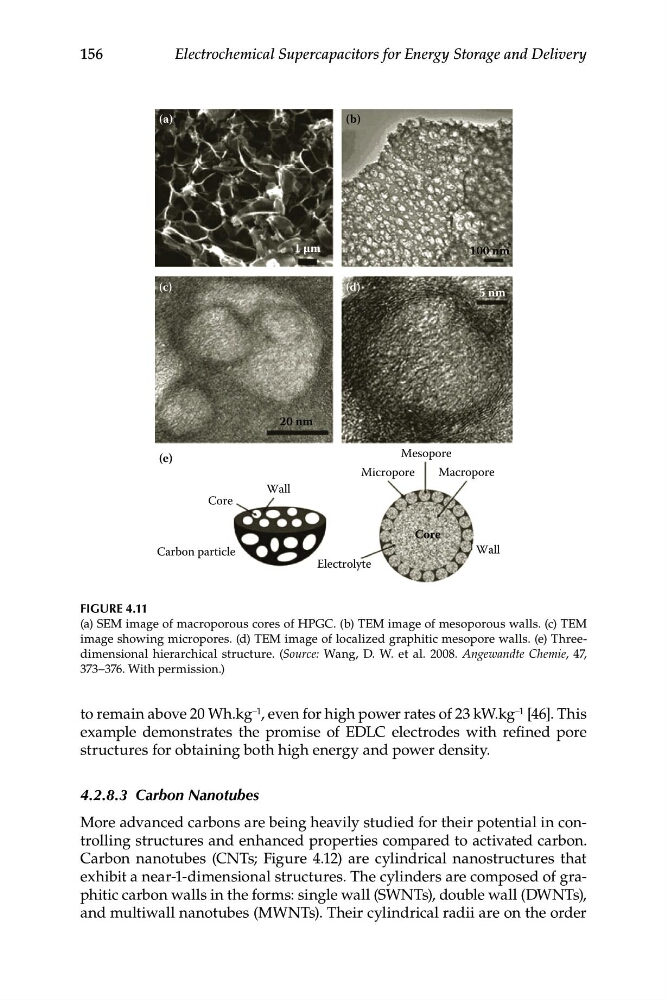
FIGURE 4.11
(a) SEM image of macroporous cores of HPGC. (b) TEM image of mesoporous walls. (c) TEM
image showing micropores. (d) TEM image of localized graphitic mesopore walls. (e) Threedimensional hierarchical structure. (Source: Wang, D. W. et al. 2008. Angewandte Chemie, 47,
373–376. With permission.)
to remain above 20 Wh.kg –1 , even for high power rates of 23 kW.kg –1 [46]. This
example demonstrates the promise of EDLC electrodes with refined pore
structures for obtaining both high energy and power density.
4.2.8.3 Carbon Nanotubes
More advanced carbons are being heavily studied for their potential in controlling structures and enhanced properties compared to activated carbon.
Carbon nanotubes (CNTs; Figure 4.12) are cylindrical nanostructures that
exhibit a near-1-dimensional structures. The cylinders are composed of graphitic carbon walls in the forms: single wall (SWNTs), double wall (DWNTs),
and multiwall nanotubes (MWNTs). Their cylindrical radii are on the order
Electrochemical Supercapacitors for Energy Storage and Delivery
(a)
(b)
1 μm
100 nm
(c)
(d)
5 nm
20 nm
Mesopore
(e)
Micropore
Macropore
Wall
Core
Core
Carbon particle
Wall
Electrolyte
FIGURE 4.11
(a) SEM image of macroporous cores of HPGC. (b) TEM image of mesoporous walls. (c) TEM
image showing micropores. (d) TEM image of localized graphitic mesopore walls. (e) Threedimensional hierarchical structure. (Source: Wang, D. W. et al. 2008. Angewandte Chemie, 47,
373–376. With permission.)
to remain above 20 Wh.kg –1 , even for high power rates of 23 kW.kg –1 [46]. This
example demonstrates the promise of EDLC electrodes with refined pore
structures for obtaining both high energy and power density.
4.2.8.3 Carbon Nanotubes
More advanced carbons are being heavily studied for their potential in controlling structures and enhanced properties compared to activated carbon.
Carbon nanotubes (CNTs; Figure 4.12) are cylindrical nanostructures that
exhibit a near-1-dimensional structures. The cylinders are composed of graphitic carbon walls in the forms: single wall (SWNTs), double wall (DWNTs),
and multiwall nanotubes (MWNTs). Their cylindrical radii are on the order