

100
90
Retention/%
80
70
60
HPGC
CMK-3
CMK-5
Activated carbon
0 10 20 30 40 50 60 70 80 90 100
Sweep Rate/mV s –1
155
Components and Materials for Electrochemical Supercapacitors
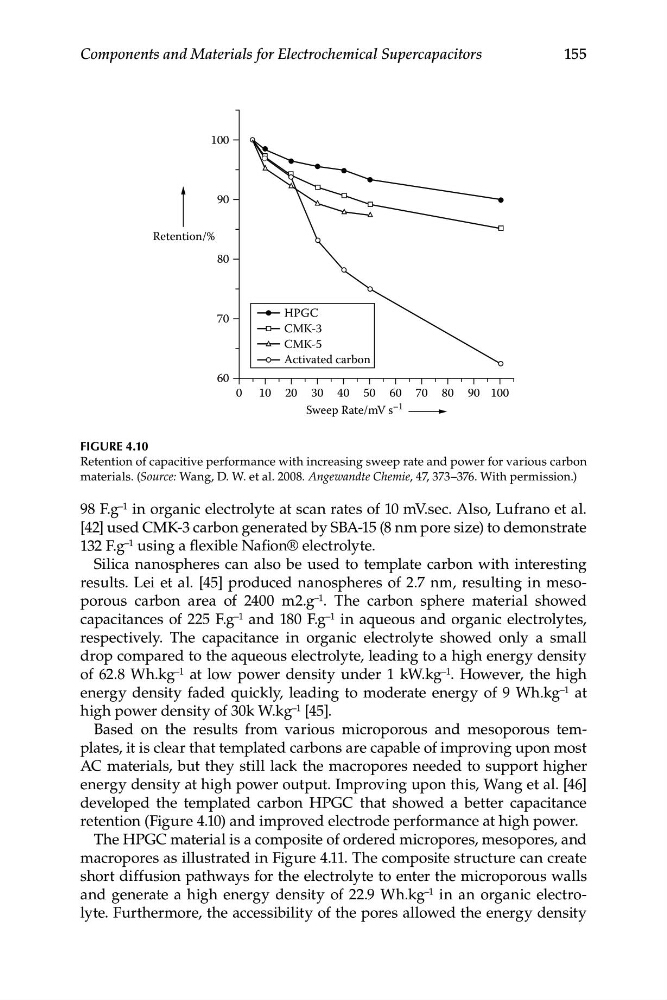
FIGURE 4.10
Retention of capacitive performance with increasing sweep rate and power for various carbon
materials. (Source: Wang, D. W. et al. 2008. Angewandte Chemie, 47, 373–376. With permission.)
98 F.g –1 in organic electrolyte at scan rates of 10 mV.sec. Also, Lufrano et al.
[42] used CMK-3 carbon generated by SBA-15 (8 nm pore size) to demonstrate
132 F.g –1 using a flexible Nafion® electrolyte.
Silica nanospheres can also be used to template carbon with interesting
results. Lei et al. [45] produced nanospheres of 2.7 nm, resulting in mesoporous carbon area of 2400 m2.g –1 . The carbon sphere material showed
capacitances of 225 F.g –1 and 180 F.g –1 in aqueous and organic electrolytes,
respectively. The capacitance in organic electrolyte showed only a small
drop compared to the aqueous electrolyte, leading to a high energy density
of 62.8 Wh.kg –1 at low power density under 1 kW.kg –1 . However, the high
energy density faded quickly, leading to moderate energy of 9 Wh.kg –1 at
high power density of 30k W.kg –1 [45].
Based on the results from various microporous and mesoporous templates, it is clear that templated carbons are capable of improving upon most
AC materials, but they still lack the macropores needed to support higher
energy density at high power output. Improving upon this, Wang et al. [46]
developed the templated carbon HPGC that showed a better capacitance
retention (Figure 4.10) and improved electrode performance at high power.
The HPGC material is a composite of ordered micropores, mesopores, and
macropores as illustrated in Figure 4.11. The composite structure can create
short diffusion pathways for the electrolyte to enter the microporous walls
and generate a high energy density of 22.9 Wh.kg –1 in an organic electrolyte. Furthermore, the accessibility of the pores allowed the energy density
90
Retention/%
80
70
60
HPGC
CMK-3
CMK-5
Activated carbon
0 10 20 30 40 50 60 70 80 90 100
Sweep Rate/mV s –1
155
Components and Materials for Electrochemical Supercapacitors
FIGURE 4.10
Retention of capacitive performance with increasing sweep rate and power for various carbon
materials. (Source: Wang, D. W. et al. 2008. Angewandte Chemie, 47, 373–376. With permission.)
98 F.g –1 in organic electrolyte at scan rates of 10 mV.sec. Also, Lufrano et al.
[42] used CMK-3 carbon generated by SBA-15 (8 nm pore size) to demonstrate
132 F.g –1 using a flexible Nafion® electrolyte.
Silica nanospheres can also be used to template carbon with interesting
results. Lei et al. [45] produced nanospheres of 2.7 nm, resulting in mesoporous carbon area of 2400 m2.g –1 . The carbon sphere material showed
capacitances of 225 F.g –1 and 180 F.g –1 in aqueous and organic electrolytes,
respectively. The capacitance in organic electrolyte showed only a small
drop compared to the aqueous electrolyte, leading to a high energy density
of 62.8 Wh.kg –1 at low power density under 1 kW.kg –1 . However, the high
energy density faded quickly, leading to moderate energy of 9 Wh.kg –1 at
high power density of 30k W.kg –1 [45].
Based on the results from various microporous and mesoporous templates, it is clear that templated carbons are capable of improving upon most
AC materials, but they still lack the macropores needed to support higher
energy density at high power output. Improving upon this, Wang et al. [46]
developed the templated carbon HPGC that showed a better capacitance
retention (Figure 4.10) and improved electrode performance at high power.
The HPGC material is a composite of ordered micropores, mesopores, and
macropores as illustrated in Figure 4.11. The composite structure can create
short diffusion pathways for the electrolyte to enter the microporous walls
and generate a high energy density of 22.9 Wh.kg –1 in an organic electrolyte. Furthermore, the accessibility of the pores allowed the energy density