

154
Electrochemical Supercapacitors for Energy Storage and Delivery
(a)
(c)
(b)
(e)
(d)
100 nm
10 nm
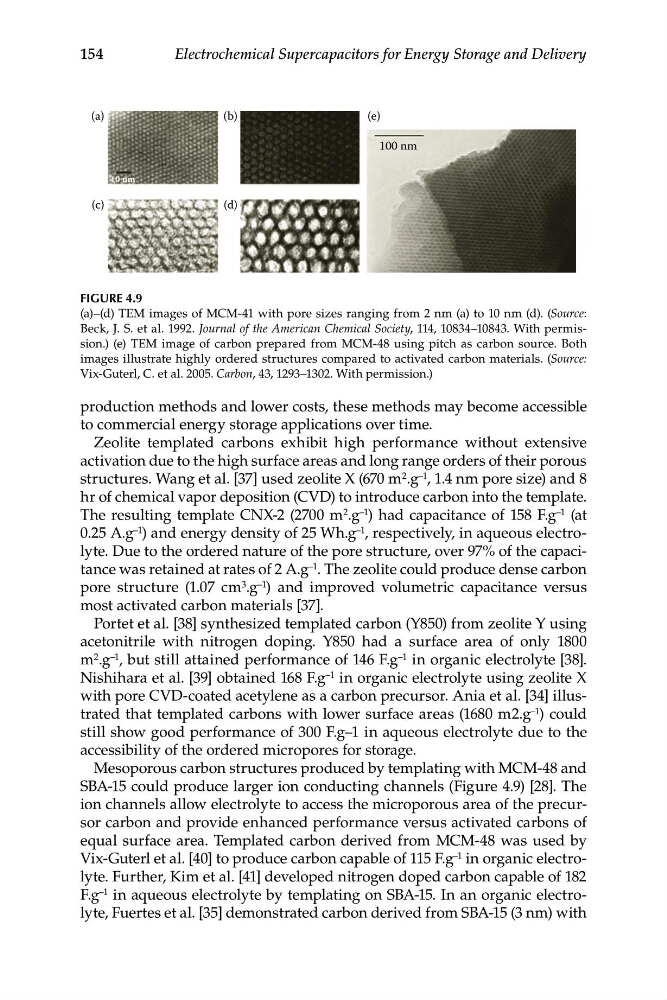
FIGURE 4.9
(a)–(d) TEM images of MCM-41 with pore sizes ranging from 2 nm (a) to 10 nm (d). (Source:
Beck, J. S. et al. 1992. Journal of the American Chemical Society, 114, 10834–10843. With permission.) (e) TEM image of carbon prepared from MCM-48 using pitch as carbon source. Both
images illustrate highly ordered structures compared to activated carbon materials. (Source:
Vix-Guterl, C. et al. 2005. Carbon, 43, 1293–1302. With permission.)
production methods and lower costs, these methods may become accessible
to commercial energy storage applications over time.
Zeolite templated carbons exhibit high performance without extensive
activation due to the high surface areas and long range orders of their porous
structures. Wang et al. [37] used zeolite X (670 m 2 .g –1 , 1.4 nm pore size) and 8
hr of chemical vapor deposition (CVD) to introduce carbon into the template.
The resulting template CNX-2 (2700 m 2 .g –1 ) had capacitance of 158 F.g –1 (at
0.25 A.g –1 ) and energy density of 25 Wh.g –1 , respectively, in aqueous electrolyte. Due to the ordered nature of the pore structure, over 97% of the capacitance was retained at rates of 2 A.g –1 . The zeolite could produce dense carbon
pore structure (1.07 cm 3 .g –1 ) and improved volumetric capacitance versus
most activated carbon materials [37].
Portet et al. [38] synthesized templated carbon (Y850) from zeolite Y using
acetonitrile with nitrogen doping. Y850 had a surface area of only 1800
m 2 .g –1 , but still attained performance of 146 F.g –1 in organic electrolyte [38].
Nishihara et al. [39] obtained 168 F.g –1 in organic electrolyte using zeolite X
with pore CVD-coated acetylene as a carbon precursor. Ania et al. [34] illustrated that templated carbons with lower surface areas (1680 m2.g –1 ) could
still show good performance of 300 F.g–1 in aqueous electrolyte due to the
accessibility of the ordered micropores for storage.
Mesoporous carbon structures produced by templating with MCM-48 and
SBA-15 could produce larger ion conducting channels (Figure 4.9) [28]. The
ion channels allow electrolyte to access the microporous area of the precursor carbon and provide enhanced performance versus activated carbons of
equal surface area. Templated carbon derived from MCM-48 was used by
Vix-Guterl et al. [40] to produce carbon capable of 115 F.g –1 in organic electrolyte. Further, Kim et al. [41] developed nitrogen doped carbon capable of 182
F.g –1 in aqueous electrolyte by templating on SBA-15. In an organic electrolyte, Fuertes et al. [35] demonstrated carbon derived from SBA-15 (3 nm) with
Electrochemical Supercapacitors for Energy Storage and Delivery
(a)
(c)
(b)
(e)
(d)
100 nm
10 nm
FIGURE 4.9
(a)–(d) TEM images of MCM-41 with pore sizes ranging from 2 nm (a) to 10 nm (d). (Source:
Beck, J. S. et al. 1992. Journal of the American Chemical Society, 114, 10834–10843. With permission.) (e) TEM image of carbon prepared from MCM-48 using pitch as carbon source. Both
images illustrate highly ordered structures compared to activated carbon materials. (Source:
Vix-Guterl, C. et al. 2005. Carbon, 43, 1293–1302. With permission.)
production methods and lower costs, these methods may become accessible
to commercial energy storage applications over time.
Zeolite templated carbons exhibit high performance without extensive
activation due to the high surface areas and long range orders of their porous
structures. Wang et al. [37] used zeolite X (670 m 2 .g –1 , 1.4 nm pore size) and 8
hr of chemical vapor deposition (CVD) to introduce carbon into the template.
The resulting template CNX-2 (2700 m 2 .g –1 ) had capacitance of 158 F.g –1 (at
0.25 A.g –1 ) and energy density of 25 Wh.g –1 , respectively, in aqueous electrolyte. Due to the ordered nature of the pore structure, over 97% of the capacitance was retained at rates of 2 A.g –1 . The zeolite could produce dense carbon
pore structure (1.07 cm 3 .g –1 ) and improved volumetric capacitance versus
most activated carbon materials [37].
Portet et al. [38] synthesized templated carbon (Y850) from zeolite Y using
acetonitrile with nitrogen doping. Y850 had a surface area of only 1800
m 2 .g –1 , but still attained performance of 146 F.g –1 in organic electrolyte [38].
Nishihara et al. [39] obtained 168 F.g –1 in organic electrolyte using zeolite X
with pore CVD-coated acetylene as a carbon precursor. Ania et al. [34] illustrated that templated carbons with lower surface areas (1680 m2.g –1 ) could
still show good performance of 300 F.g–1 in aqueous electrolyte due to the
accessibility of the ordered micropores for storage.
Mesoporous carbon structures produced by templating with MCM-48 and
SBA-15 could produce larger ion conducting channels (Figure 4.9) [28]. The
ion channels allow electrolyte to access the microporous area of the precursor carbon and provide enhanced performance versus activated carbons of
equal surface area. Templated carbon derived from MCM-48 was used by
Vix-Guterl et al. [40] to produce carbon capable of 115 F.g –1 in organic electrolyte. Further, Kim et al. [41] developed nitrogen doped carbon capable of 182
F.g –1 in aqueous electrolyte by templating on SBA-15. In an organic electrolyte, Fuertes et al. [35] demonstrated carbon derived from SBA-15 (3 nm) with